

Clarity Review: Pros, Cons, Features, and Pricing
Clarity excels in workflow and job management, offering intuitive features that simplify quoting, scheduling, job tracking, and operational data analysis.

We review tools independently, and commissions help fund our testing. See our transparency policy, our methodology, or suggest a tool.
Clarity Software is a CFO financial reporting software built for finance teams that need to consolidate data, automate report generation, and produce board-ready outputs without heavy IT involvement. I'd consider it if you're evaluating tools like Workiva but want something faster to implement and easier to maintain without a dedicated admin. This review covers what Clarity does well, where it has real limitations, and who it's a realistic fit for.
Clarity Software Evaluation Summary

4.1/5
- From £35/user/month
- Free trial available
Why Trust Our Software Recommendations
6,700+
Reviews
20
Industry experts
16+
Evaluation factors
14
Years
Our team has been testing and reviewing software since 2012. As finance leaders ourselves, we know how difficult—and important—it is to choose the right software.
For this guide, we evaluated tools using hands-on testing and independent research, scoring tools using our selection criteria.
Our reviews reflect our human editorial judgment, not a sales pitch.
Clarity Software Overview
In my opinion, Clarity delivers strong workflow and job-management functionality with intuitive features and responsive customer support. Its standout strengths lie in streamlining operational processes, such as quoting, scheduling, job tracking, and order handovers, while also offering helpful financial tools like job costing and real-time performance visibility. These features support day-to-day decision-making and reduce manual work through automation. For smaller businesses, pricing may still be a consideration, especially if they need only light workflow management or have simpler production needs. Clarity is best suited for medium to large production-focused companies that need a structured, end-to-end operational workflow with built-in costing and reporting. If you’re evaluating software for your team, consider how Clarity aligns with your workflow requirements, operational complexity, and the level of financial insight you genuinely need.
Pros
- You’ll find the interface easy to navigate for your team.
- It offers standout features that enhance financial data analysis.
- Customer support is responsive and helpful when you need it.
Cons
- It might not have all the integration options your team needs.
- Smaller businesses may find it less scalable for their needs.
- Some users report a learning curve during initial use.
Is Clarity Software Right For Your Needs?
Who Would be a Good Fit for Clarity Software?
Clarity is ideal for medium to large production-oriented businesses where managing complex workflows is essential. Teams responsible for quoting, scheduling, proofing, and job tracking will appreciate its user-friendly interface, configurable templates, and tools that bring real-time visibility to every stage of the production process. While Clarity offers helpful financial elements like job costing and performance reporting, user reviews indicate that its real strength lies in unifying operational tasks and improving accuracy across the entire job lifecycle. If your organization needs a system that streamlines day-to-day operations, supports consistent pricing, and reduces reliance on spreadsheets, Clarity is a strong choice, especially for teams that value reliable customer support and a platform that adapts well to unique production workflows.
- Retail IndustryClarity helps your team manage large volumes of operational data with ease and precision through modules that support resource management.
- Manufacturing CompaniesYour operations will benefit from detailed cost analysis and reporting features across datasets.
- Finance DepartmentsClarity provides your team with intuitive tools for accurate financial reporting integrated with accounting software such as Xero and QuickBooks.
- Accounting TeamsYour team will find the software easy to navigate and useful for generating detailed portfolio management reports in a streamlined workflow.
- Large EnterprisesClarity scales well with your complex financial reporting needs and supports comprehensive business processes.
- Financial AnalystsYou'll find that the data analysis features enhance your ability to interpret financial trends using advanced management tools ideal for financial services.
Who Would be a Bad Fit for Clarity Software?
Clarity isn't ideal for small businesses or startups with limited budgets and basic financial reporting needs. If your team requires extensive integrations with providers or you need a simpler solution for minimal data analysis, Clarity may not suit your business needs. User reviews suggest that its advanced features, methodology, and pricing might be excessive for small-scale operations.
- Small StartupsYour team might find the software's extensive features and confusing usability as overwhelming as it is cost prohibitive.
- FreelancersClarity offers more complexity than your solo practice likely needs.
- NonprofitsIf your organization needs basic reporting, the advanced tools may be unnecessary.
- Sole ProprietorsYou may not benefit from the detailed analytics and extensive notifications that Clarity provides.
- Small RetailersIf your company size is too small, your team might not need the extensive reporting capabilities offered.
- Basic BookkeepingFor simple financial tasks, Clarity's advanced features may be excessive.
How We Test & Score Tools
We’ve spent years building, refining, and improving our software testing and scoring system. The rubric is designed to capture the nuances of software selection and what makes a tool effective, focusing on critical aspects of the decision-making process.
Below, you can see exactly how our testing and scoring works across seven criteria. It allows us to provide an unbiased evaluation of the software based on core functionality, standout features, ease of use, onboarding, customer support, integrations, customer reviews, and value for money.
Core Functionality (25% of final scoring)
The starting point of our evaluation is always the core functionality of the tool. Does it have the basic features and functions that a user would expect to see? Are any of those core features locked to higher-tiered pricing plans? At its core, we expect a tool to stand up against the baseline capabilities of its competitors.
Standout Features (25% of final scoring)
Next, we evaluate uncommon standout features that go above and beyond the core functionality typically found in tools of its kind. A high score reflects specialized or unique features that make the product faster, more efficient, or offer additional value to the user.
We also evaluate how easy it is to integrate with other tools typically found in the tech stack to expand the functionality and utility of the software. Tools offering plentiful native integrations, 3rd party connections, and API access to build custom integrations score best.
Ease of Use (10% of final scoring)
We consider how quick and easy it is to execute the tasks defined in the core functionality using the tool. High scoring software is well designed, intuitive to use, offers mobile apps, provides templates, and makes relatively complex tasks seem simple.
Onboarding (10% of final scoring)
We know how important rapid team adoption is for a new platform, so we evaluate how easy it is to learn and use a tool with minimal training. We evaluate how quickly a team member can get set up and start using the tool with no experience. High scoring solutions indicate little or no support is required.
Customer Support (10% of final scoring)
We review how quick and easy it is to get unstuck and find help by phone, live chat, or knowledge base. Tools and companies that provide real-time support score best, while chatbots score worst.
Customer Reviews (10% of final scoring)
Beyond our own testing and evaluation, we consider the net promoter score from current and past customers. We review their likelihood, given the option, to choose the tool again for the core functionality. A high scoring software reflects a high net promoter score from current or past customers.
Value for Money (10% of final scoring)
Lastly, in consideration of all the other criteria, we review the average price of entry level plans against the core features and consider the value of the other evaluation criteria. Software that delivers more, for less, will score higher.
Core Features
Customizable Reports: You can tailor workflow reports to fit your specific needs, enhancing your team's analysis and decision-making.
Real-Time Data: Your team gets instant access to the latest operational data, keeping your reports accurate and up-to-date for tasks like project management.
Multi-Currency Support: If your business operates globally, Clarity helps manage transactions in various currencies easily.
Automated Calculations: This feature saves your team time by automatically performing complex financial calculations from invoicing and beyond.
User-Friendly Dashboards: Your team will appreciate the intuitive dashboards that make navigating reams of data straightforward.
Data Visualization: This functionality can help you transform raw numbers into easy-to-understand charts and graphs, improving your data interpretation and forecasting.
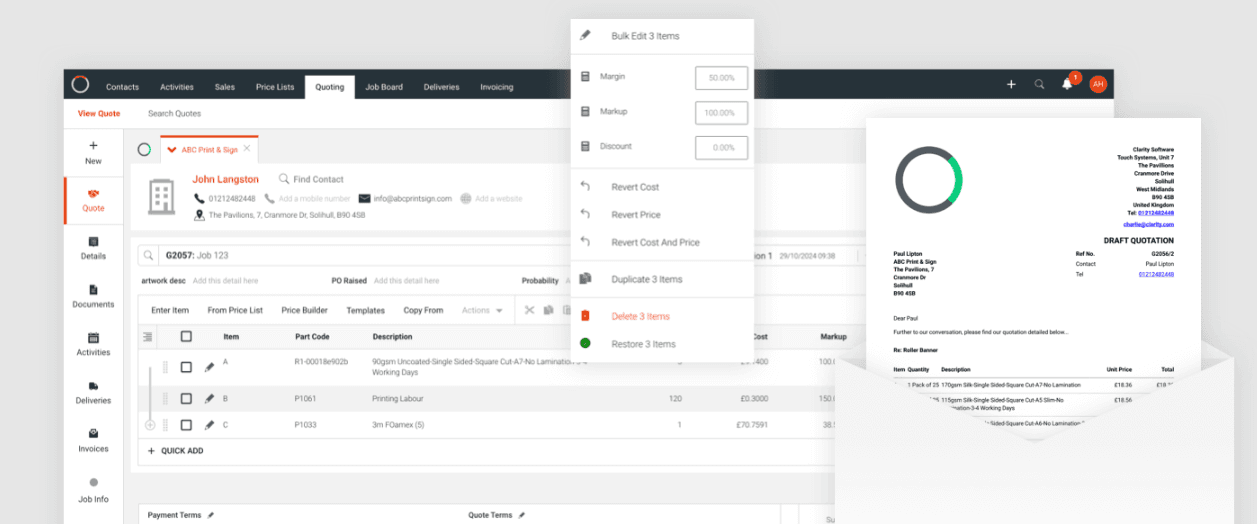
Ease of Use
Clarity stands out for its user-friendly design, making it easy for your team to navigate operational and financial reports. The intuitive dashboards and customizable reports simplify complex data, ensuring your team spends less time on technicalities and more on analysis. Users appreciate the straightforward user interface that doesn’t require extensive training, letting you get up and running quickly.

Integrations
Clarity integrates with Xero, QuickBooks, Sage, Microsoft Dynamics, Mailchimp, HubSpot, Google Drive, OneDrive, Dropbox, and Zoho Analytics.
Clarity also offers an API for custom integrations, allowing you to connect with third-party tools to enhance functionality.

Clarity Software Specs
- Access Management: No
- API: Yes
- Audit Management: No
- Batch Permissions & Access: Yes
- Calendar Management: No
- Collaboration Support: No
- Custom Data Forms: No
- Customer Management: Yes
- Dashboards: No
- Data Export: Yes
- Data Import: Yes
- Data Visualization: Yes
- Document Management: No
- External Integrations: Yes
- Form Builder: No
- Inventory Tracking: Yes
- Notifications: Yes
- Process Modeling: Yes
- Process Reporting: Yes
- Project Management: Yes
- Reports: No
- Status Notifications: No
- Supplier Management: Yes
- Task Scheduling/Tracking: Yes
- Third-Party Plugins/Add-Ons: Yes