

Fathom Review: Pros, Cons, Features and Pricing
Fathom excels in providing intuitive financial insights, setting it apart with its user-friendly interface and robust reporting capabilities.

We review tools independently, and commissions help fund our testing. See our transparency policy, our methodology, or suggest a tool.
Fathom is a forecasting software for finance teams and accountants who need to combine financial reporting, KPI tracking, and scenario modeling in one place. It pulls data directly from your accounting software, so you can build forecasts and dashboards without rebuilding your numbers from scratch. I'd lean toward Fathom over Spotlight Reporting if visual, presentation-ready outputs matter to you—Fathom's dashboards are noticeably more polished, which makes a real difference when you're reporting to clients or non-finance stakeholders regularly.
Fathom Evaluation Summary
4.6/5
- From $16/user/month (billed annually)
- Free plan + free demo available
Why Trust Our Software Recommendations
6,700+
Reviews
20
Industry experts
16+
Evaluation factors
14
Years
Our team has been testing and reviewing software since 2012. As finance leaders ourselves, we know how difficult—and important—it is to choose the right software.
For this guide, we evaluated tools using hands-on testing and independent research, scoring tools using our selection criteria.
Our reviews reflect our human editorial judgment, not a sales pitch.
Fathom Overview
In my opinion, Fathom stands out as a financial forecasting tool with its intuitive interface, streamlined workflow and strong reporting capabilities. It excels in delivering visual insights, making it a favorite among small to medium-sized businesses and accounting firms. While its onboarding could be smoother, its customer support is responsive and helpful. Compared to other software, Fathom's pricing is competitive, and its features are well-suited for teams seeking detailed financial analysis. If you're evaluating options, Fathom is a game-changer for those prioritizing ease of use and insightful data presentation.
Pros
- Fathom offers clear and insightful visual reports that enhance your team's financial analysis.
- Its user-friendly interface makes it easy for your team to navigate and use daily.
- The software provides detailed performance metrics, helping you make informed business decisions.
Cons
- Fathom's onboarding process can be more intuitive for new users.
- It may lack some advanced forecasting features found in other tools.
- Customization options for reports could be more flexible for your team's needs.
Is Fathom Right For Your Needs?
Who Would be a Good Fit for Fathom?
Fathom is a great fit for small to medium-sized businesses and accounting firms that need detailed financial analysis. Its visual reporting capabilities help you and your team easily interpret financial data. If you're in retail or service industries, Fathom's insights into seasonal trends can guide your strategic decisions. The software's intuitive interface simplifies your team's workflow, making it easier to focus on analysis rather than data entry.
- Small BusinessesFathom provides easy-to-understand financial insights, crucial for small businesses managing growth and cash flow.
- Accounting FirmsThe software's detailed performance metrics help your firm and other financial service providers deliver valuable insights to clients.
- Retail IndustryFathom's visual reports assist in analyzing seasonal sales trends, benefiting your inventory and sales strategies.
- Financial AnalystsIts comprehensive metrics and analysis tools support your need for deep financial analysis and data-driven decisions.
- Service CompaniesFathom's insights into revenue streams help your team optimize service offerings and profitability.
- StartupsThe platform's user-friendly interface and financial insights can guide your startup's strategic planning and growth.
Who Would be a Bad Fit for Fathom?
Fathom might not be the best choice for large enterprises needing highly customizable and advanced forecasting features. Its current capabilities may not support extensive data analytics required by big corporations or industries with complex financial structures, such as manufacturing. In fact, one of the key points to determine if Fathom is a bad fit for you is if your team relies on highly detailed, custom reports. Fathom's flexibility might fall short of your expectations.
- Large Enterprises:Fathom lacks the advanced forecasting features and customization options needed for large-scale operations.
- Manufacturing IndustryThe software doesn't offer the complex analytics your industry might require for detailed production forecasts.
- Tech StartupsIf your startup needs highly customizable reports, Fathom's options may not meet your expectations.
- Corporate Finance TeamsYour team might find Fathom's data handling insufficient for complex financial structures and analysis.
- Investment Firms:Fathom doesn't provide the deep analytics and forecasting you need for investment decision-making.
- Multinational CorporationsThe platform may not handle the extensive data and reporting needs of your global operations effectively.
How We Test & Score Tools
We’ve spent years building, refining, and improving our software testing and scoring system. The rubric is designed to capture the nuances of software selection and what makes a tool effective, focusing on critical aspects of the decision-making process.
Below, you can see exactly how our testing and scoring works across seven criteria. It allows us to provide an unbiased evaluation of the software based on core functionality, standout features, ease of use, onboarding, customer support, integrations, customer reviews, and value for money.
Core Functionality (25% of final scoring)
The starting point of our evaluation is always the core functionality of the tool. Does it have the basic features and functions that a user would expect to see? Are any of those core features locked to higher-tiered pricing plans? At its core, we expect a tool to stand up against the baseline capabilities of its competitors.
Standout Features (25% of final scoring)
Next, we evaluate uncommon standout features that go above and beyond the core functionality typically found in tools of its kind. A high score reflects specialized or unique features that make the product faster, more efficient, or offer additional value to the user.
We also evaluate how easy it is to integrate with other tools typically found in the tech stack to expand the functionality and utility of the software. Tools offering plentiful native integrations, 3rd party connections, and API access to build custom integrations score best.
Ease of Use (10% of final scoring)
We consider how quick and easy it is to execute the tasks defined in the core functionality using the tool. High scoring software is well designed, intuitive to use, offers mobile apps, provides templates, and makes relatively complex tasks seem simple.
Onboarding (10% of final scoring)
We know how important rapid team adoption is for a new platform, so we evaluate how easy it is to learn and use a tool with minimal training. We evaluate how quickly a team member can get set up and start using the tool with no experience. High scoring solutions indicate little or no support is required.
Customer Support (10% of final scoring)
We review how quick and easy it is to get unstuck and find help by phone, live chat, or knowledge base. Tools and companies that provide real-time support score best, while chatbots score worst.
Customer Reviews (10% of final scoring)
Beyond our own testing and evaluation, we consider the net promoter score from current and past customers. We review their likelihood, given the option, to choose the tool again for the core functionality. A high scoring software reflects a high net promoter score from current or past customers.
Value for Money (10% of final scoring)
Lastly, in consideration of all the other criteria, we review the average price of entry level plans against the core features and consider the value of the other evaluation criteria. Software that delivers more, for less, will score higher.
Core Features
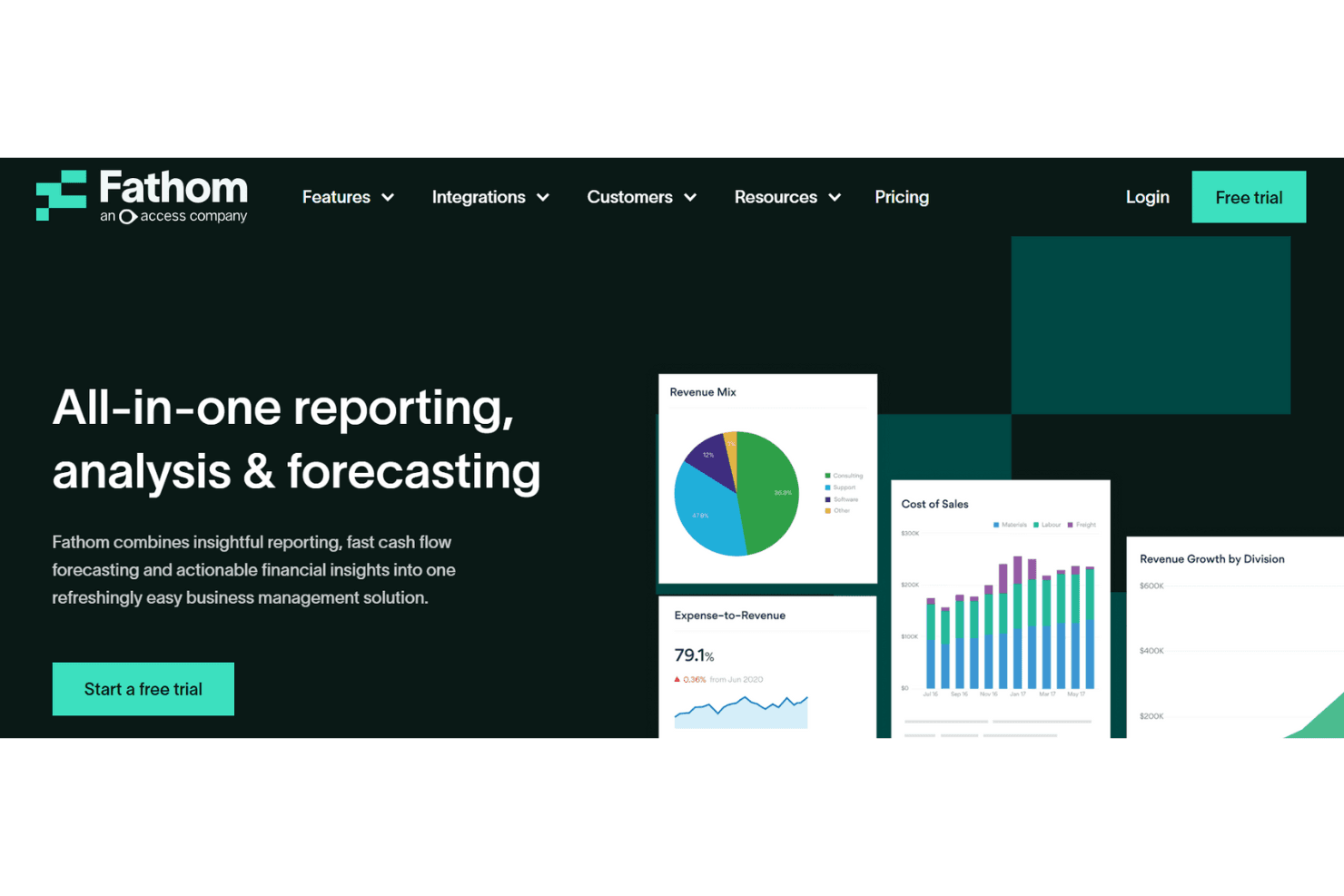
Visual Reporting: Fathom provides clear and engaging visual reports that help your team quickly grasp financial insights. It stands out with its customizable dashboards that present data in an easy-to-understand format. Alongside its visual dashboards, Fathom also supports in-depth financial reporting, giving teams access to detailed insights without needing complex spreadsheets
Performance Metrics: The software offers detailed performance metrics, enabling you to track key financial indicators effectively. These metrics help your team make informed decisions and stay on top of financial goals.
Budgeting Tools: Fathom includes robust budgeting tools that simplify your financial planning process. You can easily compare budgets against actuals to monitor your financial progress.
Cash Flow Forecasting: It provides cash flow forecasting capabilities that allow you to anticipate future cash needs. This feature helps you manage your cash resources more efficiently.
Scenario Planning: Fathom's scenario planning lets you model different financial outcomes using real-time data. You can use it to track key financial indicators such as revenue, expenses, and balance sheets to make informed decisions. . With this,your team can prepare for potential future changes.
KPI Tracking: The software tracks key performance indicators, giving you a clear picture of your business health. You can customize KPIs to align with your strategic objectives.

Ease of Use
Fathom is user-friendly and intuitive, making it easy for your team to navigate and utilize. Its interface is clean, allowing you to access features like visual reporting and KPI tracking with minimal clicks. Users often praise its straightforward setup and navigation, which reduces the learning curve compared to other financial forecasting tools. Whether you're analyzing performance metrics or planning scenarios, Fathom simplifies your tasks, ensuring you spend more time on insights rather than figuring out the software.

Integrations
Fathom requires integration with an accounting software to ensure accurate and up-to-date financial data. So, it integrates with QuickBooks and Xero to automate data syncing and ensure your reports stay up to date. It also integrates with other leading accounting software like MYOB, Microsoft Excel, Google Sheets, Sage Accounting, QuickBooks Desktop, and Access Financials UK.
Fathom also has an API, allowing for custom integrations and connections with third-party integration tools.

Fathom Specs
- 2-Factor Authentication: Yes
- Accounts Payable: Yes
- Accounts Receivable: Yes
- API: No
- Audit Trail: No
- Balance Sheet: Yes
- Billing/Invoicing: No
- Budgeting: No
- Calendar Management: No
- Comparative Reporting: No
- Compliance Tracking: No
- CRM Integration: No
- Custom Reports: No
- Dashboard: Yes
- Dashboards: No
- Data Export: No
- Data Import: Yes
- Data Mining: No
- Data Visualization: Yes
- Document Comparison: No
- Expense Tracking: No
- External Integrations: Yes
- Financial Analysis: No
- Forecasting: Yes
- General Account Ledger: No
- Multi-Currency: Yes
- Multi-User: Yes
- Notifications: Yes
- P&L: Yes
- Payroll: No
- Process Reporting: No
- Risk Assessment: No
- SAP Integration: No
- Scenario Planning: No
- Scheduling: No
- Tax Management: No
- Visualization: No
- Workflow Management: No


