

Float Review: Pros, Cons, Features, and Pricing
Float excels in user-friendly expense tracking, offering your team intuitive tools that simplify financial management without overwhelming complexity.

We review tools independently, and commissions help fund our testing. See our transparency policy, our methodology, or suggest a tool.
Float Financial is an expense management software for small business that pairs spending controls with cash flow forecasting. I'd consider it if you need more than receipt capture. Specifically, it's worth a look if you want to see how daily expenses affect your projected cash position. Compared to a tool like Expensify, Float Financial connects expense data to forward-looking cash flow views. That makes it a better fit when cash visibility matters as much as expense tracking.
Float Financial Evaluation Summary
4.2/5
- From $10/user/month
- Free plan available
Why Trust Our Software Recommendations
6,700+
Reviews
20
Industry experts
16+
Evaluation factors
14
Years
Our team has been testing and reviewing software since 2012. As finance leaders ourselves, we know how difficult—and important—it is to choose the right software.
For this guide, we evaluated tools using hands-on testing and independent research, scoring tools using our selection criteria.
Our reviews reflect our human editorial judgment, not a sales pitch.
Float Financial Overview
Float is a solid choice for teams needing straightforward expense management. Its user-friendly interface and responsive customer support stand out. However, the onboarding process could be more comprehensive, and its pricing is slightly above average without a free version.
Float excels in environments where teams prioritize ease of use and quick decision-making, such as small businesses and startups. Compared to others, it lacks some advanced features like approval workflows, but its integration with tools like Slack and Asana enhances its utility. If you value simplicity and efficient support, Float is worth considering.
Pros
- Easy to navigate the intuitive interface.
- Responsive customer support helps solve issues quickly.
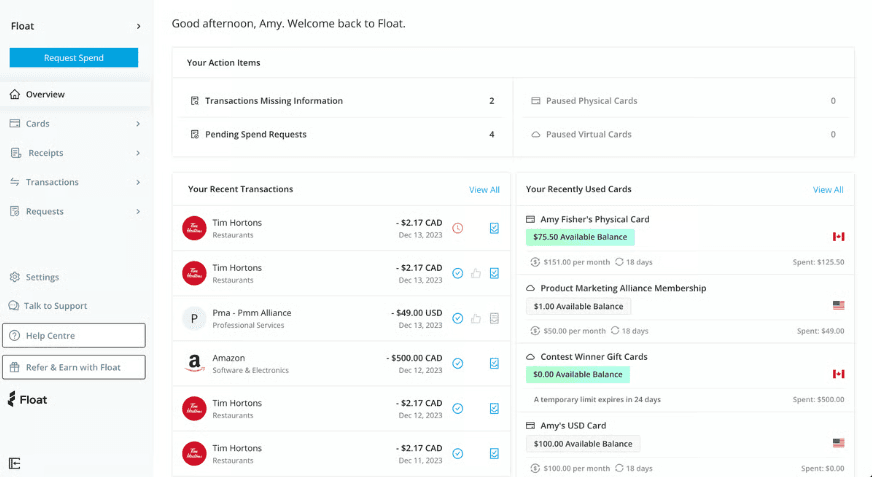
- Real-time expense tracking.
Cons
- Onboarding process lacks depth.
- Doesn't offer some advanced features like approval workflows.
- Your work might require more detailed reporting options than Float provides.
Is Float Financial Right For Your Needs?
Who Would be a Good Fit for Float Financial?
Float is ideal for small Canadian businesses and startups that need a straightforward spend management tool. Your team will appreciate its user-friendly interface and real-time tracking, which simplifies financial oversight.
Finance teams looking for efficient support and quick issue resolution will find Float's customer service valuable. If your department needs to keep expenses up-to-date without complex features, Float's simplicity is a perfect match.
- Small businessesFloat's simplicity and ease of use make it perfect for small teams managing expenses without a dedicated finance department.
- StartupsStartups benefit from Float's real-time tracking, keeping financials current and transparent for fast-paced growth.
- Finance teamsYour finance team will value Float's responsive customer support and intuitive interface, easing daily management tasks. Your team can also export transactions in a CSV file or directly to QuickBooks Online, NetSuite, or Xero.
- Remote teamsFloat's cloud-based platform lets your remote team access and manage expenses from anywhere, ensuring smooth operations.
- Consulting firmsConsultants can use Float's real-time tracking to manage client expenses efficiently, saving time on administrative tasks.
- NonprofitsNonprofits appreciate Float's straightforward tracking, making financial reporting to stakeholders easier and more transparent.
Who Would be a Bad Fit for Float Financial?
Float isn't a great choice for large enterprises or departments needing complex expense approval workflows and detailed real-time reporting. Your team might struggle with Float's lack of advanced features, which could slow down processes in environments that require thorough financial documentation and approval chains. If your business relies heavily on customized reports and intricate financial analysis, Float's straightforward nature may not meet your needs.
- Large enterprisesFloat lacks the advanced features and reporting capabilities needed for managing extensive corporate financial operations.
- Manufacturing firmsManufacturing firms needing detailed cost tracking and approval workflows might find Float too simplistic for their complex needs.
- Government agenciesGovernment agencies often require rigorous compliance and reporting standards that Float doesn't fully support.
- Financial institutionsFinancial institutions needing advanced analytics and detailed reporting will find Float's features too basic.
- Healthcare providersHealthcare providers with intricate billing and expense processes may find Float doesn't offer the detailed tracking they require.
- Educational institutionsEducational institutions often need complex budget management and approval systems, which Float's straightforward approach doesn't provide.
How We Test & Score Tools
We’ve spent years building, refining, and improving our software testing and scoring system. The rubric is designed to capture the nuances of software selection and what makes a tool effective, focusing on critical aspects of the decision-making process.
Below, you can see exactly how our testing and scoring works across seven criteria. It allows us to provide an unbiased evaluation of the software based on core functionality, standout features, ease of use, onboarding, customer support, integrations, customer reviews, and value for money.
Core Functionality (25% of final scoring)
The starting point of our evaluation is always the core functionality of the tool. Does it have the basic features and functions that a user would expect to see? Are any of those core features locked to higher-tiered pricing plans? At its core, we expect a tool to stand up against the baseline capabilities of its competitors.
Standout Features (25% of final scoring)
Next, we evaluate uncommon standout features that go above and beyond the core functionality typically found in tools of its kind. A high score reflects specialized or unique features that make the product faster, more efficient, or offer additional value to the user.
We also evaluate how easy it is to integrate with other tools typically found in the tech stack to expand the functionality and utility of the software. Tools offering plentiful native integrations, 3rd party connections, and API access to build custom integrations score best.
Ease of Use (10% of final scoring)
We consider how quick and easy it is to execute the tasks defined in the core functionality using the tool. High scoring software is well designed, intuitive to use, offers mobile apps, provides templates, and makes relatively complex tasks seem simple.
Onboarding (10% of final scoring)
We know how important rapid team adoption is for a new platform, so we evaluate how easy it is to learn and use a tool with minimal training. We evaluate how quickly a team member can get set up and start using the tool with no experience. High scoring solutions indicate little or no support is required.
Customer Support (10% of final scoring)
We review how quick and easy it is to get unstuck and find help by phone, live chat, or knowledge base. Tools and companies that provide real-time support score best, while chatbots score worst.
Customer Reviews (10% of final scoring)
Beyond our own testing and evaluation, we consider the net promoter score from current and past customers. We review their likelihood, given the option, to choose the tool again for the core functionality. A high scoring software reflects a high net promoter score from current or past customers.
Value for Money (10% of final scoring)
Lastly, in consideration of all the other criteria, we review the average price of entry level plans against the core features and consider the value of the other evaluation criteria. Software that delivers more, for less, will score higher.
Core Features
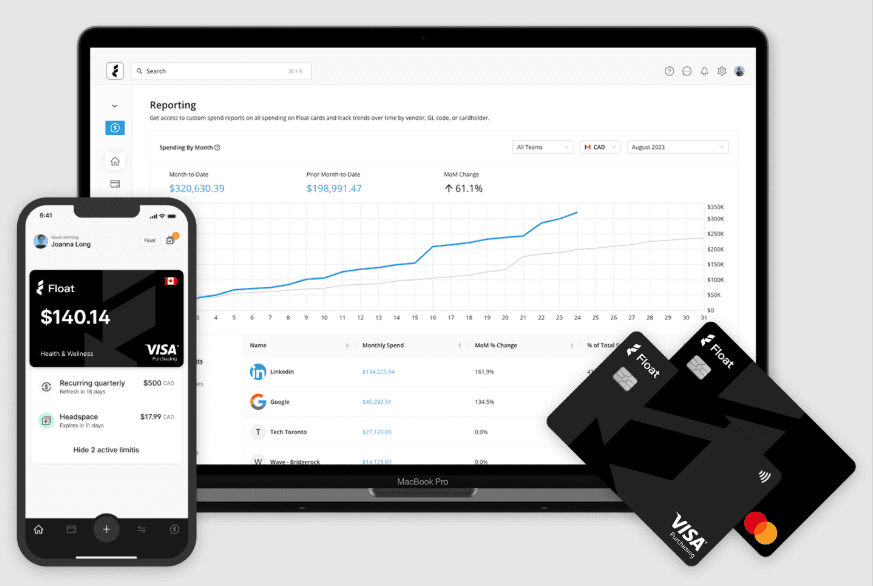
Real-time tracking: You can monitor expenses as they happen and even link your company credit card with Float to keep your finances current and transparent. These can be physical cards or any business card you use for business expenses. Float Financial also offers its own CAD (Visa) and USD (MasterCard) corporate cards. These are virtual cards for which you can set card limits to control spending. These offer low FX fees and low transaction fees, and attractive cashback depending on your monthly spending. If your Float corporate card is prepaid, all deposits are held at Scotiabank, which is a CDIC member institution, which means you don’t need to worry about losing money to fraud.
User-friendly interface: Your team will find it easy to navigate with a clean, intuitive design. It reduces the learning curve, letting everyone get up to speed fast.
Automated expense categorization: Automatically categorize business expenses to streamline your financial organization. This saves time and ensures consistency across your reports.
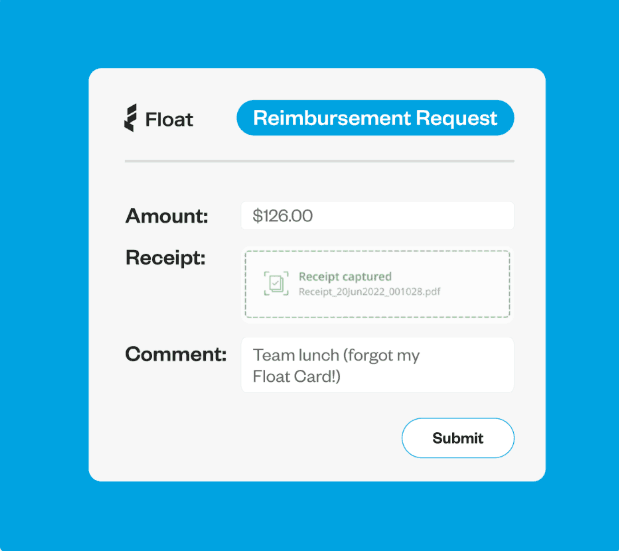
Receipt uploads: Upload and store receipts digitally, simplifying record-keeping and speeding up approval of reimbursements. This reduces paperwork and helps you maintain an audit trail.
Budget tracking: Set spending limits and monitor them to keep your spending in line with the budget. This helps you avoid overspending and stay aligned with financial goals.
Customizable reports: Generate reports tailored to your specific needs, offering flexibility in how you view your business spending data. This aids in clearer financial analysis.
Ease of Use
Float scores well on ease of use, thanks to its intuitive interface that your team will navigate with ease. The design is straightforward, reducing the learning curve and letting you focus on managing expenses rather than figuring out the software.
Features like real-time tracking and receipt uploads are simple to use, enhancing your team's productivity. Compared to others, Float's simplicity and user-friendliness make it a strong choice for those seeking an uncomplicated expense management solution.
Integrations
Float integrates with Asana, Jira, Teamwork, Trello, Slack, Google Calendar, and Zapier.
Float also offers an API and connects with third-party tools like Zapier for additional app connections.
Float Financial Specs
- 2-Factor Authentication: Yes
- API: Yes
- Batch Permissions & Access: No
- BitCoin: No
- Customer Management: No
- Data Export: Yes
- Data Import: Yes
- External Integrations: No
- Multi-Currency: Yes
- Multi-User: Yes
- Notifications: Yes
- PayPal: No
- Stripe: No


