

iManage Review: Pros, Cons, Features, and Pricing
iManage excels in providing comprehensive email and document management alongside compliance features that cater to the unique needs of law firms and financial institutions.

We review tools independently, and commissions help fund our testing. See our transparency policy, our methodology, or suggest a tool.
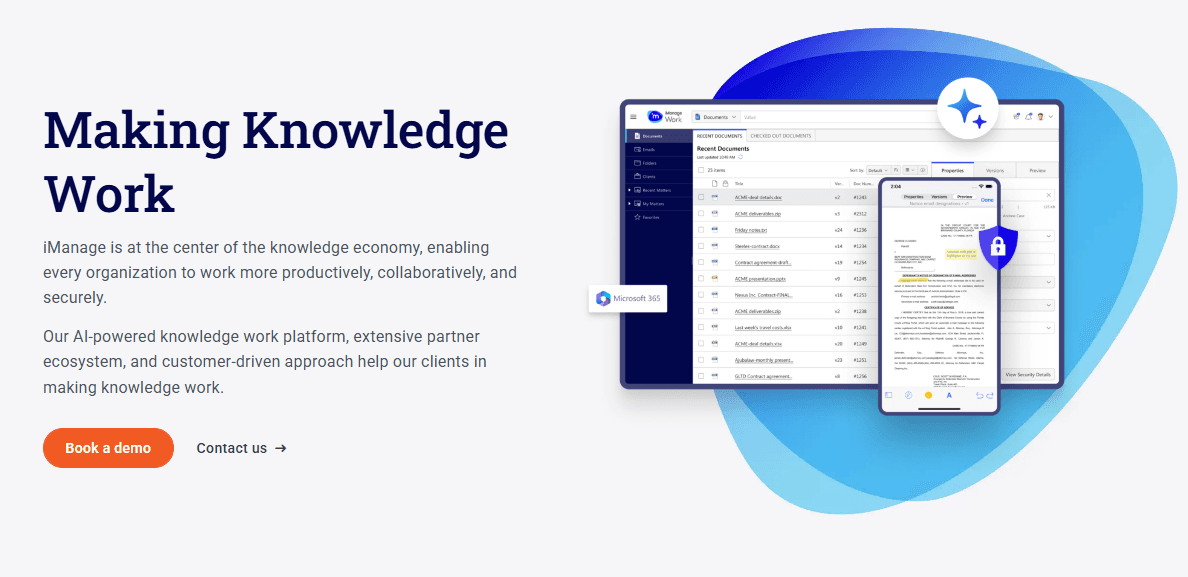
iManage is a financial compliance platform built around document and email management. It's designed for finance and legal teams that need a centralized, auditable record of their work. I'd consider it if your team handles high volumes of sensitive documents and needs version control, access governance, and matter-centric organization. Compared to NetDocuments, iManage offers deeper Microsoft 365 integration and stronger governance controls. That makes it the better pick where document security and compliance oversight are non-negotiable.
iManage Evaluation Summary
4.3/5
- Pricing upon request
- Free demo available
Why Trust Our Software Recommendations
6,700+
Reviews
20
Industry experts
16+
Evaluation factors
14
Years
Our team has been testing and reviewing software since 2012. As finance leaders ourselves, we know how difficult—and important—it is to choose the right software.
For this guide, we evaluated tools using hands-on testing and independent research, scoring tools using our selection criteria.
Our reviews reflect our human editorial judgment, not a sales pitch.
iManage Overview
In my opinion, iManage is a solid choice for larger organizations with complex document management and compliance requirements. Its standout features include iManage Work's robust document management and security capabilities, which are crucial for compliance. However, the onboarding process could be more intuitive, especially for smaller teams or those new to such information technology systems. The platform's pricing reflects its enterprise-level features, which might not suit smaller businesses with tighter budgets. Compared to competitors, iManage excels in security and compliance features but falls short in ease of use and onboarding. It's best suited for teams that prioritize comprehensive compliance and document management over simplicity and lower costs.
Pros
- iManage Work offers strong document management capabilities that enhance your team's organization.
- The software provides excellent security features to protect your sensitive financial data.
- iManage's user interface is intuitive, making it easy for your team to adapt quickly.
Cons
- Some users find the initial setup process time-consuming.
- Limited customization options might restrict the degree to which you can tailor the software to your needs.
- Customer support response times can sometimes be slow, which could impact your efficiency.
Is iManage Right For Your Needs?
Who Would be a Good Fit for iManage?
iManage is ideal for legal firms and finance departments that need document management software that enables strong security. If your team handles sensitive information, iManage's security features help protect your data. The intuitive interface supports quick adaptation, which is essential for fast-paced environments. Teams that prioritize organization and data integrity will find that iManage's features align well with their goals.
- Legal Departments and FirmsiManage provides strong legal document management and security, crucial for handling sensitive files.
- Finance DepartmentsThe software's security features safeguard your financial data, ensuring compliance and data integrity.
- Small BusinessesWith its intuitive interface, iManage is easy for your small team to adopt and use efficiently.
- Accounting FirmsiManage allows accounting firms to protect confidential client data and meet specific requirements.
- Corporate ComplianceThe software supports your compliance efforts with document management and audit trails.
- Government DepartmentsiManage helps federal, state, and local government departments manage confidential documents and data securely.
Who Would be a Bad Fit for iManage?
iManage might not suit startups or tech companies that need highly customizable solutions. Its limited options can frustrate teams that need flexibility in their workflows. If your team relies on rapid implementation, the time-consuming setup could be a hindrance. Additionally, if quick customer support is crucial for your operations, iManage's slower response times might not align with your needs.
- StartupsThe limited customization options may not provide the flexibility your agile team needs.
- Tech CompaniesYour need for rapid deployment might conflict with iManage's time-consuming setup process.
- Creative AgenciesThe software's structured document management may not fit your dynamic and creative workflows.
- Large EnterprisesIf quick customer support is critical, iManage's slower response times could impact your operations.
- Retail BusinessesYour fast-paced environment might not benefit from iManage's slower setup and support.
- Marketing TeamsThe rigid structure may not support the creative and flexible nature of your marketing projects.
How We Test & Score Tools
We’ve spent years building, refining, and improving our software testing and scoring system. The rubric is designed to capture the nuances of software selection and what makes a tool effective, focusing on critical aspects of the decision-making process.
Below, you can see exactly how our testing and scoring works across seven criteria. It allows us to provide an unbiased evaluation of the software based on core functionality, standout features, ease of use, onboarding, customer support, integrations, customer reviews, and value for money.
Core Functionality (25% of final scoring)
The starting point of our evaluation is always the core functionality of the tool. Does it have the basic features and functions that a user would expect to see? Are any of those core features locked to higher-tiered pricing plans? At its core, we expect a tool to stand up against the baseline capabilities of its competitors.
Standout Features (25% of final scoring)
Next, we evaluate uncommon standout features that go above and beyond the core functionality typically found in tools of its kind. A high score reflects specialized or unique features that make the product faster, more efficient, or offer additional value to the user.
We also evaluate how easy it is to integrate with other tools typically found in the tech stack to expand the functionality and utility of the software. Tools offering plentiful native integrations, 3rd party connections, and API access to build custom integrations score best.
Ease of Use (10% of final scoring)
We consider how quick and easy it is to execute the tasks defined in the core functionality using the tool. High scoring software is well designed, intuitive to use, offers mobile apps, provides templates, and makes relatively complex tasks seem simple.
Onboarding (10% of final scoring)
We know how important rapid team adoption is for a new platform, so we evaluate how easy it is to learn and use a tool with minimal training. We evaluate how quickly a team member can get set up and start using the tool with no experience. High scoring solutions indicate little or no support is required.
Customer Support (10% of final scoring)
We review how quick and easy it is to get unstuck and find help by phone, live chat, or knowledge base. Tools and companies that provide real-time support score best, while chatbots score worst.
Customer Reviews (10% of final scoring)
Beyond our own testing and evaluation, we consider the net promoter score from current and past customers. We review their likelihood, given the option, to choose the tool again for the core functionality. A high scoring software reflects a high net promoter score from current or past customers.
Value for Money (10% of final scoring)
Lastly, in consideration of all the other criteria, we review the average price of entry level plans against the core features and consider the value of the other evaluation criteria. Software that delivers more, for less, will score higher.
Core Features
Document Management: iManage helps your team organize and store documents securely. You can access and manage files with ease.
Security Controls: The software provides robust security measures to protect your sensitive data. You can set permissions to control access.
Audit Trails: This feature tracks document changes, so you can see who did what and when. It helps your team maintain compliance.
Version Control: iManage keeps track of document versions, allowing you to revert to previous versions if needed. It ensures your team works with the most current data.
User Access Management: You can manage who has access to specific documents and data. This feature helps your team maintain control over sensitive information.

Ease of Use
iManage is generally user-friendly, with an intuitive interface that helps your team get up to speed quickly. Its straightforward navigation makes accessing documents and managing tasks easy. However, some real users mention the initial setup can be a bit time-consuming. Once everything's in place, though, your team can enjoy a smooth user experience. Compared to other options, iManage's design supports productivity, letting you focus on your work without having to deal with complicated processes.

Integrations
iManage integrates with Microsoft Office 365 (including Email Management for Outlook), Adobe Acrobat, Clio, ServiceNow, and Salesforce.
iManage also provides an API for custom integrations and connects with third-party integration tools to extend its functionality.

iManage Specs
- 2-Factor Authentication: Yes
- API: Yes
- Approval Workflows: Yes
- Audit Trail: Yes
- Batch Permissions & Access: Yes
- Chat: Yes
- Dashboard: Yes
- Data Export: Yes
- Data Import: Yes
- Document Comparison: Yes
- Document Sharing: Yes
- Electronic Signature: Yes
- Email Integration: Yes
- External Integrations: Yes
- File Sharing: Yes
- File Transfer: Yes
- Google Apps Integration: Yes
- History/Version Control: Yes
- Metadata Management: Yes
- Multi-User: Yes
- NDA Management: Yes
- Notifications: Yes
- Password & Access Management: Yes
- Project Management: Yes
- Template Designer: Yes


