

Manager.io Review: Pros, Cons, Features, and Pricing



Manager.io is an accounting software for small businesses that need double-entry bookkeeping, invoicing, payroll, and inventory tracking. I'd mainly consider it if you want the feature depth of paid tools like QuickBooks or Xero, but need a no-cost solution you can run as a desktop app, self-hosted server, or in the cloud—without paying monthly licensing fees.
Manager.io Evaluation Summary
- From $59/user/month
- Free trial available
Why Trust Our Software Reviews
We’ve been testing and reviewing financial software since 2023. As finance specialists ourselves, we know how critical and difficult it is to make the right decision when selecting software.
We invest in deep research to help our audience make better software purchasing decisions. We’ve tested more than 2,000 tools for different finance use cases and written over 1,000 comprehensive software reviews. Learn how we stay transparent & our software review methodology.
Manager.io Overview
In my opinion, Manager.io is a solid choice for small businesses and freelancers looking for an affordable and user-friendly accounting software. Its ease of use stands out, making it accessible for users without extensive financial experience. While it may lack some advanced features found in pricier competitors like QuickBooks Online, it excels in providing essential tools at a great value for money.
It's best suited for environments where straightforward financial management is key, rather than complex integrations or advanced analytics. If you're deciding on a tool that balances cost and functionality, Manager.io is worth considering for your accounting needs.
pros
-
No accounting expertise is required to navigate its intuitive interface.
-
It offers robust invoicing and expense tracking features.
-
It provides reliable offline access to financial data.
cons
-
Some end users find its reporting features limited compared to other tools.
-
Customer support response times can be slower than you'd like.
-
Certain user reviews report a lack of advanced analytics functionality.
-

Creatio CRM
Visit WebsiteThis rating combines scores from multiple user review sites to reflect overall customer sentiment about the product.4.7 -
Rippling Spend
Visit WebsiteThis rating combines scores from multiple user review sites to reflect overall customer sentiment about the product.4.8 -
DealHub AI
Visit WebsiteThis rating combines scores from multiple user review sites to reflect overall customer sentiment about the product.4.7


How We Test & Score Tools
We’ve spent years building, refining, and improving our software testing and scoring system. The rubric is designed to capture the nuances of software selection and what makes a tool effective, focusing on critical aspects of the decision-making process.
Below, you can see exactly how our testing and scoring works across seven criteria. It allows us to provide an unbiased evaluation of the software based on core functionality, standout features, ease of use, onboarding, customer support, integrations, customer reviews, and value for money.
Core Functionality (25% of final scoring)
The starting point of our evaluation is always the core functionality of the tool. Does it have the basic features and functions that a user would expect to see? Are any of those core features locked to higher-tiered pricing plans? At its core, we expect a tool to stand up against the baseline capabilities of its competitors.
Standout Features (25% of final scoring)
Next, we evaluate uncommon standout features that go above and beyond the core functionality typically found in tools of its kind. A high score reflects specialized or unique features that make the product faster, more efficient, or offer additional value to the user.
We also evaluate how easy it is to integrate with other tools typically found in the tech stack to expand the functionality and utility of the software. Tools offering plentiful native integrations, 3rd party connections, and API access to build custom integrations score best.
Ease of Use (10% of final scoring)
We consider how quick and easy it is to execute the tasks defined in the core functionality using the tool. High scoring software is well designed, intuitive to use, offers mobile apps, provides templates, and makes relatively complex tasks seem simple.
Onboarding (10% of final scoring)
We know how important rapid team adoption is for a new platform, so we evaluate how easy it is to learn and use a tool with minimal training. We evaluate how quickly a team member can get set up and start using the tool with no experience. High scoring solutions indicate little or no support is required.
Customer Support (10% of final scoring)
We review how quick and easy it is to get unstuck and find help by phone, live chat, or knowledge base. Tools and companies that provide real-time support score best, while chatbots score worst.
Customer Reviews (10% of final scoring)
Beyond our own testing and evaluation, we consider the net promoter score from current and past customers. We review their likelihood, given the option, to choose the tool again for the core functionality. A high scoring software reflects a high net promoter score from current or past customers.
Value for Money (10% of final scoring)
Lastly, in consideration of all the other criteria, we review the average price of entry level plans against the core features and consider the value of the other evaluation criteria. Software that delivers more, for less, will score higher.
Core Features
Invoicing: Manager.io lets you create and customize invoices easily, helping you manage billing efficiently. Your team can track payments and send reminders with just a few clicks, supported by flexible modules that improve workflow.
Expense Tracking: You can keep a close eye on expenses with Manager.io's clear categorization and reporting tools. This helps you maintain accurate financial records without hassle, similar to other small business accounting tools.
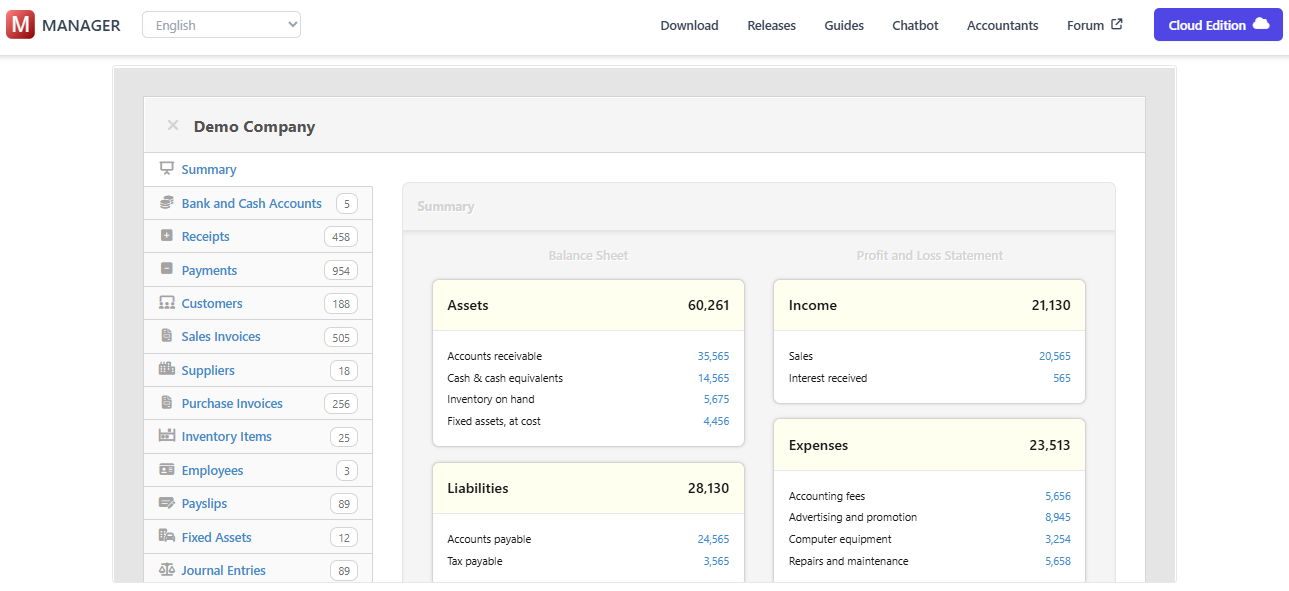
Financial Reporting: Generate essential reports like profit and loss statements to understand your financial health. It's straightforward, so you can focus on making informed decisions that support your bookkeeping processes.
Inventory Management: Manager.io helps you track inventory levels and costs, ensuring you always know what you have on hand. This feature is perfect for businesses needing simple stock management without detailed oversight of inventory items.
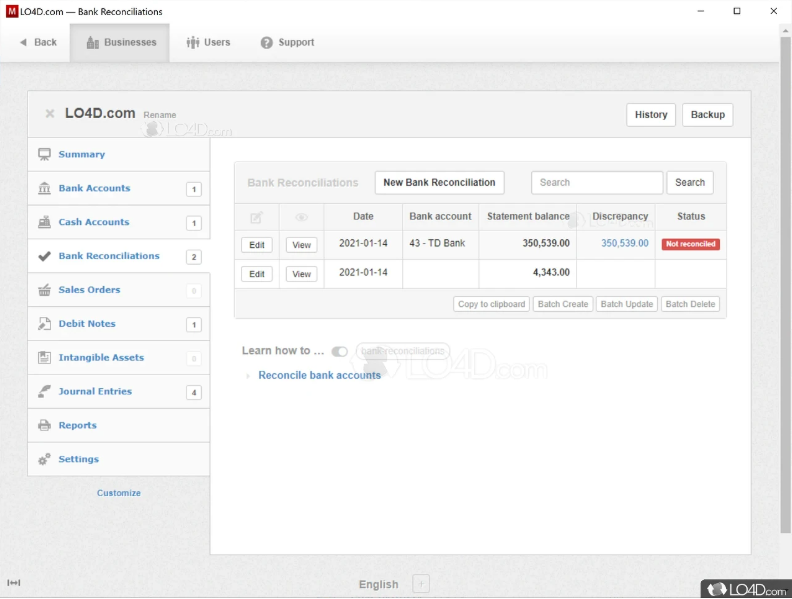
Bank Reconciliation: You can match bank transactions with your records easily, reducing errors in your financial data. It simplifies your reconciliation process using bank statements, saving you time.
Multi-Currency Support: If your work involves multiple currencies, Manager.io lets you manage transactions across them seamlessly. This feature is crucial for businesses dealing with international clients.
Ease of Use
Manager.io stands out for its user-friendly interface, making it easy for your team to navigate without prior accounting experience. You’ll find its layout intuitive, with straightforward menus that simplify tasks like invoicing and expense tracking. The offline access feature adds to its usability, allowing you to work from anywhere without the internet. Compared to other software, Manager.io reduces the learning curve, helping you and your team get started quickly and efficiently, even if you're transitioning from other accounting packages like QuickBooks Online.

Integrations
Manager.io does not provide out-of-the-box integrations or turnkey connectors for many apps. It provides tailored integration by allowing you to write an extension that lets you build a custom connector.
For simpler needs like exporting data or synchronizing with BI tools, it supports integration through JSON.
Manager.io Specs
- 2-Factor Authentication
- Accounts Payable
- Accounts Receivable
- API
- Balance Sheet
- Billing/Invoicing
- BitCoin
- Budgeting
- Calendar Management
- Contact Management
- CRM Integration
- Customer Management
- Dashboard
- Data Export
- Data Import
- Data Visualization
- Expense Tracking
- External Integrations
- Forecasting
- General Account Ledger
- Inventory Tracking
- Multi-Currency
- Multi-User
- Notifications
- P&L
- PayPal
- Payroll
- SAP Integration
- Stripe
- Supplier Management
- Tax Management