

10 Best Financial Close Software Reviewed in 2026

Best Financial Close Software Shortlist


Closing the books shouldn’t feel like a never-ending struggle, but with outdated financial close software, it often does.
As a financial controller, I’ve seen how inefficient close processes can drain time and energy. A well-chosen financial close solution doesn’t just save hours—it reduces risk, ensures compliance, and keeps everything running smoothly. But with so many options on the market, how can you know which is right for you?
To get you started, I tested and reviewed the best financial close software options, so you can find a reliable fit. Whether you’re looking for automation, better integrations, or stronger audit trails, this listicle will help you get a clear comparison of the top tools to help you close faster and smarter.
Why Trust Our Software Recommendations
Our team has been testing and reviewing software since 2012. As finance leaders ourselves, we know how difficult—and important—it is to choose the right software.
For this guide, we evaluated tools using hands-on testing and independent research, scoring tools using our selection criteria.
Our reviews reflect our human editorial judgment, not a sales pitch.
Best Financial Close Software Summary
This comparison chart summarizes pricing details for my top financial close software selections to help you find the best one for your budget and business needs.
| Tool | Best For | Trial Info | Price | ||
|---|---|---|---|---|---|
| 1 | Best for variance analysis for enterprises | Free demo available | Pricing upon request | Website | |
| 2 | Best for AI-powered financial close | Free demo available | Pricing upon request | Website | |
| 3 | Best for tracking financial status while closing | Free demo available | Pricing upon request | Website | |
| 4 | Best for unified financial consolidation | Free demo available | Pricing upon request | Website | |
| 5 | Best for multi-entity management | Free demo available | From $99/month | Website | |
| 6 | Best for Excel-based planning | Free demo available | Pricing upon request | Website | |
| 7 | Best for financial planning integration | Free demo available | Pricing upon request | Website | |
| 8 | Best for optimizing team collaboration | Free demo available | Pricing upon request | Website | |
| 9 | Best for enterprise-grade automation | Free demo available | Pricing upon request | Website | |
| 10 | Best for rapid data integration | Free demo available | Pricing upon request | Website |
Best Financial Close Software Review
Below are my detailed summaries of the best financial close software that made it onto my shortlist. My reviews offer an in-depth look at the key features, pros & cons, integrations, and ideal use cases of each tool to help you find the best one for you.

Vena
Best for variance analysis for enterprises

Vena is an AI-powered financial planning and analysis platform that helps finance teams manage the financial close process directly within Microsoft Excel. It’s built to reduce manual effort, improve close accuracy, and support real-time collaboration across budgeting, forecasting, and account reconciliations.
Why I Picked Vena: I picked Vena because it combines the familiarity of Excel with AI-driven financial close capabilities. Its flexible modeling and centralized templates allow you to create detailed, dynamic financial close processes that fit your organization’s needs. I also like that Vena offers collaborative planning and task tracking to help teams stay accountable throughout the close cycle. Additionally, Vena’s real-time dashboards and variance analysis tools make it easier to spot and resolve issues as they arise.
Standout features & integrations:
Features include account reconciliation dashboards, tax provisioning tools to manage compliance, and Vena Copilot for AI-driven insights and scenario planning during the close. Vena also provides real-time reporting and centralized templates to support faster, more accurate financial closes.
Integrations include Microsoft 365, SAP, Salesforce, Workday, NetSuite, QuickBooks, Sage, Dropbox, and OneDrive.
Pros and Cons
Pros:
- Supports team collaboration
- Custom workflows and reporting
- Automates budgeting and forecasting
Cons:
- Delays in ledger account updates
- Expensive for small businesses
New Product Updates from Vena
Vena Launches Advanced Financial Consolidation Solution
Vena launches Financial Consolidation with multi-entity consolidation, governed close workflows, and AI-powered analysis. These capabilities help finance teams manage complex close processes with stronger control and auditability. For more information, visit Vena’s official site.
 .
.
DOKKA
Best for AI-powered financial close

DOKKA is a financial close software designed to streamline month-end and year-end closing processes for small to medium-sized businesses. It uses AI-powered automation to handle tasks such as journal entry preparation, reconciliation, and document management, reducing the time and effort needed to finalize accurate financial reports.
Why I picked DOKKA: I chose DOKKA because it offers AI-powered financial close. Its machine learning engine automatically categorizes and processes financial documents, minimizing manual data entry and human error. This AI-driven approach accelerates the close cycle, while its collaborative workflows ensure finance teams can review, approve, and sign off quickly. For organizations seeking efficiency and accuracy, DOKKA’s use of AI makes it a strong choice.
Standout features & integrations:
Features include automated journal entry creation, reconciliation tools, and digital audit trails to simplify financial close compliance. Its centralized workspace enables real-time team collaboration and approval tracking. AI-powered document capture and classification ensure all supporting records are properly stored and linked to close activities.
Integrations include QuickBooks, Xero, Sage, NetSuite, Microsoft Dynamics, SAP, FreshBooks, Zoho Books, MYOB, and KashFlow.
Pros and Cons
Pros:
- Effective document automation
- Real-time collaboration tools
- Automated reconciliation
Cons:
- Limited scalability for large organizations
- Potential learning curve for new users

Best for tracking financial status while closing

DualEntry is an AI-native ERP platform built for mid-market businesses that need to automate and accelerate the financial close process. It’s designed to reduce manual work, ensure compliance, and provide real-time visibility across multi-entity operations.
Why I Picked DualEntry: I picked DualEntry because it simplifies the financial close with AI-powered tools like automated reconciliations, transaction matching, and variance analysis. You can manage complex consolidations across entities and currencies while maintaining tight audit trails for ASC 606, IFRS 15, and SOX compliance. I also like that it offers real-time dashboards, so you can track financial status as you close, not just after.
Standout features & integrations:
Features include role-based approval controls to protect sensitive data, CPA-led onboarding and support, and AI-driven reconciliations that help you close faster with fewer errors.
Integrations include BambooHR, Bill.com, Brex, Deel, Google SSO, Gusto, HubSpot, Ramp, Rippling, Salesforce, Stripe Billing, and Stripe Invoicing.
Pros and Cons
Pros:
- Automated revenue recognition ensures compliance with standards
- Supports multi-entity and multi-currency operations
- Advanced AI features help with complex accounting tasks
Cons:
- As an ERP, it may offer more features than needed for simpler accounting needs
- Customization options require careful setup

Best for unified financial consolidation
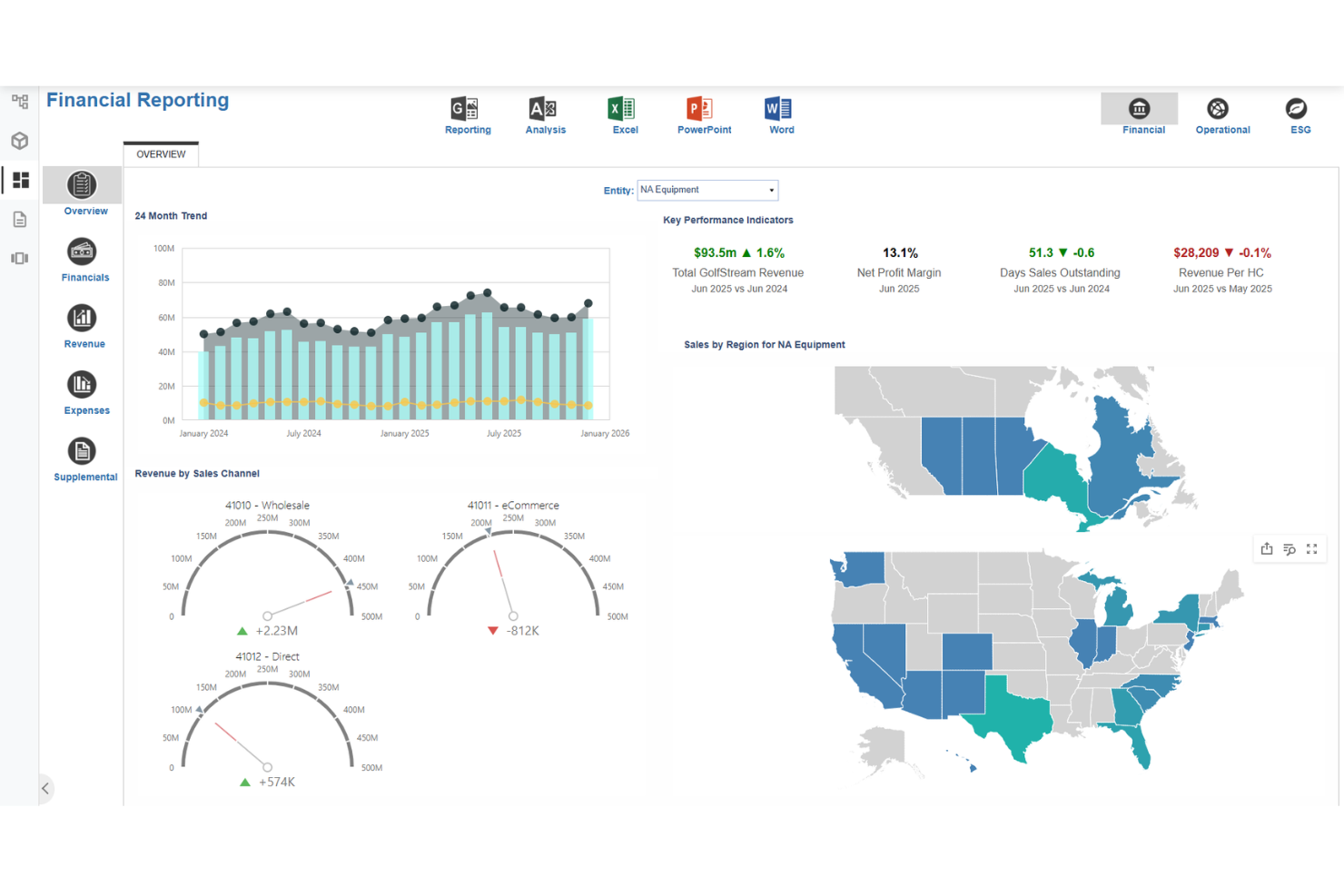
OneStream is an enterprise financial close and consolidation platform that covers financial close, account reconciliation, FP&A, and integrated business planning in a single unified environment.
Who Is OneStream Best For?
OneStream is a strong fit for enterprise finance teams managing multi-entity consolidations across complex legal structures, currencies, and reporting frameworks.
Why I Picked OneStream
OneStream earns its spot on my shortlist because it's one of the only platforms where financial consolidation, close, FP&A, and ESG reporting all run on the same data model, with no translation layer between them. What I find particularly compelling is the built-in consolidation engine, which handles intercompany eliminations, multi-currency translation, and ownership structures automatically. I also like that the always-on audit trail can't be switched off, which means every data, metadata, and process change is logged from report back to source without any performance trade-off.
OneStream Key Features
- Close task management: Assign, track, and certify close tasks across teams using a centralized workflow dashboard with status visibility.
- Account reconciliation: Automate balance sheet account reconciliations with built-in matching, variance thresholds, and sign-off workflows.
- Disclosure management: Author, review, and publish financial statements and footnotes directly within the platform using structured templates.
- Extensible MarketPlace solutions: Add pre-built solutions for tax provisioning, lease accounting, and cash flow reporting without leaving the platform.
OneStream Integrations
OneStream provides direct integration with over 250 ERP, HCM, CRM, and other source systems, including Oracle, PeopleSoft, JDE, SAP, Infor, and Microsoft AX/Dynamics. It also connects to SAP S/4HANA, Oracle Fusion, and Snowflake, and offers a REST API for custom integrations.
Pros and Cons
Pros:
- SensibleAI portfolio includes AI-powered forecasting and anomaly detection
- Supports multi-GAAP and local statutory reporting
- Extensible Dimensionality adds custom dimensions without performance loss
Cons:
- MarketPlace solution documentation lacks implementation-level detail
- Relies heavily on VB coding over low-code options

Tipalti
Best for multi-entity management

Tipalti is an accounts payable and financial management solution for businesses with complex, multi-entity structures. It automates payment processes, compliance checks, and financial reporting to manage operations across different business units.
Why I picked Tipalti: Tipalti is ideal for businesses managing multiple entities, offering features that simplify global payments and compliance. Its automated payment reconciliation helps reduce manual errors. The platform's tax compliance features also keep your team aligned with international regulations. Additionally, Tipalti's centralized dashboard provides a clear view of financial activities across all entities.
Standout features & integrations:
Features include fraud detection tools that help safeguard transactions and reduce financial risks. Its multi-currency support enables seamless global transactions, making it easier to manage international payments. The platform also provides detailed audit trails, ensuring transparency and compliance with financial reporting standards.
Integrations include NetSuite, QuickBooks, Xero, Sage Intacct, Microsoft Dynamics, Salesforce, SAP, Bill.com, and Expensify.
Pros and Cons
Pros:
- Automated payment reconciliation
- Strong tax compliance features
- Centralized financial dashboard
Cons:
- Complexity in initial setup
- Requires training for full use

Best for Excel-based planning

Datarails is a financial planning and analysis software designed for finance teams that rely heavily on Excel. It enhances financial visibility and automates data consolidation to improve business insights.
Why I picked Datarails: Datarails offers advanced Excel integration, making it ideal for teams that prefer working within Excel's familiar environment. It automates data collection and consolidation, reducing the time spent on manual input. The platform also provides real-time analytics to help teams accurately forecast trends and adequately adjust. Overall, these features, plus Datarails' focus on Excel-based planning, ensures a smooth transition for teams not ready to move away from spreadsheets entirely.
Standout features & integrations:
Features include scenario modeling, enabling businesses to evaluate various strategic options effectively. The platform also offers strong financial reporting tools, allowing teams to generate detailed insights with ease. Additionally, its built-in compliance tracking ensures that financial data aligns with industry regulations, reducing the risk of reporting errors.
Integrations include Salesforce, NetSuite, QuickBooks, Microsoft Dynamics, SAP, Xero, Sage Intacct, FreshBooks, and HubSpot.
Pros and Cons
Pros:
- Scenario modeling capabilities
- Automated data consolidation
- Smooth transition from spreadsheets
Cons:
- Limited customization options
- Complex initial setup

Jedox
Best for financial planning integration
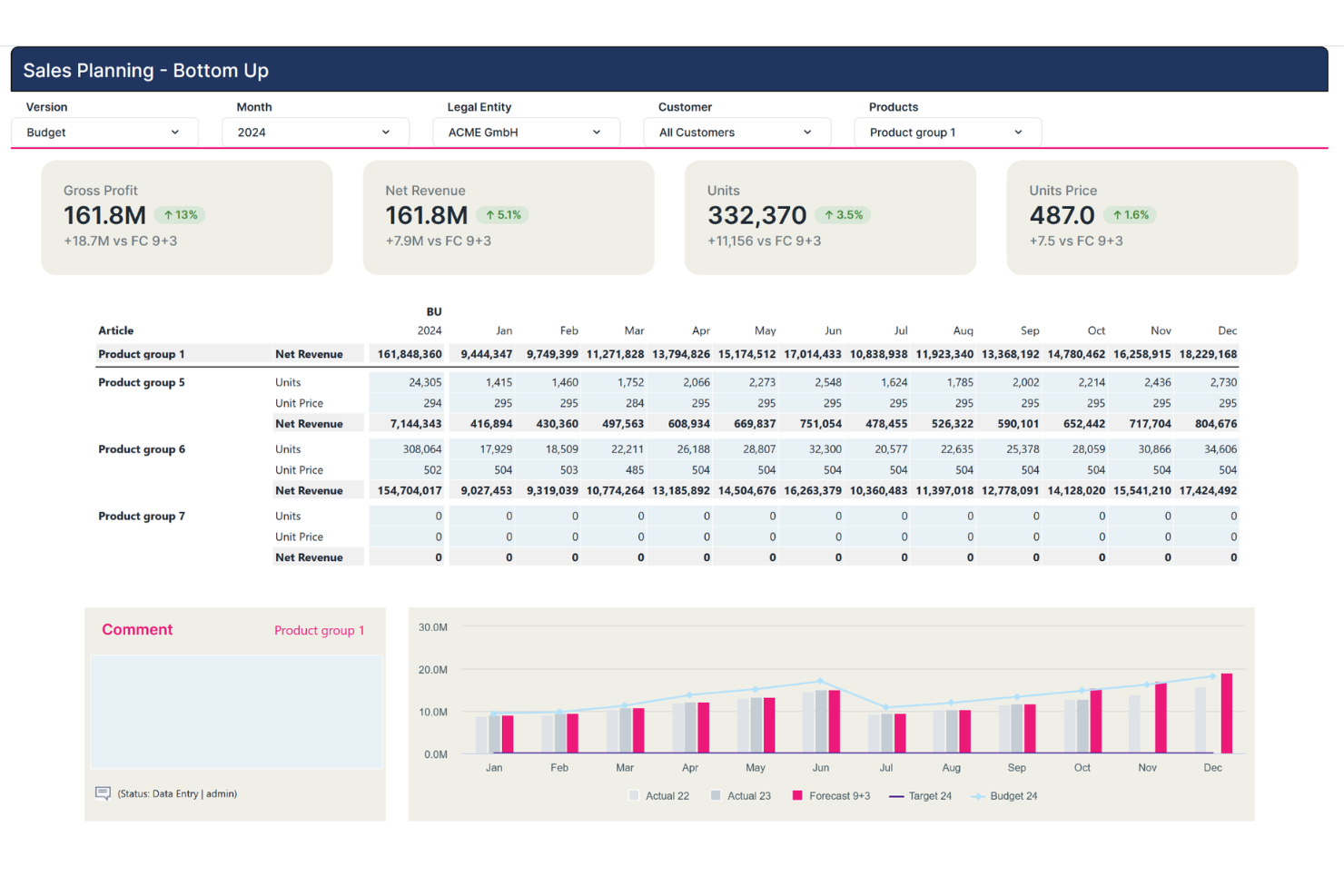
Jedox is a financial planning and analysis (FP&A) platform that covers budgeting, forecasting, financial consolidation, integrated business planning, and ESG reporting in a single environment.
Who Is Jedox Best For?
Jedox is a strong fit for FP&A teams at midmarket and enterprise companies that need budgeting and forecasting to run alongside the financial close.
Why I Picked Jedox
I've included Jedox in my top picks because it's one of the few financial close tools where the close process and the planning cycle share the same data model. What I like most is that actuals posted at close feed directly into your rolling forecasts and scenario models, so there's no re-keying or manual data hand-offs between systems. Jedox's Integrator handles built-in ETL from sources like SAP, Oracle, and Salesforce, so close data and plan data stay in sync automatically. I also think the native Excel Add-in, which supports live write-back, is a real advantage for FP&A teams who want to work in familiar territory without disconnecting from the governed planning environment.
Jedox Key Features
- Multi-dimensional OLAP engine: Slice and analyze financial data across dimensions like entity, cost center, account, and period without flattening the data structure.
- Financial consolidation: Consolidate actuals across multiple legal entities, handle intercompany eliminations, and manage currency translation within a single model.
- Workflow management: Assign close tasks, set deadlines, and track completion status across teams using a built-in workflow engine.
- Audit trail and version control: Log all data changes and model edits with user-level traceability to support period-end sign-off and audit readiness.
Jedox Integrations
Jedox connects to a wide range of business systems through its built-in Integrator, including SAP ERP, SAP S/4HANA, SAP BW, Salesforce, Microsoft Dynamics 365, Oracle NetSuite, Snowflake, Power BI, Qlik Sense, and Tableau. It also supports relational databases like Microsoft SQL Server, Oracle Database, IBM DB2, SAP HANA, MySQL, and PostgreSQL, plus file-based sources and REST/SOAP web services. An OData Hub and REST API are available for custom integrations.
Pros and Cons
Pros:
- In-memory OLAP handles large data volumes
- Scenario modeling built into close workflows
- Actuals and forecasts share one data model
Cons:
- Change tracking within the tool is limited
- Complex models introduce bugs at rollover

FloQast
Best for optimizing team collaboration
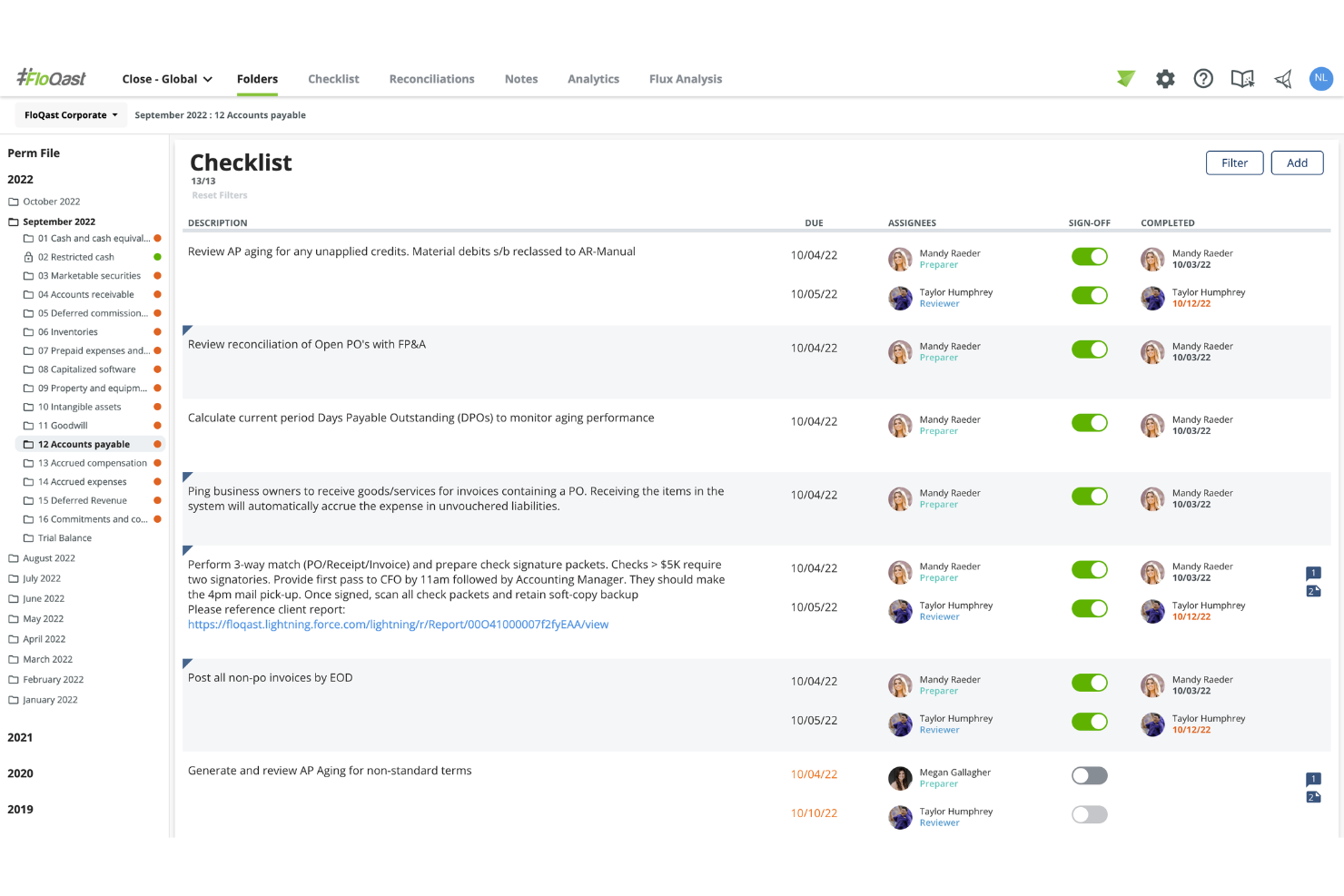
FloQast is an AI-powered accounting transformation platform that handles financial close management, automated reconciliations, compliance, and record-to-report workflows across accounting teams.
Who Is FloQast Best For?
FloQast is a strong fit for mid-market and enterprise accounting teams that need better visibility and coordination across their close process.
Why I Picked FloQast
FloQast is one of my top picks because I love how it centralizes close task tracking and reconciliation status across teams and entities in one view. My team is able to monitor every preparer's progress against deadlines in real time, which makes it easy to spot bottlenecks before they delay the close. The FloQast Request feature also cuts down the manual back-and-forth with internal and external stakeholders by using AI to handle information requests in one place.
FloQast Key Features
- AI transaction matching: Automates high-volume reconciliations across bank, credit card, intercompany, and subledger accounts using AI-generated matching rules that your team reviews and approves.
- Journal entry automation: Standardizes and automates journal entry creation, approval workflows, and posting, with all supporting documentation managed in one place.
- Close status monitoring: Tracks the real-time status of close tasks and reconciliations across entities against milestones and deadlines, with visibility into each team member's progress.
- Accounting and finance operations management: Connects workflows across AP/AR, FP&A, and board reporting to coordinate cross-department activity during close and ad-hoc projects like M&A or ERP upgrades.
FloQast Integrations
FloQast offers native integrations across several categories, including ERP systems like Oracle NetSuite, SAP, Sage Intacct, Microsoft Dynamics 365, Xero, QuickBooks, and Yardi, along with AP tools like Bill.com, Expensify, Ramp, Stripe, Coupa, and Concur. It also connects with collaboration platforms like Slack, Google Drive, Dropbox, Microsoft SharePoint, and Microsoft OneDrive, as well as payroll systems like ADP, Rippling, and UKG. FloQast also integrates with identity providers like OneLogin. An API is not clearly documented, but the platform supports direct ERP connections and bank integrations to pull financial data into its workflows.
Pros and Cons
Pros:
- Real-time close task and deadline tracking
- Replaces spreadsheet-based close checklists entirely
- Built-in SOX compliance and audit trail tools
Cons:
- Flux reporting layout is hard to modify
- Struggles with high-volume transaction matching

Best for enterprise-grade automation
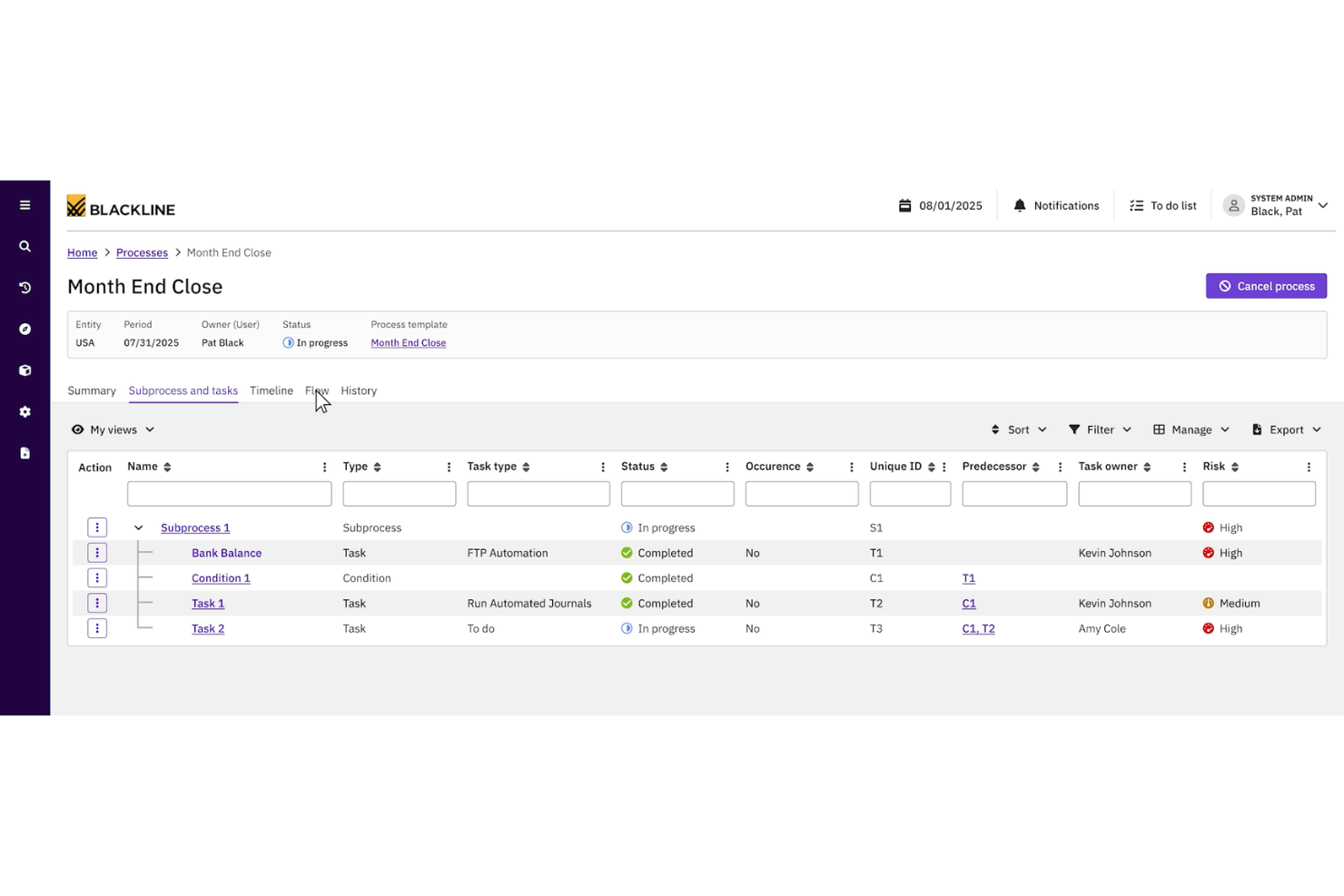
BlackLine is a financial close and accounts receivable platform that automates record-to-report and invoice-to-cash processes, including account reconciliations, journal entries, intercompany balancing, and financial consolidation.
Who Is BlackLine Best For?
BlackLine is built for large enterprises and multinational corporations with high transaction volumes, complex entity structures, and dedicated accounting operations teams.
Why I Picked BlackLine
BlackLine earns its spot as one of the best on my shortlist because no other tool in this space matches its depth of automation across the full record-to-report cycle. I'm particularly impressed by Smart Close for SAP, which runs the close directly inside SAP with minimal manual touchpoints, and by Transaction Matching, which ingests high-volume data from ERPs, banks, and payroll providers and applies rule-based automation to flag differences automatically. For enterprises running multi-entity consolidations, the Consolidation module handles ownership interest calculations and intercompany eliminations without a single spreadsheet in sight.
BlackLine Key Features
- Account reconciliation templates: Standardizes reconciliation formats across the organization, with risk-based assignment rules that route high-risk accounts to senior reviewers automatically.
- Journal entry management: Centralizes journal entry creation, supporting documentation, and multi-level approval workflows in one place, with audit trail logging on every action.
- Variance analysis: Compares period-over-period account balances and flags unexpected movement for controller review before the close is certified.
- Intercompany hub: Manages intercompany transaction agreements, matching, and dispute resolution across entities in a single workflow before consolidation runs.
BlackLine Integrations
BlackLine is ERP-agnostic and provides native connectors for SAP, Oracle, Microsoft Dynamics 365, Workday, Sage Intacct, NetSuite, and Acumatica, with the ability to import data from any system via flat-file imports or secure data transfer. Zapier support is not available, but BlackLine offers an API for custom integrations.
Pros and Cons
Pros:
- Bulk transaction matching with audit-ready controls
- Centralizes data and segregation of duties globally
- Auto-certification with advanced customization options
Cons:
- Significant setup and training required upfront
- ERP data sync delays can exceed one day

Cube
Best for rapid data integration

Cube is a FP&A platform that serves finance teams across various industries like business services, healthcare, and manufacturing. It helps automate financial processes and provides strategic insights through real-time data syncing and predictive forecasting.
Why I picked Cube: Cube integrates with your existing spreadsheets, so you don't have to abandon familiar workflows. Its AI-driven predictive forecasting is designed to enhance your team's data processing capabilities. The software’s real-time data syncing also makes sure you can generate accurate reports quickly, cutting down on manual consolidation time. These features, mixed with Cube’s adaptability, makes it a good fit for growing businesses with complex data.
Standout features & integrations:
Features include automated data consolidation, reducing the time spent on manual entry and reconciliation. Its drill-down capabilities allow users to explore financial data in greater detail, providing deeper insights for decision-making. Additionally, Cube integrates seamlessly with ERP systems and business intelligence tools, ensuring a smooth data flow across platforms.
Integrations include NetSuite, QuickBooks, Xero, Sage Intacct, Salesforce, Google Sheets, Microsoft Excel, Slack, Snowflake, and Looker.
Pros and Cons
Pros:
- Speeds up financial reporting
- Flexible for process management
- Easy ERP report adjustments
Cons:
- Google Sheets add-in runs slow
- No multi-user data loading
Other Financial Close Software
Here are some additional financial close software options that didn’t make it onto my shortlist, but are still worth checking out:
- Puzzle
For continuous accuracy checks
- HighRadius
For AI-driven reconciliation
- Coefficient
For automating data collection and reporting
- Slash
For crypto-enabled financial close
- Board
For decision-making support
- Redwood
For large enterprises
- Lucanet
For mid-sized enterprises
- Flexi
For flexible deployment options
- Aleph
For small teams
- BILL
For integrating payable and receivable processes
- Stampli
For invoice-centric financial operations
- Prophix
For integrated business planning
- Solver
For Excel-native consolidations
- CCH Tagetik
For connected close and planning workflows
- Trintech
For risk management
- Numeric
For data-driven decision making
- Abacum
For collaborative scenario planning
- NetSuite Financial Close Management
For real-time financial visibility


How I Evaluate Financial Close Software
I look at every tool through two lenses: the core close capabilities it must have to qualify, and the differentiators that matter most to controllers closing multi-entity books under audit pressure.
Core Functionality (Table Stakes For This List)
When I'm selecting tools for my list, I rank each one on a scale from 0 (does not offer the functionality) to 5 (excels in this area) for each core functionality listed below. Then, I calculate the tool's total score into a percentage. Each tool needs to achieve a minimum total score of 65% to be considered for inclusion.
- Account Reconciliation Automation: I evaluate how each tool handles balance sheet reconciliations—auto-certifying low-risk accounts like prepaid expenses while routing high-risk ones through review.
- Close Task Management: Each platform should offer a centralized checklist with task dependencies, assignments, and real-time status tracking so controllers can see exactly where Day 3 stands.
- Journal Entry Management: I check whether JE workflows support multi-level approvals, segregation of duties, and supporting document attachment—especially for accruals and reclassifications.
- Transaction Matching: High-volume matching matters here. I look at how well each tool handles many-to-many matching scenarios, like clearing hundreds of intercompany transactions across entities.
- Audit Trail & Controls: Every sign-off, approval, and document attachment should be logged and accessible. I evaluate whether auditors can pull a complete reconciliation package without chasing down files.
- ERP Integration: The tool needs solid connectors to pull trial balances and transactional data from the GL. I look at which ERPs each platform supports natively and whether syncs run in real time.
Once I have a list of tools that meet this criteria, I consider what sets each platform apart.
Differentiating Factors (What Sets Vendors Apart)
Here's how I compare and contrast different vendors:
Standout Features
Intercompany reconciliation is a big differentiator—teams closing books across ten or more entities need purpose-built matching and netting workflows, not manual spreadsheets. I also look at flux and variance analysis capabilities, where the best tools let reviewers set thresholds by account and capture commentary directly in the workflow. Close analytics dashboards round things out by showing controllers exactly where bottlenecks form, with period-over-period benchmarking that helps shorten future cycles.
Beyond Features
ERP ecosystem fit is one of the first things I check—a tool that connects natively to your GL means faster implementation and fewer data integrity issues during close. Scalability matters just as much, especially for growing companies adding entities or preparing for an IPO that brings SOX compliance into scope. I also evaluate customer success teams for domain expertise, since having access to advisors who understand close cycles can make a real difference during your first quarter-end on a new platform.
How to Choose Financial Close Software
It’s easy to get bogged down in long feature lists and complex pricing structures. To help you stay focused as you work through your unique software selection process, here’s a checklist of factors to keep in mind:
| Factor | What to Consider |
| Scalability | Ensure the software can grow with your business. Look for solutions that handle increasing data volumes and users without compromising performance. |
| Integrations | Check if it integrates with your existing systems like ERP, CRM, or accounting team software to ensure smooth data flow and minimize manual entry. |
| Customizability | Choose software that lets you tailor features and reports to fit your team's specific needs, enhancing workflow and efficiency. |
| Ease of Use | Look for an intuitive interface that requires minimal training, so your team can quickly adapt and start using the software effectively. |
| Budget | Assess the total cost, including subscription fees, implementation, and potential add-ons, to ensure it aligns with your financial constraints. |
| Security Safeguards | Verify that the software offers robust security measures to protect sensitive financial data, such as encryption and access controls. |
| Support Services | Consider the level of customer support, including availability and response times, to help resolve issues quickly and efficiently. |
| Compliance Features | Ensure the software supports regulatory compliance relevant to your industry, offering tools to ease audit preparation and reporting. |
Trends in Financial Close Software
In my research, I sourced countless product updates, press releases, and release logs from different financial close software vendors. Here are some of the emerging trends I’m keeping an eye on:
- AI-Powered Insights: More software solutions are using AI to analyze financial data for patterns and trends, offering actionable insights. This helps teams make informed decisions faster.
- Real-Time Collaboration: Tools are increasingly supporting real-time collaboration, allowing teams to work together from anywhere. This trend is crucial for remote work environments.
- Enhanced Security Features: With growing concerns over data breaches, financial close software is focusing more on advanced security measures. This includes multi-factor authentication and real-time threat detection.
- User-Centric Design: There's a shift towards more intuitive and user-friendly interfaces that require less training. This trend makes software more accessible to non-technical users.
- Regulatory Compliance Tools: As regulations change, software is evolving to include tools that help businesses stay compliant. Features for audit trails and automatic compliance checks are becoming standard, with companies like SAP and HighRadius leading the way.
What Is Financial Close Software?
Financial close software is a tool that automates and manages the financial closing process for businesses. It’s typically used by finance teams, accountants, and CFOs to ensure accurate financial reporting and compliance.
This type of system includes key features like automated reconciliation, real-time collaboration, and compliance tracking to help teams reduce errors, enhance collaboration, and meet regulatory standards. Overall, financial close software saves time and improves the accuracy of financial data, making the closing process more efficient prior to consolidation.
Features of Financial Close Software
When selecting financial close software, keep an eye out for the following key features:
- Automated Reconciliation: Helps reduce manual errors by automatically matching transactions, outstanding debts, and accounts during the close cycle, saving time for your team.
- Real-Time Collaboration: Allows multiple users to work on financial close tasks simultaneously, improving teamwork and efficiency.
- Compliance Tracking: Ensures your financial reports and balance sheets meet regulatory standards, reducing the risk of non-compliance.
- Customizable Dashboards: Lets users tailor their view to focus on key metrics, enhancing decision-making processes.
- AI-Powered Insights: Analyzes financial data to uncover trends and patterns, providing actionable insights for better decision-making during month-end close.
- Scenario Analysis: Assists in evaluating different business strategies, helping teams plan for various financial health outcomes.
- Multi-Currency Support: Manages transactions in different currencies, making it ideal and less time-consuming for global businesses.
- Security Safeguards: Protects sensitive financial information with features like encryption and access controls.
- User-Centric Design: Offers an intuitive interface that requires minimal training, allowing teams to adapt quickly.
- Audit Trail Capabilities: Provides a detailed record of all financial transactions, including loan origination, aiding in transparency and accountability.
Benefits of Financial Close Software
Implementing financial close software provides several benefits for your team and your business. Here are a few you can look forward to:
- Increased Accuracy: Financial close software reduces human error by automating business processes, calculations, and data entries.
- Time Savings: By automating repetitive tasks, the software frees up time for your team to focus on analysis and strategic planning.
- Better Compliance: With built-in compliance checks, financial close software helps you adhere to accounting standards and regulations effortlessly.
- Improved Visibility: Real-time dashboards and reporting process features give you a clear view of financial performance, helping in informed decision-making.
- Enhanced Collaboration: The software facilitates collaboration by allowing multiple users to work on financial data simultaneously, ensuring everyone is on the same page.
- Cost Management: By tracking expenses and revenues accurately, financial close software assists in maintaining budgets and controlling costs effectively.
- Data Consistency: Integrations with other systems ensure that your financial data is consistent across platforms, reducing discrepancies. This also aids in general ledger creation and financial reporting processes.
Costs and Pricing of Financial Close Software
Selecting financial close software requires an understanding of the various pricing models and plans available. Costs vary based on features, team size, add-ons, and more. The table below summarizes common plans, their average prices, and typical features included in financial close software solutions:
Plan Comparison Table for Financial Close Software
| Plan Type | Average Price | Common Features |
| Free Plan | $0 | Basic reporting, limited users, and essential integrations. |
| Personal Plan | $10-$30/user/month | Enhanced reporting, single-user access, data import/export, and basic support. |
| Business Plan | $40-$80/user/month | Multi-user access, customizable dashboards, automated reconciliation, and compliance tracking. |
| Enterprise Plan | $100-$200/user/month | Advanced analytics, real-time collaboration, comprehensive security, and priority customer support. |
Financial Close Software FAQs
Here are some answers to common questions about financial close software:
How does financial close software improve reporting accuracy?
Financial close software automates many of the repetitive tasks involved in closing the books, reducing the chance of human error. By consolidating data from multiple sources and providing real-time updates, it ensures that your reports are based on accurate and up-to-date information. This leads to more trustworthy financial statements.
Can financial close software integrate with existing ERP systems?
Yes, most financial close software can integrate with popular ERP systems like SAP, Oracle, and Microsoft Dynamics. These integrations allow for seamless data transfer, making it easier for your team to consolidate information and generate reports without manual data entry. It’s important to check compatibility with your specific ERP system before purchasing.
What kind of compliance features does financial close software offer?
Financial close software often includes compliance features like audit trails, automated checks, and regulatory reporting tools. These features help ensure your financial processes meet industry standards and regulatory requirements. This is particularly useful for businesses operating in highly regulated industries.
What is the typical implementation time for financial close software?
Implementation time can vary based on the complexity of your financial processes and the software you choose. Generally, it can take anywhere from a few weeks to a few months. Factors like data migration, system integration, and staff training can influence the timeline, so it’s crucial to plan accordingly.
How can financial close software assist with audit preparation?
Financial close software can simplify audit preparation by providing detailed audit trails and comprehensive reporting features. These tools allow your team to quickly gather and organize the necessary documentation for auditors. This not only saves time but also ensures that your financial records are transparent and easy to review.
What's Next?
If you're in the process of researching financial close software, connect with a SoftwareSelect advisor for free recommendations.
You fill out a form and have a quick chat where they get into the specifics of your needs. Then you'll get a shortlist of software to review. They'll even support you through the entire buying process, including price negotiations.