
Koyfin Review: Pros, Cons, Features, and Pricing
Koyfin excels with its intuitive interface and extensive data visualization tools, making it a top choice for your financial analysis needs.

We review tools independently, and commissions help fund our testing. See our transparency policy, our methodology, or suggest a tool.
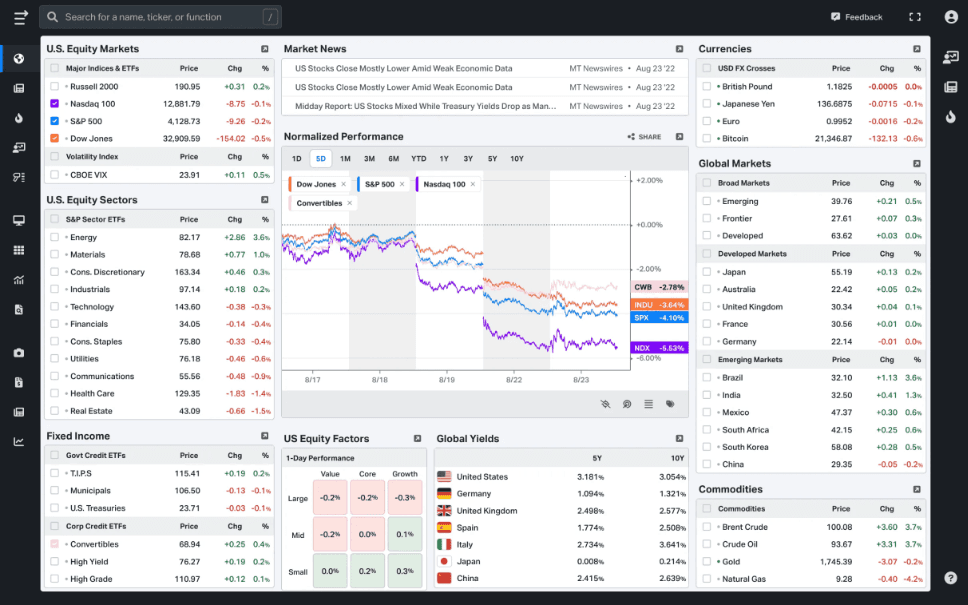
Koyfin is a financial analytics software for investment professionals who need to research equities, track macro trends, and build custom dashboards in one place. I'd consider it most seriously if you want the market data depth of a Bloomberg Terminal without the enterprise price tag. Koyfin gives you charting, screening, and portfolio analytics that rival what Bloomberg offers, but at a cost that's actually accessible to smaller teams, independent analysts, and buy-side professionals who can't justify a six-figure subscription.
Koyfin Evaluation Summary
4.8/5
- From $39/month (billed annually)
- Free plan available
Why Trust Our Software Recommendations
6,700+
Reviews
20
Industry experts
16+
Evaluation factors
14
Years
Our team has been testing and reviewing software since 2012. As finance leaders ourselves, we know how difficult—and important—it is to choose the right software.
For this guide, we evaluated tools using hands-on testing and independent research, scoring tools using our selection criteria.
Our reviews reflect our human editorial judgment, not a sales pitch.
Koyfin Overview
In my opinion, Koyfin is a solid choice for financial analysts and investment teams seeking detailed market data, valuation tools, and analytics. The platform excels with its advanced charting, graphing, and extensive data coverage across the global market, making it a top contender for those who value in-depth market research and analysis. While its interface offers an enhanced user experience, onboarding can be smoother, especially for those new to financial data tools. Compared to alternatives such as Bloomberg Terminal, Koyfin offers competitive pricing, though its customer support can be more responsive. It's best suited for teams that need robust data visualization without the hefty price tag of more established Wall Street platforms.
Pros
- You get advanced charting tools and financial metrics for intensive data analysis.
- Your team can access extensive live market data and up-to-date market news.
- It's user-friendly, making navigation easy for your work.
Cons
- You may find the onboarding process less intuitive for beginners.
- Your access to customer support can be more responsive.
- It offers limited coverage of U.S. mutual funds for basic users.
Is Koyfin Right For Your Needs?
Who Would be a Good Fit for Koyfin?
Koyfin is ideal for financial analysts and investment teams who need detailed market insights and flexible custom dashboards. If your team values advanced charting and real-time data, Koyfin's functionalities will support your analysis needs. Its accessible interface makes it easier for experienced analysts to navigate customizable dashboards and custom watchlists. For example, investment firms benefit from its extensive data coverage, helping you make informed decisions.
- Investment FirmsYour firm will benefit from Koyfin's live market data, stock screener, and advanced analytics for better investment strategies.
- Hedge FundsKoyfin's detailed charting tools help your team analyze trends and make informed trading decisions.
- Corporate Finance TeamsYour team can leverage real-time data for strategic financial planning and analysis.
- Equity Research AnalystsYou can use Koyfin's in-depth data visualization to support your research reports.
- Portfolio ManagersKoyfin offers tools to track and analyze portfolios, aiding your decision-making process.
- Financial AdvisorsYou can provide clients with detailed market insights using Koyfin's comprehensive data.
Who Would be a Bad Fit for Koyfin?
Koyfin isn't the best choice for beginners or small businesses without dedicated financial teams. If your team lacks experience with financial data tools, Koyfin's advanced features may overwhelm you. Businesses needing detailed U.S. mutual fund data will find it limited, as this functionality is only available in the Pro account. Additionally, if you rely heavily on customer support, Koyfin's response time may not meet your expectations.
- Small StartupsYour team may find Koyfin's advanced features too complex and unnecessary for basic financial tracking.
- Non-Finance DepartmentsKoyfin's specialized tools won't benefit your team if you're outside the financial sector.
- Casual InvestorsYou may not need Koyfin's in-depth data if you're not making frequent investment decisions.
- Educational InstitutionsIf you're teaching basic finance, Koyfin's advanced tools may be overkill for students.
- Retail BusinessesYour focus on sales and inventory doesn't align with Koyfin's financial analysis capabilities.
- Customer Support TeamsKoyfin's tools don't cater to customer service functions, making it irrelevant for your work.
How We Test & Score Tools
We’ve spent years building, refining, and improving our software testing and scoring system. The rubric is designed to capture the nuances of software selection and what makes a tool effective, focusing on critical aspects of the decision-making process.
Below, you can see exactly how our testing and scoring works across seven criteria. It allows us to provide an unbiased evaluation of the software based on core functionality, standout features, ease of use, onboarding, customer support, integrations, customer reviews, and value for money.
Core Functionality (25% of final scoring)
The starting point of our evaluation is always the core functionality of the tool. Does it have the basic features and functions that a user would expect to see? Are any of those core features locked to higher-tiered pricing plans? At its core, we expect a tool to stand up against the baseline capabilities of its competitors.
Standout Features (25% of final scoring)
Next, we evaluate uncommon standout features that go above and beyond the core functionality typically found in tools of its kind. A high score reflects specialized or unique features that make the product faster, more efficient, or offer additional value to the user.
We also evaluate how easy it is to integrate with other tools typically found in the tech stack to expand the functionality and utility of the software. Tools offering plentiful native integrations, 3rd party connections, and API access to build custom integrations score best.
Ease of Use (10% of final scoring)
We consider how quick and easy it is to execute the tasks defined in the core functionality using the tool. High scoring software is well designed, intuitive to use, offers mobile apps, provides templates, and makes relatively complex tasks seem simple.
Onboarding (10% of final scoring)
We know how important rapid team adoption is for a new platform, so we evaluate how easy it is to learn and use a tool with minimal training. We evaluate how quickly a team member can get set up and start using the tool with no experience. High scoring solutions indicate little or no support is required.
Customer Support (10% of final scoring)
We review how quick and easy it is to get unstuck and find help by phone, live chat, or knowledge base. Tools and companies that provide real-time support score best, while chatbots score worst.
Customer Reviews (10% of final scoring)
Beyond our own testing and evaluation, we consider the net promoter score from current and past customers. We review their likelihood, given the option, to choose the tool again for the core functionality. A high scoring software reflects a high net promoter score from current or past customers.
Value for Money (10% of final scoring)
Lastly, in consideration of all the other criteria, we review the average price of entry level plans against the core features and consider the value of the other evaluation criteria. Software that delivers more, for less, will score higher.
Core Features
Advanced Charting Tools: You can create detailed and customizable charts to visualize financial data effectively. These tools help your team analyze trends and make informed decisions.
Real-Time Market Data: Access up-to-the-minute data to keep your analysis current. This feature ensures your decisions are based on the latest market conditions.
Customizable Watchlists: You can track specific stocks or financial instruments with ease. This lets you monitor market movements that matter most to your work.
Financial Statement Analysis: Dive deep into company financials to understand performance indicators. Your team can use this functionality to thoroughly evaluate investment opportunities.
Macro Dashboards: Get a comprehensive view of economic indicators and market trends. This helps you stay informed about global financial movements.
Portfolio Management: Manage and analyze your investment portfolios efficiently. This tool provides insights into asset allocation and performance.
Ease of Use
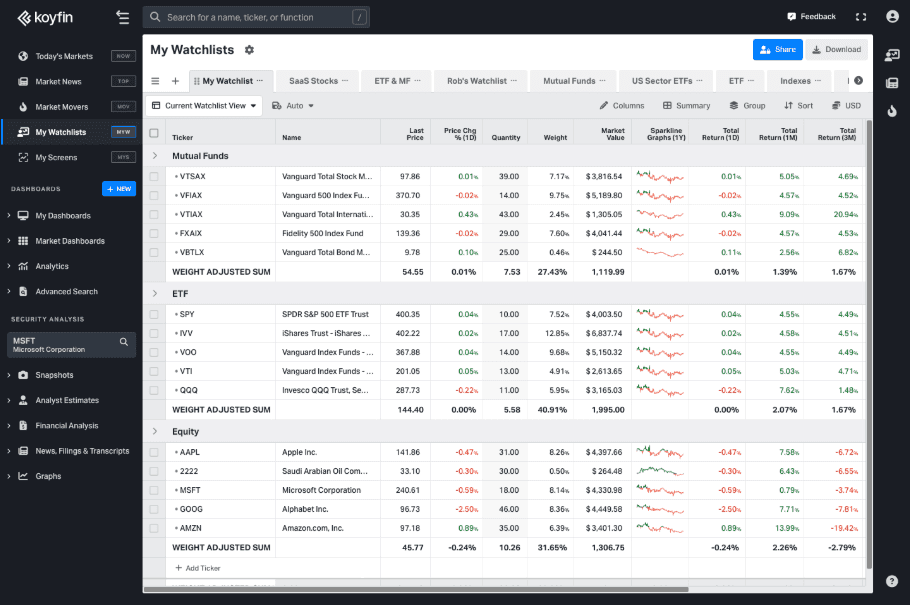
Koyfin is generally user-friendly, with an intuitive interface that makes navigation easy for experienced analysts. You can quickly access tools such as advanced charting and customizable watchlists, which streamline your workflow. However, beginners may face a learning curve due to its complex features. Compared to other software, Koyfin's layout is clean and logical, allowing your team to focus on analysis without unnecessary distractions.
Integrations
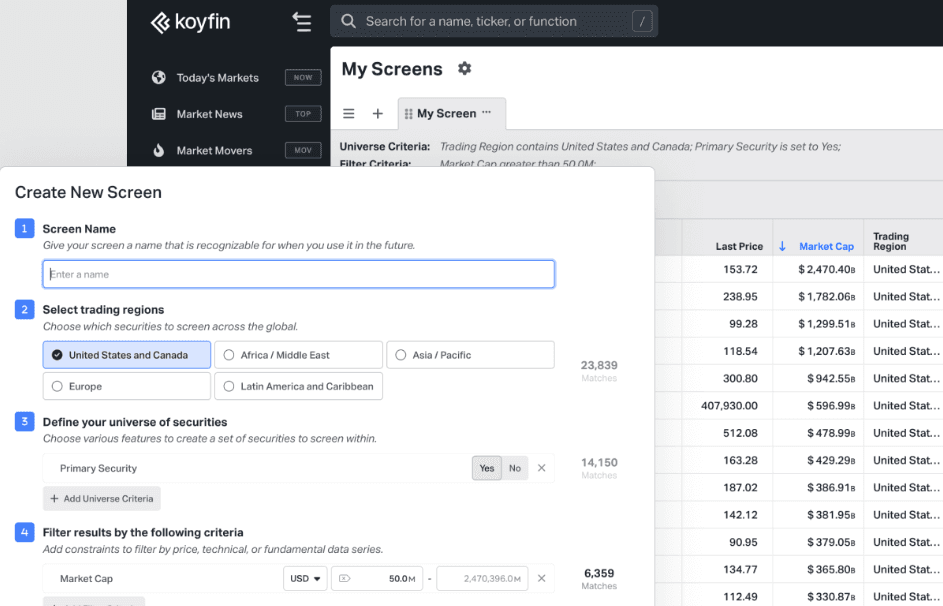
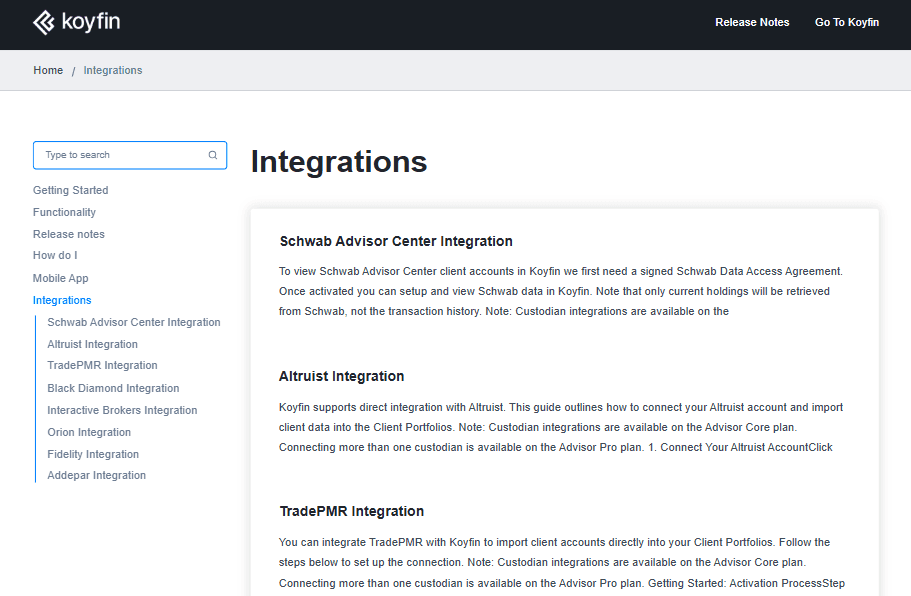
Koyfin integrates with Schwab Advisor Center, Altruist, TradePMR, Black Diamond, Interactive Brokers, and Orion. Koyfin does not offer an API for data access due to restrictions from data providers.
Koyfin Specs
- 2-Factor Authentication: Yes
- Accounts Payable: No
- Accounts Receivable: No
- API: No
- Audit Trail: No
- Balance Sheet: No
- Billing/Invoicing: No
- Budgeting: No
- Calendar Management: No
- Comparative Reporting: Yes
- Compliance Tracking: No
- CRM Integration: No
- Custom Reports: Yes
- Dashboard: No
- Dashboards: Yes
- Data Export: Yes
- Data Import: Yes
- Data Mining: No
- Data Visualization: Yes
- Document Comparison: No
- Expense Tracking: No
- External Integrations: Yes
- Financial Analysis: Yes
- Forecasting: Yes
- General Account Ledger: No
- Multi-Currency: Yes
- Multi-User: Yes
- Notifications: Yes
- P&L: Yes
- Payroll: No
- Process Reporting: No
- Risk Assessment: Yes
- SAP Integration: No
- Scenario Planning: No
- Scheduling: No
- Tax Management: No
- Visualization: No
- Workflow Management: No


