

10 Best Employer of Record Canada in 2026

Best Employer of Record Canada Shortlist


An employer of record Canada is a service that officially employs workers on your behalf so you can hire Canadian talent without setting up your own local entity. If you’re searching for employer of record services in Canada, you’re likely focused on making cross-border hiring compliant and fast while avoiding regulatory risks. I understand you need to compare the best providers side by side—seeing who handles payroll, benefits, and onboarding—so you can choose the right fit with total confidence. Below, you’ll find a shortlist of top employer of record services for Canada so you can expand your team while staying compliant and in control.
Why Trust Our Software Recommendations
Our team has been testing and reviewing software since 2012. As finance leaders ourselves, we know how difficult—and important—it is to choose the right software.
For this guide, we evaluated tools using hands-on testing and independent research, scoring tools using our selection criteria.
Our reviews reflect our human editorial judgment, not a sales pitch.
Employer of Record Canada Comparison Table
This comparison table summarizes pricing details for my top employer of record Canada selections:
| Tool | Best For | Trial Info | Price | ||
|---|---|---|---|---|---|
| 1 | Best for $1M indemnification-backed EOR | Free demo available | From $399/employee/month | Website | |
| 2 | Best for automating payroll compliance | Free demo available | From $599/employee/month | Website | |
| 3 | Best for managing statutory benefits | Free demo available | Pricing upon request | Website | |
| 4 | Best for instant contract and benefit setup | Free demo available | From $459/user/month (billed annually) | Website | |
| 5 | Best for Quebec-compliant contract management | Free demo available | From $399/employee/month | Website | |
| 6 | Best for full provincial employment law coverage | Free demo available | From $699/user/month | Website | |
| 7 | Best for multi-country payroll from one platform | Free demo available | From $499/user/month | Website | |
| 8 | Best for local HR experts and regulatory updates | Free demo available | From $599/user/month | Website | |
| 9 | Best for fast global hiring with local entities | Free demo available | From $699/employee/month | Website | |
| 10 | Best for expert local support in all provinces | Free demo available | From $599/employee/month | Website |


Best Employer of Record Canada Reviews
Below are my detailed summaries of the best employer of record Canada options that made it onto my shortlist. My reviews offer a detailed look at the features, pricing, and compliance capabilities of each platform to help you find the best one for you.

Best for $1M indemnification-backed EOR
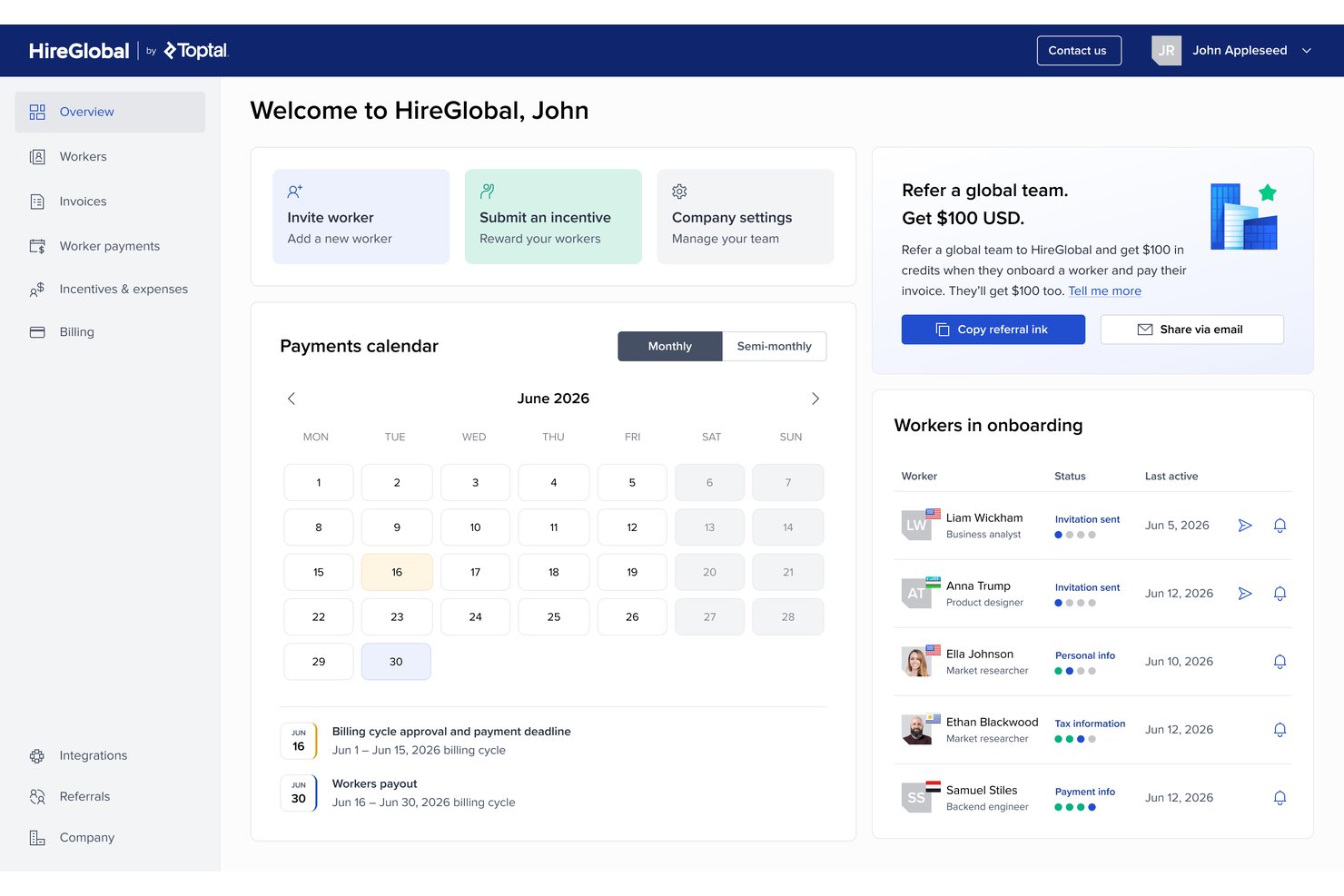
HireGlobal is a multi-model global workforce platform by Toptal that covers contractor management, agent of record, virtual employer of record, and full EOR services across 180+ countries, including Canada.
Who Is HireGlobal Best For?
HireGlobal suits CFOs and finance leaders at SMBs who need predictable per-worker EOR costs and want meaningful misclassification liability coverage built into the price.
Why I Picked HireGlobal
I've included HireGlobal in my top picks because its $1M indemnification-backed V-EOR model is the kind of liability coverage that actually moves the needle for CFOs converting Canadian contractors to employees. If CRA challenges a worker's classification, HireGlobal's in-house team of 40+ lawyers steps in with legal defence support, and that indemnification covers the exposure. I also like that it consolidates all worker types (contractor, AOR, V-EOR, and full EOR) into a single invoice with full payroll visibility, which keeps Canadian headcount costs clean and auditable.
HireGlobal Key Features
- Multi-model workforce platform: Manage contractors, AOR, V-EOR, and full EOR workers across 180+ countries from a single platform with one consolidated invoice.
- CRA-aligned payroll processing: Handles CPP matched contributions, EI remittances, and federal and provincial income tax deductions on bi-weekly or semi-monthly pay cycles.
- T4 filing management: Generates and submits annual T4 slips as part of the EOR service, keeping Canadian tax documentation compliant with CRA requirements.
- Worker misclassification risk assessment: Applies CRA's worker classification tests—control, integration, financial dependence, and tools—to evaluate contractor-to-employee conversion decisions.
HireGlobal Integrations
HireGlobal has a native TopTracker integration and an integration with Google Apps. It offers API access for custom integrations, while Stripe handles payment processing; no specific accounting or HRIS integrations are documented.
Pros and Cons
Pros:
- Multi-model platform covers all worker types
- Single-invoice structure simplifies payroll audits
- $1M indemnification for misclassification liability
Cons:
- Uses partner network for Canada legal entity
- Quebec compliance documentation is not available

Best for automating payroll compliance
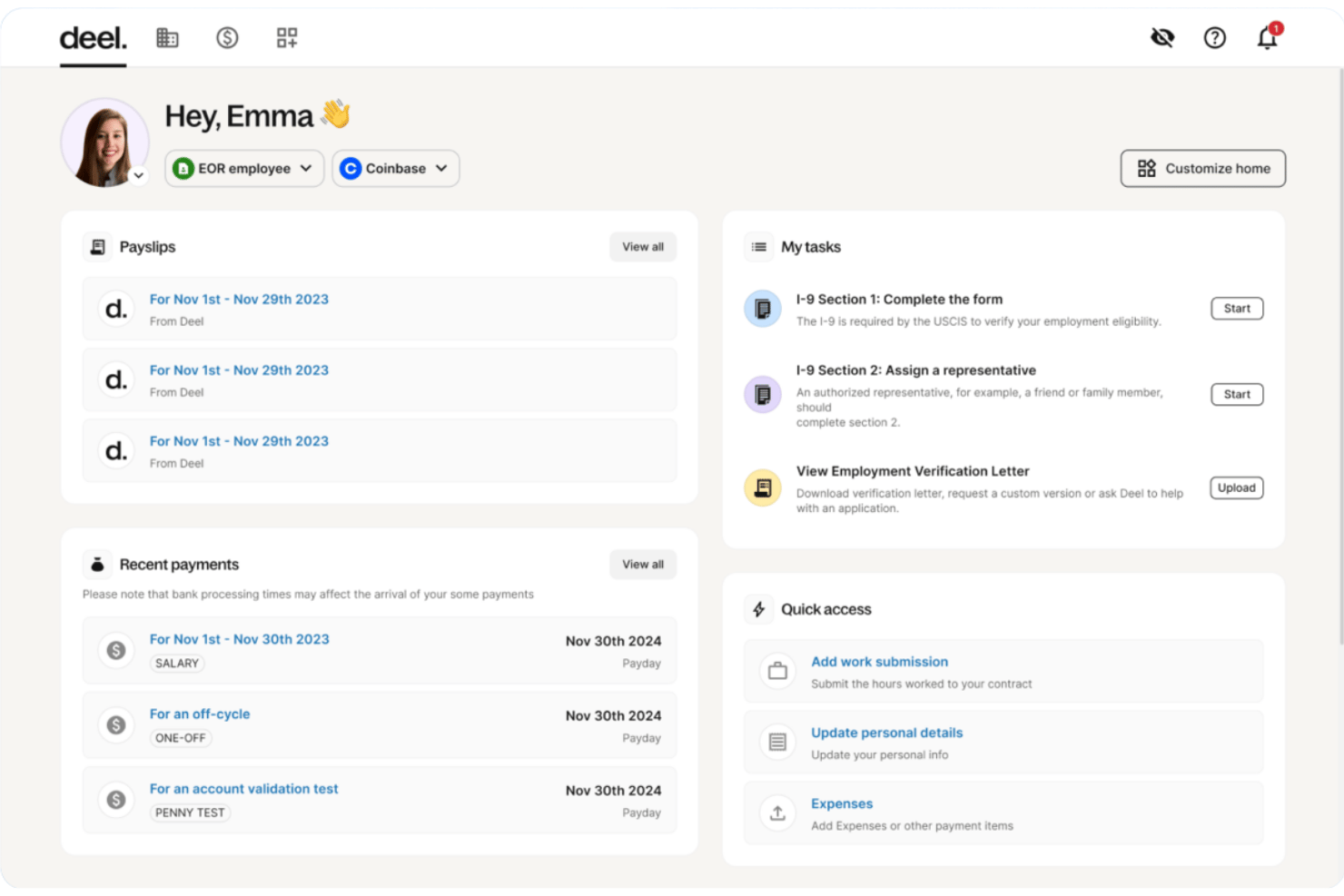
Deel Hire is an employer of record platform with a wholly-owned Canadian entity that handles employment contracts, payroll processing, statutory benefits administration, and provincial tax compliance across all Canadian provinces including Québec.
Who Is Deel Hire Best For?
Deel Hire fits CFOs and payroll managers at SMBs and mid-market firms hiring Canadian employees without the overhead of setting up a local entity.
Why I Picked Deel Hire
I picked Deel Hire as one of the best because its payroll compliance automation goes deeper than most EOR platforms I've reviewed. The Compliance Hub monitors Canadian regulatory changes in real time and automatically updates payroll calculations, so CPP, EI, and provincial deductions stay current without manual intervention. I also like that Québec's separate tax system, including Revenu Québec remittances and RL-1 filings, is handled natively rather than treated as an edge case.
Deel Hire Key Features
- Bilingual contract generation: Create bilingual English and French employment agreements that cover province-specific legal requirements.
- Group benefits integration: Offer Manulife health benefits and Wealthsimple pension options managed inside Deel's platform.
- Real-time compliance hub: Monitor legal changes across all Canadian provinces with instant alerts and document templates.
- CRA and Revenu Québec remittance: Automate tax payment workflows including T4, T4A, RL-1, and ROE form generation and filing.
Deel Hire Integrations
Deel Hire offers native integrations with QuickBooks, Xero, NetSuite, Sage Intacct, BambooHR, Workday, HiBob, Personio, Greenhouse, and Ashby. An open API is available for custom integrations.
Pros and Cons
Pros:
- Automated CPP, EI, and provincial tax deductions
- Native Québec payroll including Revenu Québec filing
- Wholly-owned Canadian entity across all provinces
Cons:
- Onboarding can take longer than competitors
- Support response times slow at lower tiers

Best for managing statutory benefits
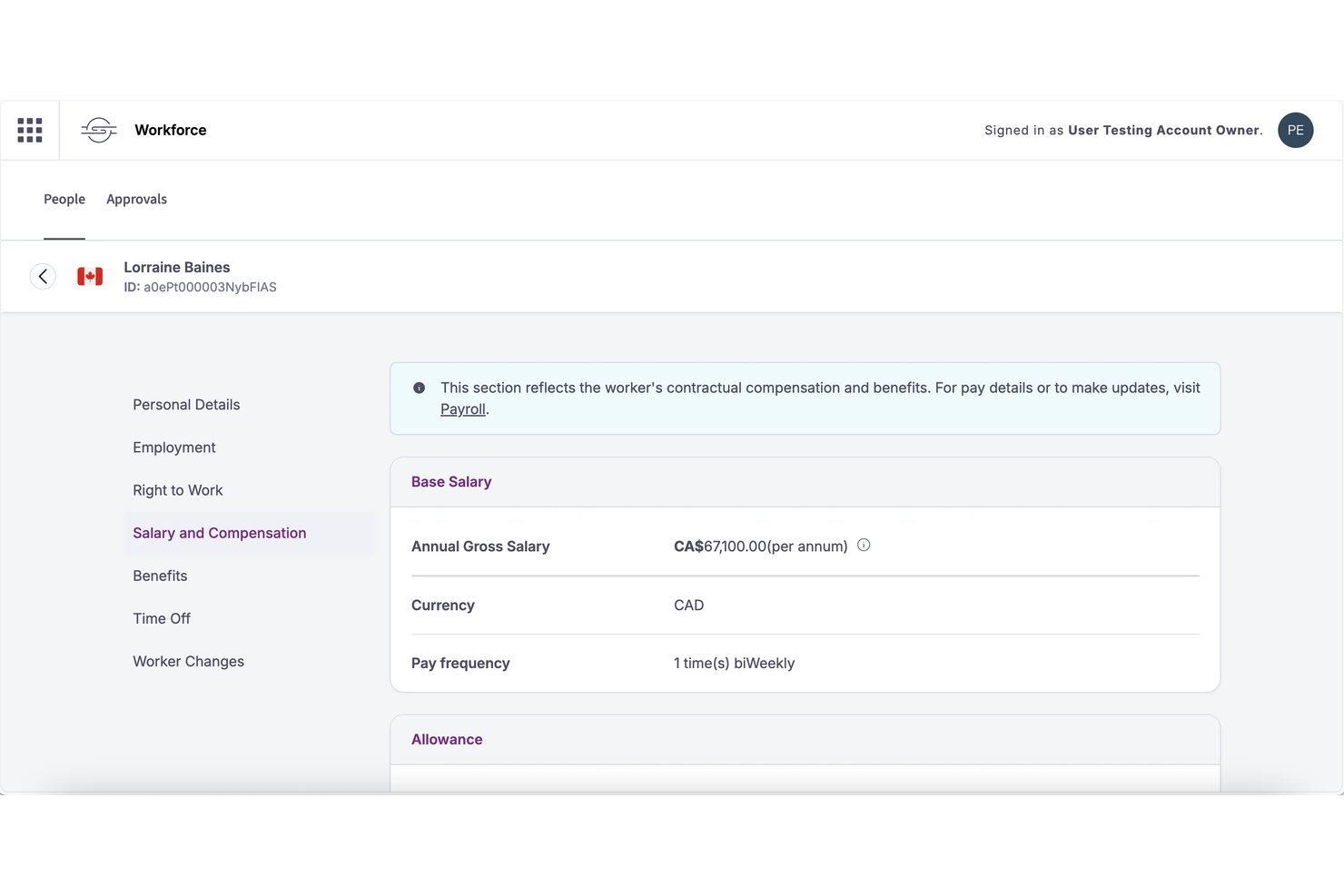
Safeguard Global is a global EOR platform that handles Canadian employee onboarding, payroll processing, statutory benefits administration, and tax compliance without requiring you to set up a local legal entity.
Who Is Safeguard Global Best For?
Safeguard Global is a strong fit for mid-market finance teams that prioritize compliance depth over speed when hiring across Canadian provinces.
Why I Picked Safeguard Global
Safeguard Global earns its spot on my shortlist because of how thoroughly it handles Canadian statutory obligations. I like that CPP, EI, WCB, and provincial health premiums are all administered as part of the core EOR service, not treated as add-ons. In practice, my team gets a dedicated local HR representative in Canada who manages remittances directly and keeps pace with province-level regulatory changes.
Safeguard Global Key Features
- Time and expense tracking: Employees can record work hours and upload receipts directly through a mobile app.
- Intelligent workforce analytics: Get visibility into global workforce costs, taxes, and contract types across all regions.
- Centralized invoice repository: Access and filter invoices by country, date, or project from a single dashboard.
- Integrated Workday bi-directional connector: Sync Safeguard Global data with Workday for streamlined HR and payroll coordination.
Safeguard Global Integrations
Safeguard Global offers a certified native integration with Workday and supports integrations with most HRIS, ERP, and accounting systems. An API is available for custom integrations.
Pros and Cons
Pros:
- Long-standing Canadian compliance track record
- Deep statutory benefits administration across provinces
- Dedicated in-country Canadian HR representative assigned
Cons:
- Québec-specific filings lack clear documentation
- Entity ownership in Canada not disclosed

Best for instant contract and benefit setup
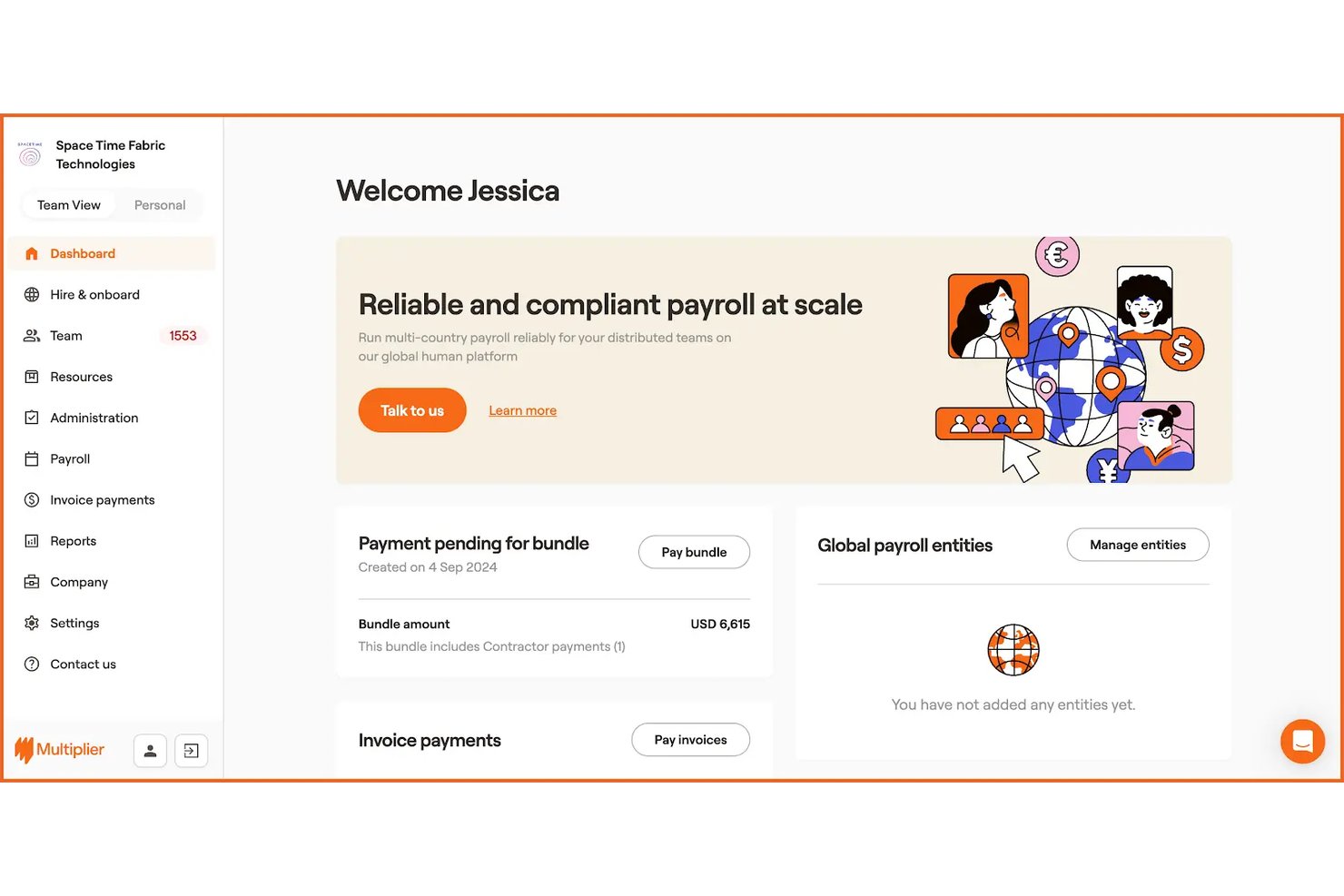
Multiplier is an employer of record platform with owned Canadian entities across all provinces and territories, handling local payroll in CAD, statutory benefits administration, and province-specific employment contracts including Québec bilingual requirements.
Who Is Multiplier Best For?
Multiplier suits SMBs and fast-growing companies hiring their first Canadian employees without the cost or complexity of incorporating a local entity.
Why I Picked Multiplier
I picked Multiplier as one of the best because the contract and onboarding setup genuinely takes 24-72 hours. The platform generates province-specific employment agreements, including French-language contracts for Québec hires, and immediately ties in benefits and insurance administration. I like that Multiplier runs through its own Canadian entity, so there's no third-party coordination slowing things down when a new hire needs to be up and running fast.
Multiplier Key Features
- Owned Canadian legal entities: Multiplier directly employs staff across all provinces and territories without local third-party partners.
- Automated CRA and Revenu Québec tax remittance: Payroll runs in CAD with required federal and provincial deductions handled end-to-end.
- Quebec labor law and French contract support: The platform accommodates French-language requirements and unique provincial rules for Québec hires.
- Worker classification and contractor conversion tools: Built-in workflows help assess and convert contractors to employees in line with Canadian legal risk standards.
Multiplier Integrations
Multiplier offers native integrations with Workday, BambooHR, HiBob, Personio, and more, and provides an API for custom integrations.
Pros and Cons
Pros:
- Competitive group health and dental plans available
- French-language Québec contracts generated automatically
- All 13 provinces and territories covered
Cons:
- Contract amendments require support involvement
- RRSP administration not clearly documented

Pebl
Best for Quebec-compliant contract management
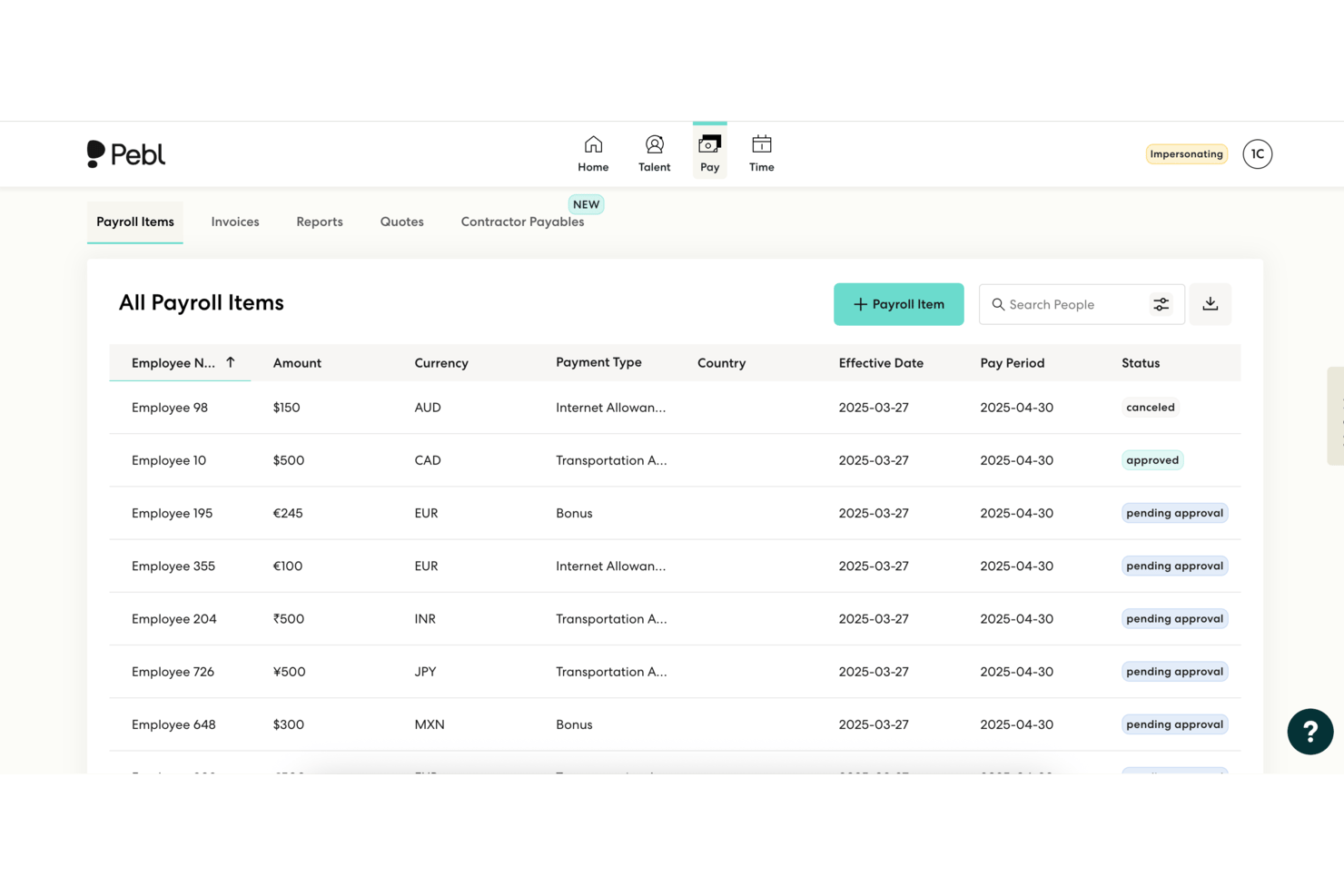
Pebl is an employer of record platform with owned legal entities across 185+ countries, handling Canadian employment contracts, provincial payroll, statutory benefits, and tax filing including Québec-specific compliance.
Who Is Pebl Best For?
Pebl suits mid-market and enterprise finance teams hiring across multiple Canadian provinces, especially those navigating Québec's distinct labor and language requirements.
Why I Picked Pebl
Pebl earns its spot on my shortlist because its contract generation for Québec goes beyond a translated template. The platform produces legally reviewed, French-language employment agreements that address Bill 96 requirements, provincial notice periods, and CNESST-specific leave provisions. I also like that Pebl's Baker McKenzie-backed legal infrastructure keeps those contracts current as Québec's labor rules evolve, which matters when a stale clause can trigger a wrongful termination claim.
Pebl Key Features
- Automated Canadian payroll processing: Runs payroll in CAD and handles all federal, provincial, and Revenu Québec remittances.
- In-market statutory benefits administration: Manages CPP, EI, QPP, WCB, and provincial health premiums directly from the platform.
- Local tax documentation generation and filing: Produces and files T4, T4A, RL-1, and ROE tax forms for Canadian employees.
- MIS classification risk assessment workflow: Guides teams through contractor-to-employee conversion and compliance checks for CRA regulations.
Pebl Integrations
Pebl offers native integrations with Greenhouse, JazzHR, Workable, Ashby, Lever, HiBob, BambooHR, Namely, Oracle HCM, and Workday. Bi-directional sync is supported with BambooHR.
Pros and Cons
Pros:
- Covers all 13 Canadian provinces and territories
- Baker McKenzie legal backing ensures contract currency
- Québec French contract generation built in natively
Cons:
- Canadian owned-entity status not publicly confirmed
- Québec-specific payroll automation not fully disclosed

Remote
Best for full provincial employment law coverage
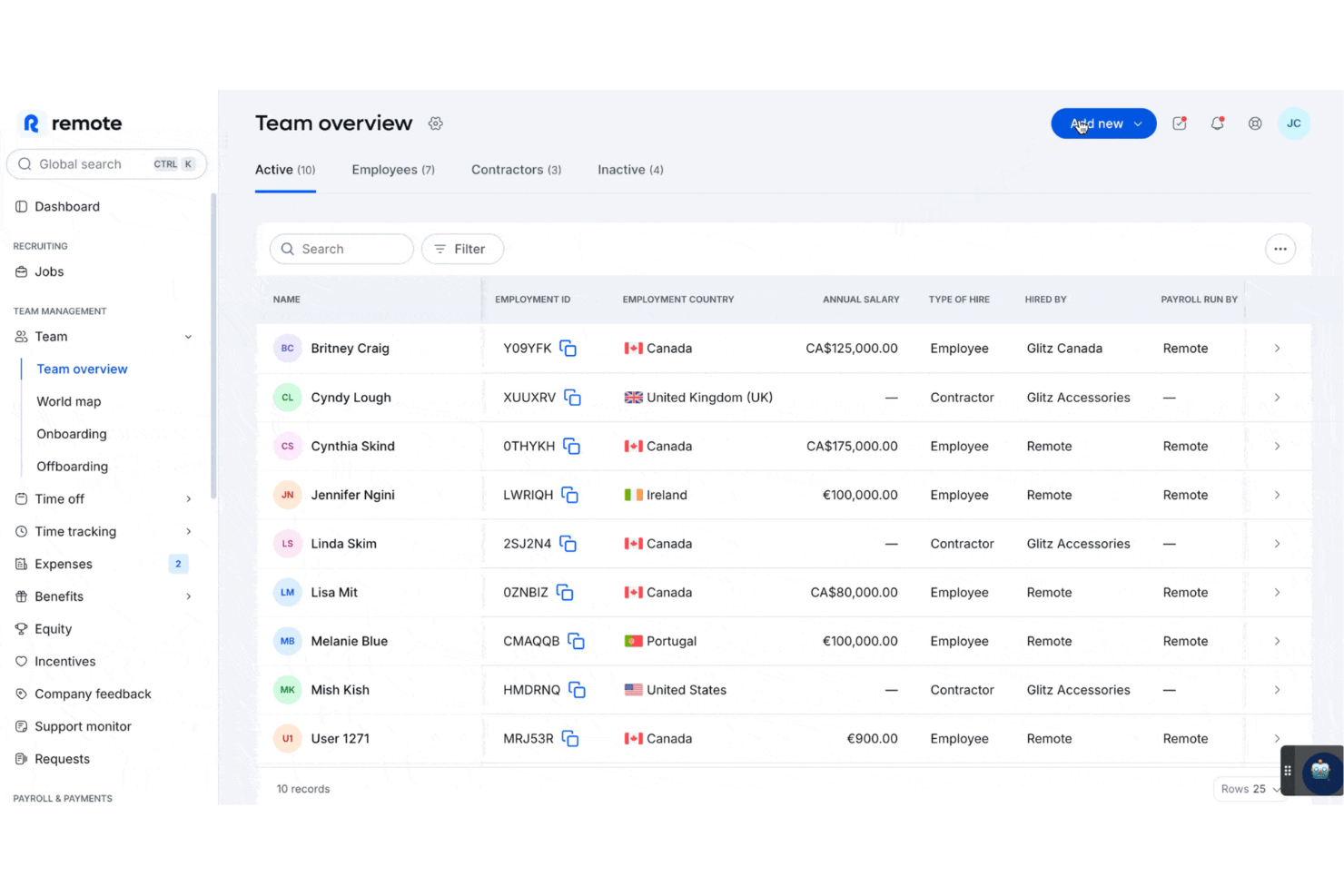
Remote is an employer of record platform with a fully owned Canadian legal entity that handles provincial payroll, CRA tax filings, statutory benefits administration, and localized employment contracts across all Canadian provinces and territories.
Who Is Remote Best For?
Remote is a strong fit for SMBs and scaling companies that need to hire across multiple Canadian provinces without setting up a local legal entity.
Why I Picked Remote
I picked Remote as one of the best because it owns its Canadian legal entity outright, meaning there's no partner network sitting between Remote and CRA compliance obligations. What I find most valuable is the Compliance Watchtower, which monitors and flags regulatory changes at the provincial level automatically. When British Columbia updates its termination notice requirements or Alberta adjusts its minimum wage, Remote catches it before it becomes a payroll problem.
Remote Key Features
- Direct Canadian payroll engine: Processes payroll in CAD with automated CRA and Revenu Québec remittances.
- Employment contract localization: Generates compliant contracts tailored for each province, including French-language agreements for Québec.
- Integrated tax form generation: Issues T4, T4A, RL-1, and ROE forms as part of regular payroll cycles.
- Canadian benefits administration: Manages mandatory benefits like CPP, EI, WCB, and provincial health premiums for all provinces.
Remote Integrations
Remote offers native integrations with Workday, HiBob, BambooHR, Personio, QuickBooks, NetSuite, Gusto, Greenhouse, Slack, and more. It also connects with Zapier and provides an API for custom integrations.
Pros and Cons
Pros:
- Compliance Watchtower monitors provincial law changes
- Covers all 13 provinces and territories
- Owns its Canadian legal entity outright
Cons:
- Limited support for complex unionized workforces
- Limited flexibility for custom employment terms in Canada

Best for multi-country payroll from one platform
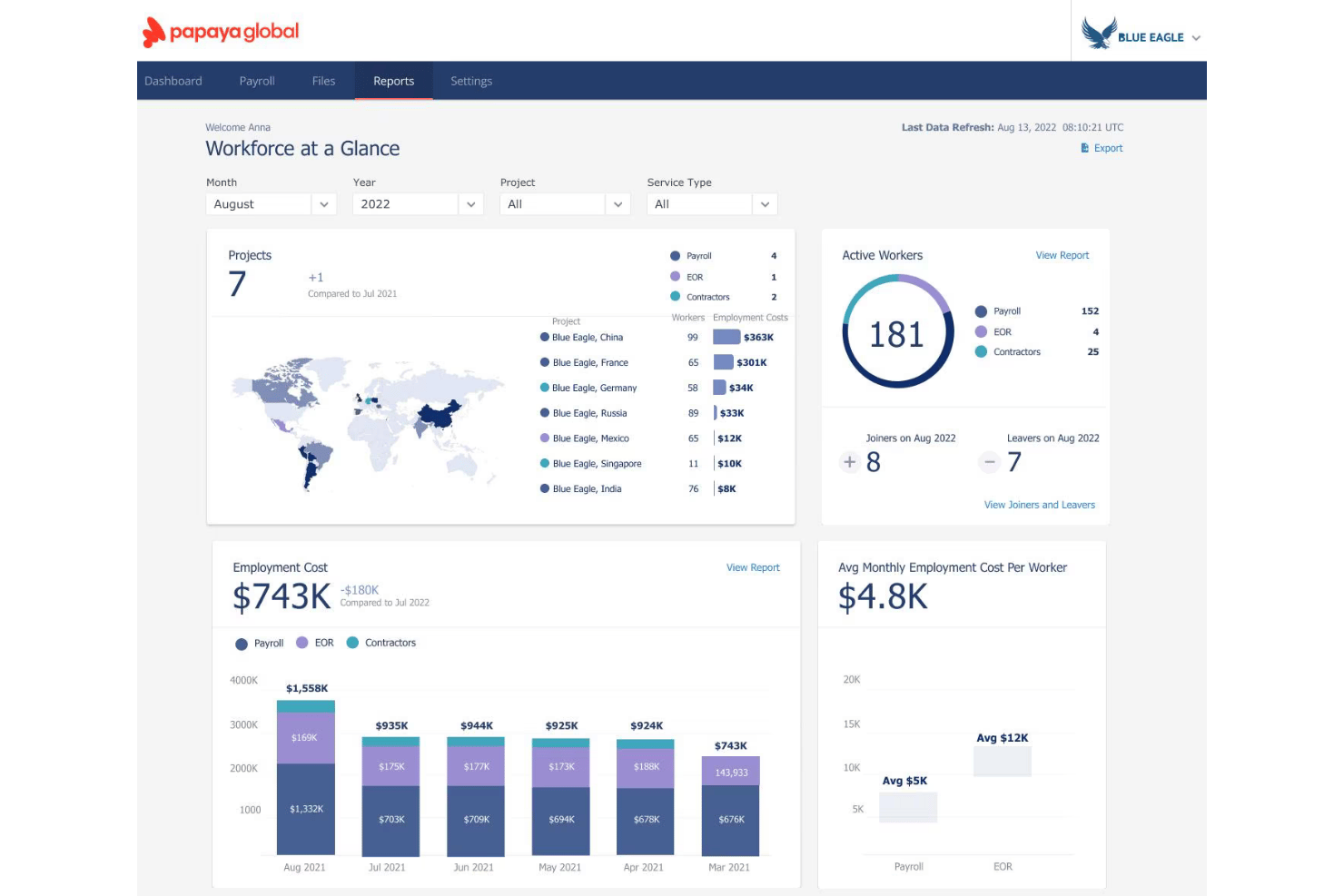
Papaya Global is a workforce management platform that combines employer of record services, multi-country payroll processing, contractor management, and international payments across 160+ countries from a single system.
Who Is Papaya Global Best For?
Papaya Global is a strong fit for mid-market and enterprise finance teams managing payroll across multiple countries from a single platform.
Why I Picked Papaya Global
I picked Papaya Global as one of the best because it runs Canadian EOR alongside 160+ other countries through a single platform, eliminating the fragmentation of managing separate vendors per region. I particularly like how Papaya's native payment rails (OnePay) handle CAD transfers and CRA remittances without third-party processors. The built-in analytics layer (OneData) lets my team track payroll spend across Canada and other active markets in one dashboard.
Papaya Global Key Features
- Auto-generated Canadian employment contracts: Create province-specific, locally compliant agreements, including templates for French-speaking employees in Quebec.
- Automated statutory benefits administration: Manage and remit CPP, EI, WCB, QPIP, and provincial health premiums for all provinces and territories.
- Tax documentation and filing engine: Generate and file T4, T4A, RL-1, and ROE forms in compliance with CRA and Revenu Québec requirements.
- PIPEDA and SOC 2 certified data security: Maintain employee data privacy and enable Canadian data residency for regulated industries.
Papaya Global Integrations
Papaya Global offers native integrations with Workday, NetSuite, SAP SuccessFactors, and BambooHR, plus provides an API for custom integrations.
Pros and Cons
Pros:
- Full coverage across all 13 provinces
- Automated CRA remittances and T4 filing
- Covers payroll across 160+ countries simultaneously
Cons:
- Québec-specific RL-1 filing not clearly documented
- Canadian EOR relies on partner entities

Best for local HR experts and regulatory updates
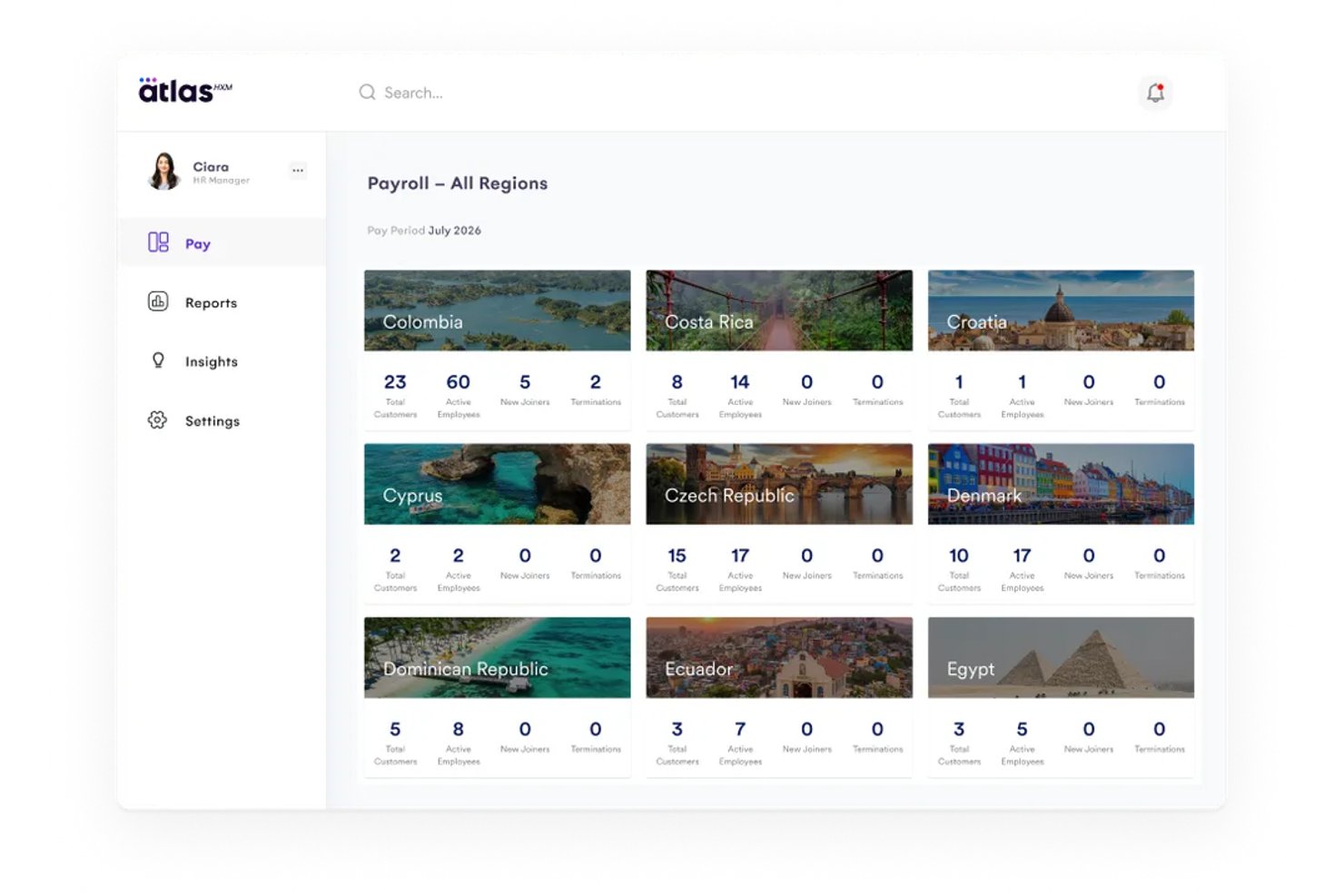
Atlas HXM is a direct-entity employer of record platform that manages Canadian and global hiring, payroll, statutory benefits, and employment contracts through its own owned legal entities rather than third-party partners.
Who Is Atlas HXM Best For?
Atlas HXM is a strong fit for mid-market and enterprise companies whose legal and finance teams require a direct-entity EOR with no third-party intermediaries.
Why I Picked Atlas HXM
Atlas HXM earns its spot on my shortlist because of how granular its Canadian regulatory coverage actually is. I'm talking province-specific probationary periods and minimum wages tracked across all provinces (CAD 15.00–19.75/hour). Quebec's QPIP paternity leave is handled separately from federal EI, which is exactly the kind of detail that prevents costly compliance errors. What I find most valuable is that Atlas backs all of this with in-country HR experts, not just a self-serve knowledge base.
Atlas HXM Key Features
- Direct Canadian entity infrastructure: Atlas employs Canadian workers through its own legal entity without relying on third-party partners.
- Automated provincial tax calculations: The platform calculates federal and provincial payroll deductions for all Canadian regions, including Quebec and Atlantic provinces.
- Local employment contract generation: Generate province-specific, bilingual employment agreements tailored to Canadian labor standards and French-language requirements.
- Native CRA and Revenu Québec filing: Atlas creates and files essential tax forms like T4/T4A, RL-1, and ROE directly with Canadian authorities.
Atlas HXM Integrations
Native integrations are not clearly documented. The tool supports integrations via API for custom setup.
Pros and Cons
Pros:
- Covers Quebec's distinct labor rules and QPIP natively
- Owns legal entities across Canadian provinces directly
- Dedicated HR consultant assigned per Canadian employee
Cons:
- Contractor management relies on external partners
- Premium pricing limits access for smaller Canadian hiring needs

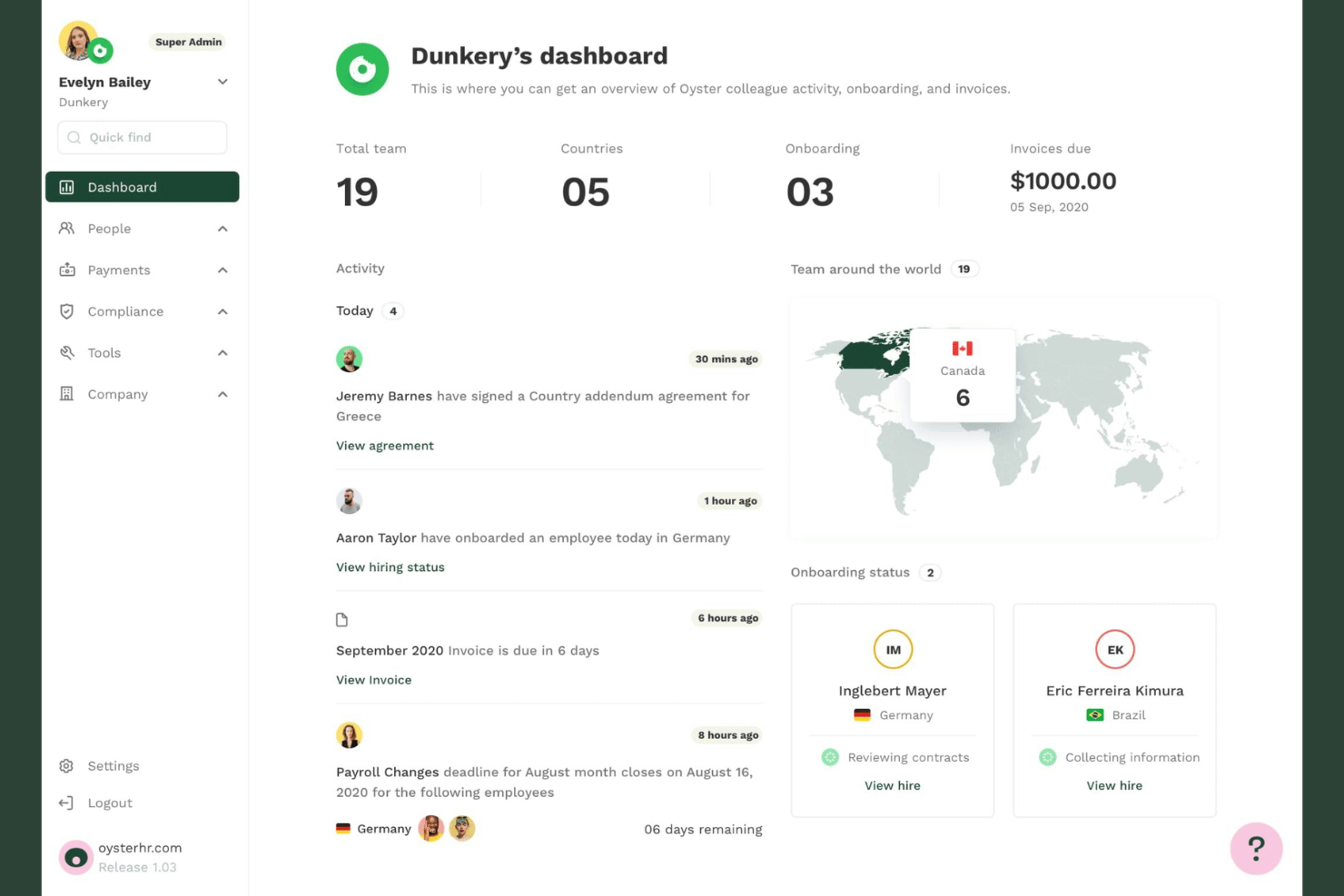
Oyster HR is a global EOR platform that lets companies hire, pay, and manage full-time employees across 180+ countries—including Canada—without setting up a local legal entity, handling contracts, payroll, statutory benefits, and tax compliance in one place.
Who Is Oyster Best For?
Oyster is a strong fit for SMBs and scaling companies that need to hire in Canada quickly, without the time or cost of setting up a local legal entity.
Why I Picked Oyster
I picked Oyster as one of the best because it owns legal entities directly in Canada, including Québec, which means I'm not relying on an undisclosed partner network when my team needs to hire there. That entity ownership is what makes 48-hour onboarding timelines realistic. I also like Oyster's contract quality scoring, which automatically benchmarks Canadian employment agreements against local statutory requirements before anything is signed.
Oyster Key Features
- Automated Canadian payroll: Calculate and pay salaries, statutory deductions, and remittances in CAD, covering all provinces and Québec.
- Provincial labor law logic: Built-in compliance with employment standards across provinces, including automatic updates for local law changes.
- T4, T4A, RL-1, and ROE handling: Generate and file required Canadian payroll tax forms and termination documentation for full legal compliance.
- Customizable paid time off policies: Configure vacation, sick, and statutory leave settings based on each province’s requirements.
Oyster Integrations
Oyster offers native integrations with Xero, QuickBooks, NetSuite, SAP Concur, BambooHR, HiBob, Personio, ADP Workforce Now, Factorial, Humaans, Lucca, Greenhouse, Ashby, Workable, TeamTailor, Slack, and Zapier, and provides an API for custom integrations.
Pros and Cons
Pros:
- Onboards Canadian employees in 48 hours
- Covers Québec with French-language contract support
- Owns legal entities directly in Canada
Cons:
- RRSP administration not confirmed as native feature
- Users report occasional payroll payment delays

G-P
Best for expert local support in all provinces
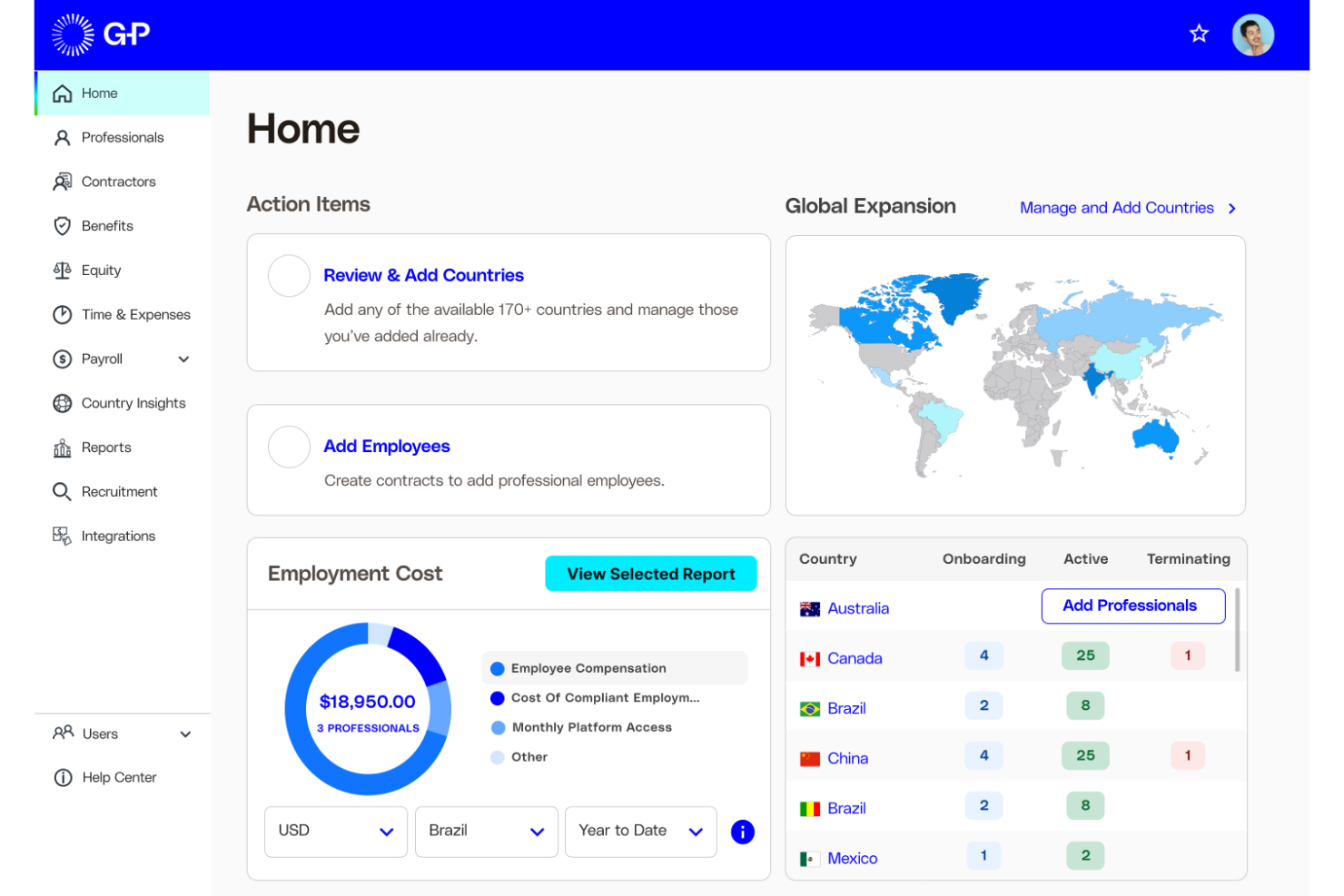
G-P is a global employer of record platform that handles compliant hiring, payroll processing, benefits administration, and employment contracts across 180+ countries, including all Canadian provinces and territories through 100% owned entities.
Who Is G-P Best For?
G-P is a strong fit for mid-market and enterprise finance teams managing multi-country hiring, where Canadian expansion is part of a broader global workforce strategy.
Why I Picked G-P
G-P earns its spot on my shortlist because it operates through 100% owned Canadian entities across every province, not third-party partner networks, giving you genuine in-country legal accountability. I particularly like that Québec compliance is built in natively: bilingual contracts, Revenue Québec remittances, and just-cause termination rules are all handled without workarounds. Dedicated CSMs with local expertise are what I rely on when provincial termination scenarios get complicated.
G-P Key Features
- Automated onboarding workflows: Create province-compliant onboarding journeys with AI-guided document collection and local right-to-work checks.
- Agentic reporting and analytics: Access real-time, customizable reports for headcount, payroll, and employment cost allocation.
- Equity payroll management: Administer equity and stock option payroll for Canadian employees under statutory rules.
- Data residency and compliance controls: Maintain Canadian employee data in alignment with PIPEDA and Law 25 standards.
G-P Integrations
G-P offers native integrations with NetSuite, QuickBooks, Xero, Workday, BambooHR, Greenhouse, and Okta. An API is available for custom integrations.
Pros and Cons
Pros:
- Contractor-to-employee conversion workflows reduce CRA risk
- Native Québec compliance including French-language contracts
- Owned Canadian entities across all 13 provinces and territories
Cons:
- Recruiting and immigration services cost extra
- Invoice breakdowns lack granularity, complicating payroll cost reporting
Other Employer of Record Canada
Here are some additional employer of record Canada options that didn’t make it onto my shortlist, but are still worth checking out:
- RemoFirst
For quick onboarding of remote teams
- Payoneer Workforce Management
For cross-border currency management
- Rippling
For integrated payroll and HR
- Native Teams
For managing tax-compliant payments
- TopSource
For statutory benefits administration
- Remote People
For direct local entity employment coverage
- Gloroots
For contract generation tailored to local law


How I Evaluate Employer of Record Canada
I evaluate employer of record Canada platforms in two layers: baseline compliance must-haves like T4 filing and CPP remittance, and differentiators like entity ownership and Quebec capability.
Core Functionality (Table Stakes For This List)
When I'm selecting tools for my list, I rank each one on a scale from 0 (does not offer the functionality) to 5 (excels in this area) for each core functionality listed below. Then, I calculate the tool's total score into a percentage. Each tool needs to achieve a minimum total score of 65% to be considered for inclusion.
- Canadian Legal Entity: I check whether the vendor owns its Canadian entity or subcontracts through a partner network, since direct ownership tends to mean clearer liability and faster onboarding.
- Provincial Compliance: Each platform should cover employment standards across provinces and territories, including Quebec's distinct labour code and French-language requirements under Bill 96.
- Canadian Payroll Processing: I look for automated CAD payroll that calculates both federal and provincial deductions and handles CRA remittances, including Quebec's separate tax system through Revenu Québec.
- Statutory Benefits Administration: The vendor should administer CPP/QPP, EI, WCB, and provincial health premiums, and I look for whether it also supports supplemental benefits like group health or RRSP plans.
- Tax Documentation and Filing: I evaluate whether the platform generates and files T4, T4A, RL-1, and ROE forms, plus handles year-end reconciliation and amendments without manual intervention.
- Employment Contracts: Province-specific, legally reviewed contracts matter here. I look for localized templates that account for Quebec's French-language obligations and include IP and non-compete clauses.
Once I have a list of tools that meet the criteria, I consider what sets each platform apart.
Differentiating Factors (What Sets Vendors Apart)
Here's how I compare and contrast different vendors:
Standout Features
Misclassification risk tools are a big differentiator. If you're converting Canadian contractors to full-time employees, I look for built-in assessment workflows that flag CRA reclassification risk before it becomes a liability. Equity and stock option support matters when a US parent company grants cross-border equity to Canadian hires. I want platforms that walk you through CCPC rules and Section 7 tax treatment. I also evaluate group benefits administration—competitive health, dental, and RRSP plans help you attract Canadian talent on par with local employers.
Beyond Features
Entity ownership is a major factor I evaluate. Vendors that own their Canadian legal entity tend to offer faster onboarding and clearer liability than those relying on undisclosed partner networks. Pricing transparency matters too—I check whether a vendor charges a flat per-employee fee or a percentage of salary, and whether FX markups are disclosed for USD-billed clients. Termination support is another area worth close attention, since Canadian common-law reasonable notice often exceeds statutory minimums and can catch foreign employers off guard.
How to Choose Employer of Record Canada
It’s easy to get bogged down in long feature lists and complex pricing structures. To help you stay focused as you work through your unique software selection process, here’s a checklist of factors to keep in mind:
| Factor | What to Consider |
|---|---|
| Scalability | Will the solution support adding employees across multiple provinces and future territory growth? |
| Integrations | Does it connect with your payroll, accounting, or HR systems to reduce manual work and errors? |
| Customizability | Can employment contracts, benefits, and reporting be tailored to fit your company’s policies? |
| Ease of use | How quickly can your team master the platform? Is routine onboarding and payroll actually simple? |
| Implementation and onboarding | What is the timeline from signature to first payroll? Are onboarding tasks clear and well-supported? |
| Cost | Beyond monthly fees, are there extra charges for off-cycle pay, terminations, or currency exchange? |
| Security safeguards | Are data residency, privacy laws, and security certifications like SOC 2 or ISO 27001 addressed? |
| Compliance requirements | Can the provider prove compliance with CRA, Revenu Québec, and all provincial employment laws? |
What Is Employer of Record Canada?
Employer of record Canada is an EOR solution that acts as the legal employer for your Canadian staff, handling global payroll, taxes, employee benefits, and compliance with Canadian employment laws and local labor laws. Many of the best global payroll service providers also offer employer of record services, allowing businesses to manage international hiring and payroll through a single platform. You simply manage day-to-day responsibilities while the provider manages onboarding, statutory deductions, terminations, and documentation in line with federal and provincial regulations. This makes it possible to onboard employees in Canada without setting up your own business entity.
Why Use an Employer of Record in Canada?
An Employer of Record (EOR) allows businesses to hire employees in Canada without establishing a local legal entity. For many organizations, this provides a faster and lower-risk way to build a global team, hire remote workers, independent contractors, or new employees, while outsourcing payroll, employment contracts, tax withholding, compliance, and work permits where applicable.
From a financial perspective, an EOR helps convert many of the fixed costs associated with international expansion into a predictable operating expense. Rather than investing in entity setup, local payroll infrastructure, legal support, and ongoing compliance administration, companies can begin hiring while preserving capital and reducing administrative overhead.
This approach is often well suited to businesses validating a new market, supporting project-based hiring, or building a small Canadian team before committing to a permanent legal presence. It also helps companies attract top talent while simplifying global HR operations. As operations grow, finance leaders can compare the ongoing cost of an EOR with the cost of operating a Canadian entity to determine the most cost-effective structure.
Deciding Between an EOR and a Legal Entity in Canada
Whether to use an Employer of Record (EOR) or establish a legal entity depends on your hiring plans, timeline, and long-term business strategy. An EOR is often the better option for companies testing the Canadian market or hiring a small number of employees, while establishing a legal entity may make more sense if you’re building a permanent presence or expect significant workforce growth.
| Aspect | Employer of Record (EOR) | Legal Entity Setup in Canada |
|---|---|---|
Setup timeline | Employees can be hired in days once onboarding is complete. | Entity setup can take several weeks, including registration and banking. |
| Initial investment | No incorporation or setup costs. | Legal, registration, and administrative costs upfront. |
| Ongoing admin | Managed by the EOR, including payroll and filings. | Requires local accounting, payroll, and compliance management. |
| Compliance risk | Lower, with local compliance handled by the EOR. | Higher, with full responsibility on the company. |
| Payroll complexity | EOR handles taxes, benefits, and mandatory contributions. | Must manage payroll rules and deductions internally. |
| Flexibility | Easy to scale or exit the market. | Harder to wind down; entity closure takes time. |
| Control over operations | Limited control over contracts and benefits. | Full control over employment terms and policies. |
| Best fit | Quick hiring, remote teams, or testing the market. | Long-term presence with a larger local workforce. |
Financial Risks to Evaluate Before Choosing an EOR
An EOR can reduce the operational complexity of international hiring, but it also introduces a third party into your payroll and financial processes. Before selecting a provider, evaluate how it will affect cost visibility, financial reporting, compliance, and long-term scalability—not just the monthly service fee.
Some key financial risks to assess include:
- Cost transparency: Look beyond the quoted service fee. Understand how statutory contributions, benefits, foreign exchange, implementation, offboarding, and one-time charges are presented so you can accurately forecast total employment costs.
- Payroll governance: Evaluate the provider’s payroll controls, approval workflows, reconciliation processes, and error resolution procedures. Payroll inaccuracies can affect financial reporting, tax compliance, and employee trust.
- Financial reporting quality: Confirm that payroll reports provide the level of detail needed for budgeting, cost allocation, month-end close, variance analysis, and audit support.
- Foreign exchange exposure: If payroll is funded in another currency, understand how exchange rates are determined, when conversions occur, and whether currency fluctuations could create budget variance.
- Vendor dependency: Assess how easily payroll data, employee records, and historical reports can be exported if you transition to another provider or establish a Canadian entity.
- Scalability and cost structure: Consider how pricing changes as headcount grows. A provider that’s cost-effective for a small team may become less economical as your Canadian operations expand.
How an EOR Affects Financial Operations
An EOR doesn’t just manage employment—it also becomes part of your finance workflow. Before choosing a provider, consider how it supports the financial processes your team relies on every month.
| Finance Function | How an EOR Impacts It |
|---|---|
| Budgeting | Supports workforce cost forecasting with predictable payroll data. |
| Payroll Accounting | Provides payroll details for journal entries and cost allocations. |
| Month-End Close | Timely payroll reports help reduce reconciliation work. |
| Financial Reporting | Gives finance teams access to payroll and statutory cost data. |
| Audit | Maintains documentation to support payroll and compliance reviews. |
| Cash Management | Improves visibility into payroll funding schedules and payment timing. |
Questions Finance Leaders Should Ask Before Signing an EOR Agreement
Choosing an EOR is also a financial decision. Use this checklist to evaluate whether a provider offers the cost visibility, financial controls, and reporting capabilities your finance team needs.
| ✓ | Question | Why It Matters |
|---|---|---|
| ✓ | How are payroll costs broken down on invoices? | Improves cost allocation, budgeting, and financial transparency. |
| ✓ | What payroll and financial reports are available? | Supports forecasting, month-end close, and financial reporting. |
| ✓ | How are payroll changes, corrections, and approvals managed? | Helps maintain strong payroll controls and reduces reporting errors. |
| ✓ | Can payroll data integrate with our ERP or accounting system? | Reduces manual reconciliations and improves reporting efficiency. |
| ✓ | How are exchange rates and currency conversions handled? | Helps assess the impact of foreign exchange on payroll costs. |
| ✓ | What documentation is available for audits and statutory reporting? | Supports compliance, internal controls, and audit readiness. |
| ✓ | What is the total cost of ownership beyond the service fee? | Identifies implementation, offboarding, and other potential costs. |
| ✓ | How easy is it to transition to our own Canadian entity later? | Reduces operational disruption if your expansion strategy changes. |
EOR vs Permanent Establishment in Canada
One consideration when hiring employees in Canada is permanent establishment (PE) risk. This occurs when your company’s business activities create a sufficient taxable presence in Canada, potentially requiring you to pay Canadian corporate income tax and comply with additional tax reporting obligations.
Hiring employees alone does not automatically create a permanent establishment. However, the risk increases if employees regularly negotiate or conclude contracts, generate revenue, or carry out core business activities on behalf of your company in Canada. Whether a PE exists depends on the facts of your operations and applicable tax laws.
Using an Employer of Record (EOR) does not eliminate permanent establishment risk, but it can help reduce employment-related compliance complexity. Because the EOR serves as the legal employer, it manages local employment responsibilities while allowing your business to hire in Canada without immediately establishing a legal entity. Companies should still seek professional tax advice to assess whether their business activities could create a permanent establishment.
How EORs Can Help Reduce Permanent Establishment Risk
- Acts as the legal employer: The EOR employs workers on your behalf, managing employment contracts and payroll in accordance with Canadian employment requirements.
- Supports compliant employment: Payroll administration, statutory deductions, and employment obligations are handled through the EOR, helping maintain compliance with local regulations.
- Helps structure employment arrangements: An experienced EOR can provide guidance on employment practices that align with your expansion strategy, while recognizing that permanent establishment depends on your overall business activities.
- Enables market entry without establishing a legal entity: Companies can hire employees and test the Canadian market before deciding whether to incorporate locally.
- Reduces administrative complexity: By outsourcing employment administration, your team can focus on business growth while evaluating longer-term expansion plans.
Hiring in Canada: Important Details
If this is your first time hiring in Canada, there are a few things worth knowing upfront. Your EOR will manage employment compliance, but understanding the basics can help you plan costs and avoid surprises.
- Employment laws vary by province: Employment standards are governed by federal or provincial legislation, depending on the employer and industry, so requirements can differ across jurisdictions.
- Written employment agreements are strongly recommended: Clear contracts help define compensation, benefits, termination terms, and other employment conditions.
- A standard workweek is typically 40 hours: Most employees work 8-hour days over 5 days, though standard hours and overtime thresholds vary by province.
- Overtime pay is regulated: Eligible employees generally receive overtime pay after working beyond the applicable provincial threshold, often at 1.5 times their regular rate.
- Employees are entitled to paid vacation: Minimum vacation entitlements vary by province but generally start at two weeks of paid annual leave, increasing with years of service.
- Public holidays are protected: Employees are generally entitled to designated public holidays or premium pay if they work on those days, subject to provincial rules.
- No 13th-month salary requirement: Canadian law does not require a 13th-month salary, though performance bonuses are common in many industries.
- Paid leave requirements vary: Employees may be entitled to job-protected sick leave and other statutory leaves, with paid entitlements depending on the applicable jurisdiction.
- Parental leave is available: Eligible employees can take maternity and parental leave, with income support generally provided through Canada’s Employment Insurance (EI) program if eligibility requirements are met.
- Termination rules apply: Employers must comply with notice, pay in lieu of notice, and, in some cases, severance requirements, which vary based on the applicable employment standards legislation.
Tax Overview for Employers in Canada
Before hiring in Canada, it’s important to understand that the total cost of employment extends beyond salary.
| Category | Tax Type | Who Pays |
|---|---|---|
| Employer costs | Canada Pension Plan (CPP), Employment Insurance (EI), and, in some provinces only, a provincial payroll tax (e.g., Ontario's Employer Health Tax, Manitoba's Health and Post-Secondary Education Tax Levy). Not all provinces impose one; Alberta currently has none | Employer |
| Employee deductions | CPP contributions and EI premiums | Employee |
| Employee taxes | Federal and provincial income tax | Employee |
In addition to salary, employers should keep these payroll considerations in mind:
- Payroll taxes vary by province: Some provinces levy an employer payroll tax (e.g., Ontario, Manitoba, Quebec), others don't (e.g., Alberta). Workers' compensation premiums are mandatory everywhere but rates are set provincially.
- Federal and provincial income taxes apply: Employees pay federal income tax along with applicable provincial or territorial income tax through payroll deductions.
- Minimum wages differ across jurisdictions: Each province and territory sets its own minimum wage, so payroll must comply with local requirements.
- CPP and EI contributions are mandatory: Employers must withhold employee contributions and remit matching employer contributions where required.
- Vacation pay is statutory: Employees are entitled to minimum vacation pay under applicable employment standards legislation.
- Benefits can affect payroll costs: While not always mandatory, health benefits, retirement plans, and other employer-sponsored programs are common and should be factored into total employment costs.
Features of Employer of Record Canada
When selecting employer of record Canada, keep an eye out for the following key features:
- Canadian legal entity: The provider directly employs your staff in Canada, allowing you to hire without establishing your own local subsidiary.
- Automated payroll in CAD: Handles all recurring payroll runs, calculates deductions, manages wage disbursement, and ensures salaries are paid in Canadian dollars.
- Provincial compliance management: Keeps up with labor laws, minimum wages, vacation, and termination standards for every Canadian province and territory, including Quebec’s unique regulations.
- Tax documentation and remittance: Generates and files required tax forms, such as T4, T4A, RL-1, and ROE, and remits taxes to the CRA and Revenu Québec.
- Statutory benefits administration: Manages contributions and enrollments for CPP/QPP, EI, WCB, and provincial health premiums for compliant employee coverage.
- Employment contract localization: Provides compliant, province-specific agreements, including French contracts for Quebec, covering statutory protections and local clauses.
- Onboarding and offboarding workflows: Streamlines digital hiring, documentation, background checks, and notices of termination, so employees start and exit smoothly.
- Data security and privacy compliance: Protects sensitive employee information, supporting requirements like PIPEDA, Quebec’s Law 25, and secure Canadian data hosting.
- Supplemental group benefits: Offers access to optional health, dental, vision, and RRSP or DPSP plans to help attract and retain top Canadian talent.
- Support for multi-province work: Facilitates compliant employment for remote and mobile staff working across several provinces or switching locations within Canada.
Benefits of Employer of Record Canada
Implementing employer of record Canada provides several benefits for your team and your business. Here are a few you can look forward to:
- Accelerated market entry: Hire Canadian employees right away without navigating entity setup or cross-border legal complexities.
- Reduced compliance risk: The provider ensures your team meets all CRA, Revenu Québec, and provincial regulations for payroll and employment standards.
- Simplified payroll management: Automated, localized payroll runs in CAD with the correct deductions and remittances handled for every province.
- Access to Canadian talent: Enable competitive offers by administering statutory and supplemental benefits on par with local employers.
- Provincial flexibility: Employ staff across multiple provinces—including Quebec—without building out region-specific infrastructure or hiring internal experts.
- Consistent onboarding and offboarding: Centralized workflows standardize hiring, contracts, and departures for all Canadian employees.
- Cost predictability: Transparent pricing structures let you forecast payroll expenses and avoid unexpected cross-border compliance costs.
Costs and Pricing of Employer of Record Canada
Selecting employer of record Canada requires an understanding of the various pricing models and plans available. Costs vary based on features, team size, add-ons, and more. The table below summarizes common plans, their average prices, and typical features included in employer of record Canada solutions:
Plan Comparison Table for Employer of Record Canada
| Plan Type | Average Price | Common Features |
|---|---|---|
| Free Plan | $0 | Access to limited resources, basic onboarding guidance, and email-only support. |
| Personal Plan | $400–$550/employee/month | Payroll processing, compliance management, tax remittances, and limited support. |
| Business Plan | $600–$750/employee/month | Advanced payroll services, multi-province compliance, group benefits access, advanced reporting, and dedicated account support. |
| Enterprise Plan | $800+/employee/month | Custom contract localization, complex compliance handling, priority onboarding, enterprise integrations, and tailored legal support. |
Employer of Record Canada FAQs
Here are some answers to common questions about employer of record Canada:
Can an employer of record Canada help with hiring in Quebec?
Yes, an employer of record Canada can help you hire in Quebec, handling French-language contracts, QPIP, statutory holidays, and local employment standards unique to the province. This ensures you’re compliant with both federal and provincial rules.
How does employer of record Canada simplify cross-border hiring?
Employer of record Canada allows you to hire Canadian staff without creating a local entity, handling payroll, tax rates, remittances, and contracts so you avoid complex cross-border compliance issues and ongoing administration.
What risks do employer of record solutions in Canada reduce?
These solutions reduce risks like employee misclassification, payroll errors, late filings, and non-compliance with CRA or provincial labor laws, protecting your business from penalties and disputes.
Can I offer Canadian staff competitive benefits through an employer of record?
Yes, most employer of record Canada providers offer statutory and supplemental benefits packages, including health, dental, and retirement plans, to help you attract and retain Canadian talent.
How quickly can a new Canadian employee start under an employer of record?
Most employer of record providers can onboard new hires in a few days to a week, depending on documentation and background check requirements, minimizing delays and helping you fill roles faster.
How does an EOR handle IP transfer upon termination?
An EOR can include intellectual property (IP) assignment clauses in employment agreements to help ensure work created by employees belongs to your company. Since IP ownership depends on the contract and applicable Canadian law, it’s advisable to review employment and IP terms with legal counsel, especially for roles involving proprietary technology or confidential information.
This content is provided for general informational purposes only and does not constitute legal, tax, or other professional advice. It may not be complete, accurate, or current, and laws and practices may change without notice and vary by jurisdiction. You should not act on this information without obtaining advice from qualified legal or tax counsel in the relevant jurisdiction regarding your specific circumstances.