

Employer of record services help your business legally employ talent in other countries by handling payroll, compliance, and contracts on your behalf. If you’re exploring employer of record solutions, you’re probably looking to expand internationally without establishing local entities or risking legal missteps.
You need to be sure that the partner you choose keeps you compliant, pays your teams on time, and adapts to local labor laws wherever you hire. In this guide, I’ll break down the top employer of record services for 2026, so you can compare your options and make a confident, informed decision.
Why Trust Our Software Recommendations
6,700+
Reviews
20
Industry experts
16+
Evaluation factors
14
Years
Our team has been testing and reviewing software since 2012. As finance leaders ourselves, we know how difficult—and important—it is to choose the right software.
For this guide, we evaluated tools using hands-on testing and independent research, scoring tools using our selection criteria.
Our reviews reflect our human editorial judgment, not a sales pitch.
Employer of Record Services Comparison Table
This comparison table summarizes pricing details for my employer of record services.
| Tool | Best For | Trial Info | Price | ||
|---|---|---|---|---|---|
| 1 | Best for $1M indemnification cover | Free demo available | From $199/employee/month | Website | |
| 2 | Best for global contractor onboarding | Free demo available | From $14/user/month | Website | |
| 3 | Best for in-house legal resources | Free demo available | From $599/user/month | Website | |
| 4 | Best for crypto-based contractor payments | Free demo available | From $399/employee/month | Website | |
| 5 | Best for multilingual workforce support | Free demo available | From $20/user/month (billed annually) | Website | |
| 6 | Best for unified HR, IT, and payroll in one platform | Free demo available | From $8/user/month | Website | |
| 7 | Best for localized compliance expertise | Free demo available | From $29/user/month | Website | |
| 8 | Best for fast onboarding | Free demo available | From $399/user/month | Website | |
| 9 | Best for transparent cost breakdowns | Free demo available | From $199/user/month | Website | |
| 10 | Best for local market intelligence | Free demo available | Pricing upon request | Website |


Best Employer of Record Services Reviews
Below are my detailed summaries of the best employer of record services that made it onto my shortlist. My reviews offer a detailed look at the features, best use cases, and pricing of each platform to help you find the best one for you.
 Best for $1M indemnification cover
- Free demo available
- From $199/employee/month
Visit WebsiteCustomer Rating:4.7/5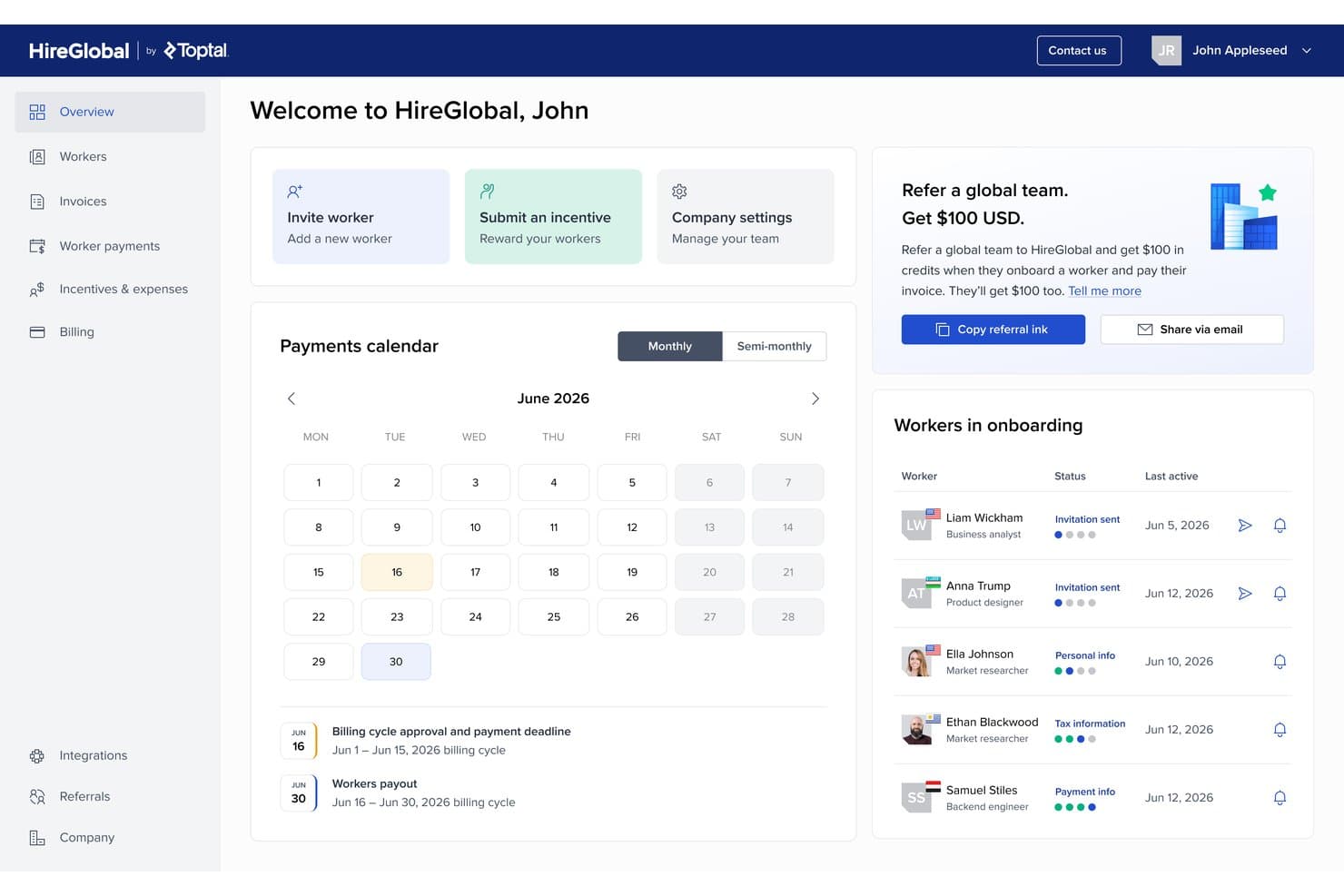
HireGlobal's dashboard centralizes global worker onboarding and payroll scheduling. HireGlobal is an employer of record platform by Toptal that manages global contractor payments, compliant employment contracts, statutory benefits, and multi-country payroll across 180+ countries through three distinct hiring models: AOR, Virtual EOR, and full EOR.
Who Is HireGlobal Best For?
HireGlobal is a strong fit for finance-led teams that need contractor compliance protection and misclassification indemnification without paying full EOR prices.
Why I Picked HireGlobal
I've included HireGlobal in my top picks because its Virtual EOR model is the only product I've seen that pairs contractor-level pricing with $1 million in misclassification indemnification per worker, including legal defense. If a worker in, say, Germany challenges their classification status, HireGlobal's 40+ in-house lawyers step in and the financial exposure is covered. I also like that this protection sits alongside automated, multi-country payroll with a single consolidated invoice across all workers.
HireGlobal Key Features
- Three-tier hiring models: Choose between AOR, Virtual EOR, or full EOR for each worker, all managed from one platform.
- Automated statutory deductions: Payroll engine calculates and applies employer taxes, social contributions, and statutory withholdings per local law in each supported country.
- Reimbursement management: Workers submit expenses through the platform, with automated tax-rule application based on jurisdiction before approval and payout.
- Centralized compliance dashboard: View payment status, contract documents, regulatory alerts, and workforce data for all countries in one place.
HireGlobal Integrations
HireGlobal has a documented integration with TopTracker.
Pros and Cons
Pros:
- Automated legal compliance in 180+ countries
- Single invoice for global payroll and benefits
- $1 million misclassification indemnification per worker
Cons:
- No equity or immigration support available
- Entity coverage relies on partner network
Learn more about HireGlobal: Best for global contractor onboarding
- Free demo available
- From $14/user/month
Visit WebsiteCustomer Rating:4.9/5
Deel Hire runs EOR employment, payroll, compliance, benefits, and terminations. Deel Hire is an employer of record platform that handles legal employment, payroll, compliance, benefits, and terminations across 130+ countries using its own wholly-owned legal entities.
Who Is Deel Hire Best For?
Deel Hire is a strong fit for fast-scaling companies that need to hire international contractors and full-time employees across multiple countries at once.
Why I Picked Deel Hire
I've included Deel Hire in my top picks because its contractor onboarding infrastructure is genuinely one of the most developed in the market. What I like most is the contractor management dashboard, which centralizes compliant contracts, automated invoicing, and payments across 120+ currencies in one place. Deel also includes a built-in misclassification assessment tool that flags whether a hire should be a contractor or a full-time employee, which saves real compliance headaches before they start.
Deel Hire Key Services
- Benefits enrollment: Administer local benefits packages for employees across 130+ countries directly within the platform.
- Automated contract generation: Generate locally compliant employment contracts automatically, with IP assignment clauses built into every agreement.
- Termination management: Manage notice periods, severance calculations, and final pay in line with country-specific labor law.
- People analytics and dashboards: Access workforce data and reporting through built-in HR dashboards to track headcount and compliance status.
Deel Hire Integrations
Deel offers integrations through its App Store, including tools like NetSuite, BambooHR, Workday, Xero, and QuickBooks. An API is available for connecting Deel to your HRIS, finance, and ERP systems for custom integrations.
Pros and Cons
Pros:
- Pays in 120+ local currencies
- Supports contractor-to-employee conversion
- Owns entities in 100+ countries directly
Cons:
- Requires upfront salary deposit
- Support can slow during payroll peaks
Learn more about Deel Hire: Best for in-house legal resources
- Free demo available
- From $599/user/month
Visit WebsiteCustomer Rating:4.6/5
Atlas HXM operates EOR entities for hiring, payroll, benefits, and onboarding. Atlas HXM is a direct employer of record platform that owns and operates its own legal entities across 160+ countries, handling global hiring, payroll, compliance, benefits, and onboarding without relying on third-party partners.
Who Is Atlas HXM Best For?
Atlas HXM is a strong fit for mid-to-large enterprises that need a direct EOR model, with owned entities in 160+ countries and in-house legal, HR, and compliance teams rather than third-party partners.
Why I Picked Atlas HXM
I've included Atlas HXM in my top picks because it runs its own legal entities across 160+ countries, with no third-party intermediaries managing your compliance exposure. I like that every country comes with in-house legal and HR specialists who understand local labor law at a granular level.
When hiring in a market like Indonesia or Nigeria, that distinction matters: you get direct accountability, not a subcontracted answer.
Atlas HXM Key Services
- Self-service employee onboarding: Employees can complete their own onboarding directly in the Atlas HXM platform, including document submission and profile setup, without HR managing each step manually.
- Single-portal payroll management: Preview, approve, and amend payroll across all countries from one dashboard, including access to past, present, and upcoming payroll cycles on demand.
- Customizable HR templates: Build and apply HR document templates across the full employee lifecycle, with country-specific customization available within the platform.
- Local legislation tracking: Monitor and prepare for upcoming changes to employment law by country directly in the platform, with alerts tied to specific markets where you have active headcount.
Atlas HXM Integrations
Integrations are not publicly listed.
Pros and Cons
Pros:
- Provides local workforce analytics
- No employee minimums or long-term contracts
- Covers EOR hiring in 160+ countries
Cons:
- Features complex platform navigation
- Contractor management features are basic
Learn more about Atlas HXM:

Rise unites EOR, AOR, contractor payments, global hiring, and RiseID. Rise is a global employer of record and contractor management platform that covers agent of record services, crypto and fiat contractor payments, and compliant employment across 160+ countries through its EOR, AOR, and RiseID products.
Who Is Rise Best For?
Rise is a natural fit for crypto-native companies and Web3 teams that pay contractors in digital currencies alongside traditional fiat.
Why I Picked Rise
I've included Rise in my top picks because it's one of the only EOR and contractor management platforms built to handle crypto payouts natively, not as a bolt-on feature. Contractors on Rise can receive payment directly to a crypto wallet in 100+ currencies, including stablecoins like USDC, on their own schedule. I also like that Rise Earn lets companies put payroll funds to work, earning variable yield in USDC on idle balances held inside the platform before payroll runs.
Rise Key Services
- RiseID on-chain identity: Rise issues each team member a verifiable on-chain professional ID used for KYC, AML, and employment record verification.
- Automated contractor onboarding: Rise generates compliant service agreements, runs background checks, and collects NDAs directly in the platform across 190+ countries.
- Flexible pay schedules: Set up one-time, milestone-based, hourly, recurring, or daily payment schedules for both contractors and full-time employees.
- International health and travel insurance: Rise connects contractors to health and travel insurance coverage through its global partner network.
Rise Integrations
Rise offers native integrations with Coinbase, Ethereum, Monad, Plasma, and more.
Pros and Cons
Pros:
- Fund payroll in USD or USDC/USDT
- Native crypto and stablecoin payout rails
- Automates variable yield payroll funding
Cons:
- Imposes mandatory identity verification flows
- Limited to cryptocurrency-native companies
Learn more about Rise: Best for multilingual workforce support
- Free demo available
- From $20/user/month (billed annually)
Visit WebsiteCustomer Rating:4.7/5
Multiplier coordinates EOR, contractors, payroll, benefits, and compliance. Multiplier is a global employment platform that handles EOR services, contractor management, global payroll, and benefits administration across 150+ countries, with built-in compliance tools and multi-currency payroll.
Who Is Multiplier Best For?
Multiplier is a strong fit for mid-size companies scaling across multiple regions who need employment contracts, payroll, and HR documents delivered in local languages.
Why I Picked Multiplier
I've included Multiplier in my top picks because it's one of the few EOR platforms that treats multilingual support as a core product feature. Employment contracts are generated in the local language of each country, not just translated on request, which matters when hiring in markets like Japan, Brazil, or the Netherlands where local-language agreements are a compliance requirement.
I also like that Multiplier's platform interface and employee self-service tools support multiple languages, so new hires can complete onboarding in their preferred language. With 100+ in-house legal and tax experts across markets, there's genuine local knowledge behind the documentation.
Multiplier Key Services
- ESOP administration: Multiplier supports Employee Stock Ownership Plan (ESOP) management, so you can issue global equity to international employees directly through the platform.
- Multi-currency payroll processing: Run payroll across 120+ currencies from a single dashboard, with automated tax and statutory contribution calculations built in for each country.
- Contractor of Record (AOR) services: Manage both full-time employees and independent contractors under one platform, with built-in misclassification risk assessment tools.
- Employee cost calculator: Multiplier includes a built-in tool to estimate the full cost of hiring in any given country, factoring in statutory benefits, taxes, and social contributions before you commit to a hire.
Multiplier Integrations
Multiplier has fewer than 10 native integrations, including HiBob, BambooHR, Workday, Deel, and more.
Pros and Cons
Pros:
- Onboards international employees within 24 hours
- No extra fees for onboarding or offboarding
- Strong local expertise in Asia-Pacific markets
Cons:
- No standalone payroll-only option available
- Undisclosed charges may surface at scale
Learn more about Multiplier: Best for unified HR, IT, and payroll in one platform
- Free demo available
- From $8/user/month
Visit WebsiteCustomer Rating:4.9/5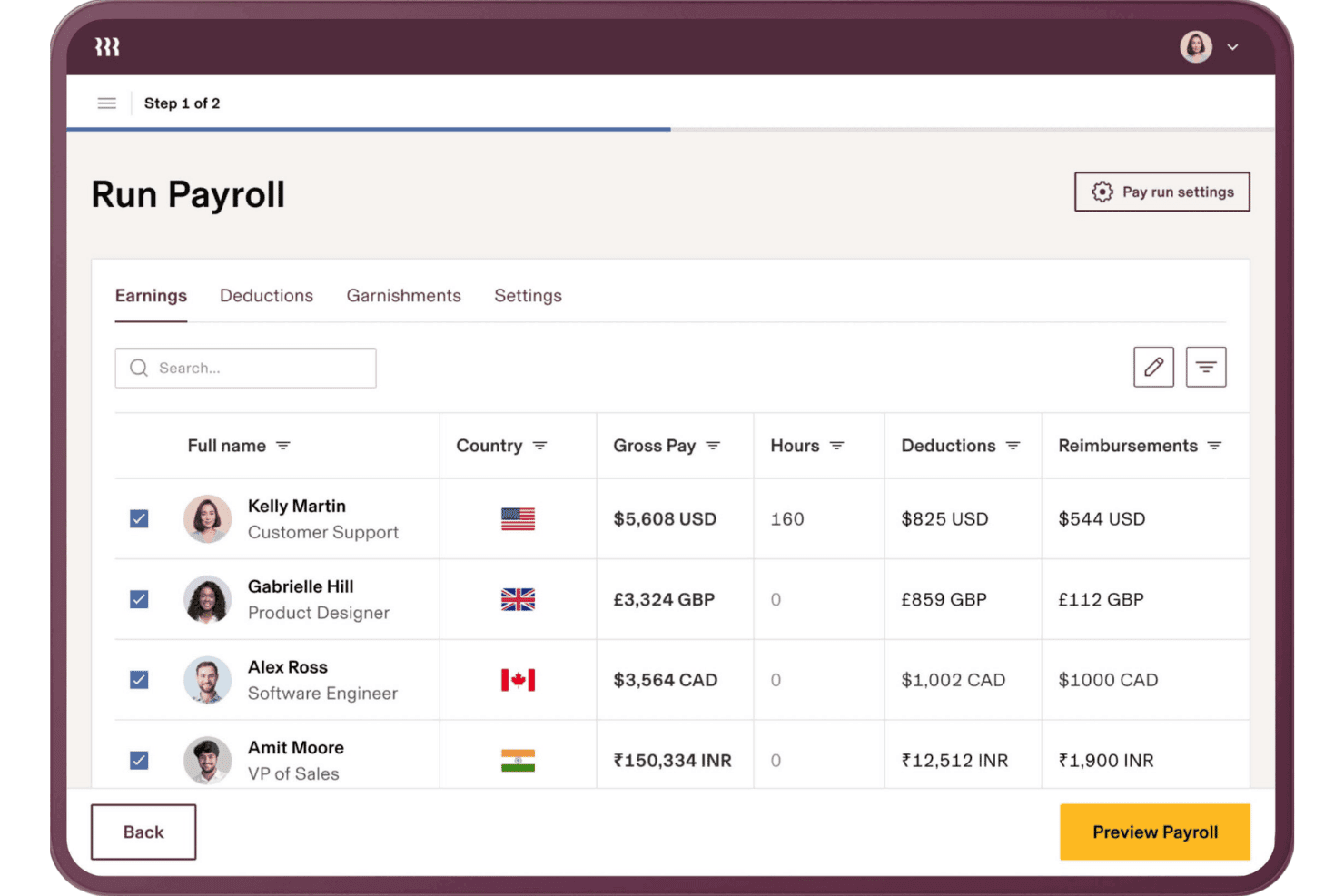
Rippling lets users run global payroll across multiple currencies at once. Rippling is an employer of record platform that combines global hiring, multi-country payroll, benefits administration, and IT provisioning with a broader HRIS spanning time tracking, expenses, and workforce reporting.
Who Is Rippling Best For?
Rippling is a strong fit for companies that already use—or want—a single platform to manage HR, IT, and payroll together alongside their global hiring.
Why I Picked Rippling
I picked Rippling as one of the best because it genuinely unifies HR, IT, and payroll in a single system rather than bolting them together. When you onboard an international hire, Rippling handles the employment contract, benefits enrollment, and device provisioning in one flow. I also like that payroll data, expenses, and PTO feed into payroll automatically, and total compensation reports consolidate multi-country salary, equity, and benefits into one currency view.
Rippling Key Features
- Contractor-to-employee management: Rippling manages contractors and EOR employees in one system, with a built-in path to transition EOR hires to direct employment once you establish a local entity.
- IT provisioning during onboarding: When you bring on an international hire, Rippling automatically sets up devices, app access, MFA, and security training through its native IT tools.
- Global equity grants: Rippling includes global equity management under its finance suite, letting you issue and track equity grants across countries in one place.
- General ledger sync: Payroll and expense data is automatically categorized and pushed to the GL, reducing manual reconciliation work for your accounting team.
Rippling Integrations
Rippling offers 600+ ready-made integrations for identity, access, and workforce workflows. It also supports custom integrations through connectors, SDKs, and developer tools.
Pros and Cons
Pros:
- Consolidated global workforce cost reporting
- Fast five-to-twelve-day payroll cycles
- Unified HR, IT, and payroll management
Cons:
- Native payroll covers only ten countries
- Owned-country coverage remains unclear
 Best for localized compliance expertise
- Free demo available
- From $29/user/month
Visit WebsiteCustomer Rating:4.6/5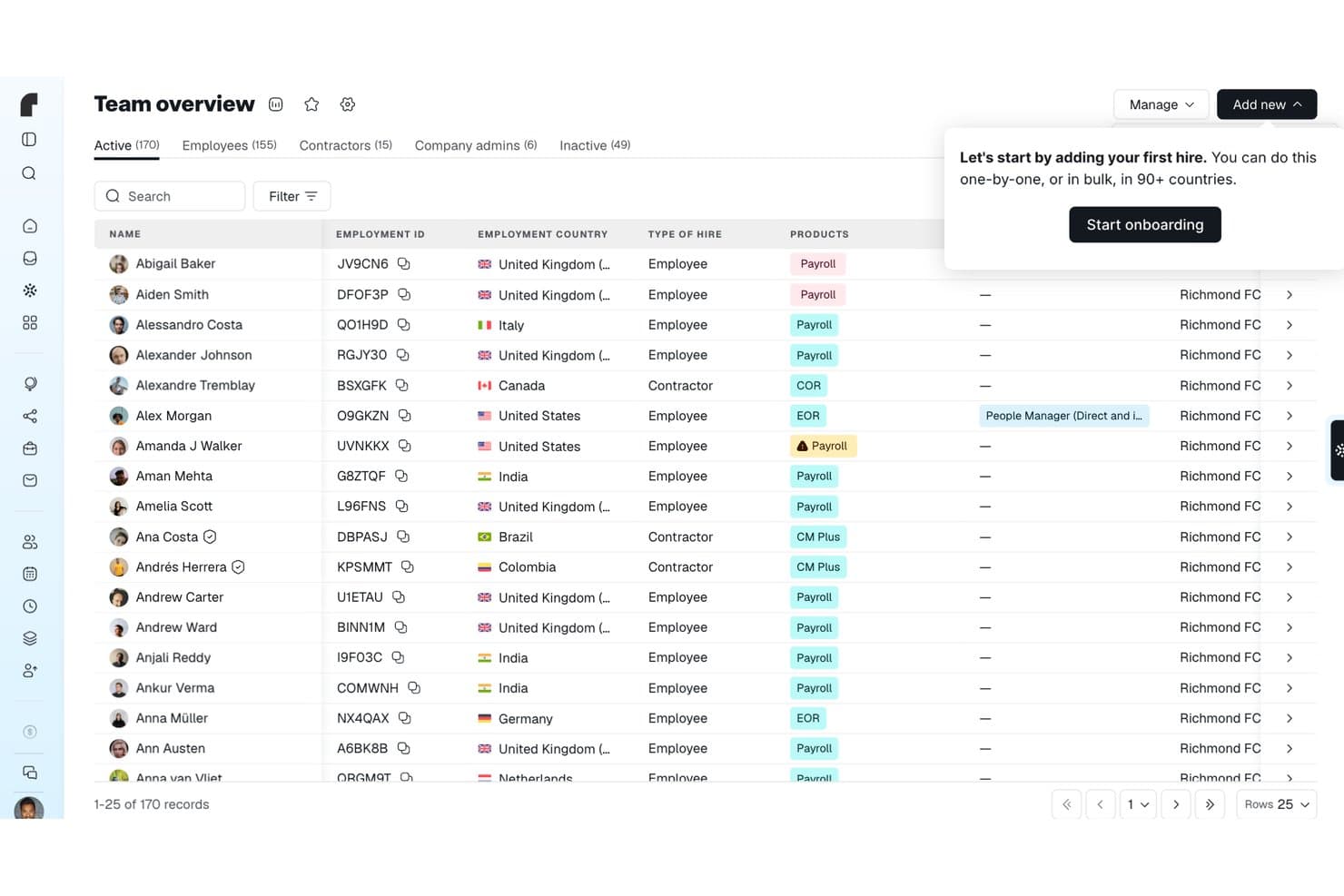
Remote centralizes global team management across 170+ employees and contractors. Built around wholly-owned legal entities in 100+ countries, Remote is an employer of record platform that covers international hiring, payroll, tax filings, benefits administration, and employment contracts.
Who Is Remote Best For?
Remote is a strong fit for mid-size to enterprise companies expanding into new markets where local labor law complexity is the biggest hiring risk.
Why I Picked Remote
Remote earns its spot on my shortlist because of its Compliance Watchtower feature, which I think is genuinely rare in this space. It monitors legal changes across 90+ countries in real time and surfaces them in-platform with actionable guidance, so your team isn't manually tracking labor law updates. I also like the unlimited indemnity coverage Remote offers EOR customers, with no caps, which shows real confidence in their in-house legal expertise across every country they operate in.
Remote Key Services
- Remote IP Guard: Automatically protects your company's IP in every country, including IP transfers and moral rights waivers where applicable law permits.
- Background checks: Run pre-employment screening across multiple countries directly from the Remote platform, without adding a separate vendor.
- Ask an Expert: Book 1:1 video calls with Remote's in-house HR, legal, and tax professionals for country-specific guidance.
- Automated onboarding flows: Country-specific onboarding with localized contracts and payroll setup, averaging a 2-day turnaround per new hire.
Remote Integrations
Remote offers native integrations with BambooHR, HiBob, Greenhouse, Slack, and Personio. An API is available for custom integrations.
Pros and Cons
Pros:
- In-house legal teams handle terminations
- Strong benefits packages in European markets
- Built-in IP protection on every contract
Cons:
- Coverage gaps in Southeast Asia and Africa
- Limited contractor management features
Learn more about Remote:

Playroll administers global hiring, payroll, benefits, contractors, and compliance. Playroll is a global employer of record platform that handles international hiring, payroll processing, benefits administration, contractor management, and compliance across 180+ countries from a single dashboard.
Who Is Playroll Best For?
Playroll is a strong fit for scaling companies that need to hire across multiple regions quickly, particularly those with hiring needs in Africa or other emerging markets.
Why I Picked Playroll
I picked Playroll as one of the best because its onboarding speed is genuinely hard to beat in this category. The platform auto-generates a locally compliant employment contract in minutes, and new hires complete the rest through a guided self-onboarding portal.
In practice, most employees are fully onboarded and payroll-ready within two to five days. I also like that Playroll charges zero onboarding or offboarding fees, so there's no added cost each time headcount changes.
Playroll Key Services
- Contractor misclassification audit: A built-in assessment flags misclassification risk before you convert contractors to full-time employees.
- Always-on compliance alerts: In-platform notifications push regulatory changes (minimum wage updates, leave policy changes) directly to you as they happen.
- Time off and expense management: Track, approve, and manage employee time off requests, timesheets, and expense submissions from one dashboard.
- Employee Success Manager: Each employee gets a dedicated support contact from day one, handling questions about pay, documents, and benefits.
Playroll Integrations
Playroll offers a small set of native integrations, including BambooHR and HiBob. An API is available for custom integrations.
Pros and Cons
Pros:
- Includes pre-validated AI compliance tools
- Dedicated customer success manager included
- Eliminates setup and termination fees
Cons:
- Refundable security deposit required per hire
- Offers basic workforce analytics reporting
Learn more about Playroll: Best for transparent cost breakdowns
- Free demo available
- From $199/user/month
Visit WebsiteCustomer Rating:4.8/5
Boundless oversees onboarding, payroll, contracts, benefits, and compliance. Boundless is an employer of record and agent of record platform that covers employee onboarding, local payroll, contract management, statutory benefits, and in-country compliance across international markets.
Who Is Boundless Best For?
Boundless is a strong fit for HR and people operations teams that need full visibility into employer costs before committing to a hire in a new country.
Why I Picked Boundless
I picked Boundless as one of the best because its employment cost calculator is genuinely one of the most detailed I've used. Before onboarding a single employee, I can model the full cost of a hire by country, including employer taxes, statutory contributions, and estimated net pay. Boundless also pairs this with country guides that cover local compliance requirements in depth, so I'm not making decisions based on incomplete information.
Boundless Key Services
- Locally compliant contract generation: Boundless provides country-specific employment contract templates built by local legal experts, sent and tracked directly from the platform.
- Consolidated monthly payroll invoice: All employer costs across countries roll into a single monthly invoice, covering salary, statutory deductions, and benefits.
- Compliant termination guidance: For each country, Boundless provides specific guidance on notice periods, required documentation, and legal exit steps.
- Contractor classification and management: Through its agent of record service, Boundless handles contractor agreements, classification, payments, and offboarding across 160+ countries.
Boundless Integrations
Native integrations are not clearly documented.
Pros and Cons
Pros:
- Delivers audited, high payroll accuracy
- Proactive contract updates for law changes
- Assigns dedicated local HR managers
Cons:
- No native HRIS or payroll integrations
- Operates in fewer global markets
Learn more about Boundless: Best for local market intelligence
- Free demo available
- Pricing upon request
Visit WebsiteCustomer Rating:4.3/5
Safeguard Global covers hiring, payroll, HR, compliance, and legal support. Safeguard Global is an EOR platform that covers hiring, payroll, compliance, and HR management across 187 countries, backed by in-country legal experts and an integrated HRIS.
Who Is Safeguard Global Best For?
Safeguard Global is a strong fit for enterprises expanding into emerging or complex markets where in-country labor law expertise is a non-negotiable hiring requirement.
Why I Picked Safeguard Global
Safeguard Global earns its spot on my shortlist because of its ChatSG tool, which gives you on-demand answers to country-specific HR and compliance questions, backed by Safeguard's own in-country experts.
I also like its worker classification quiz, which helps you identify the least-risk employment type before you hire in a new market. With 400+ in-house experts across 187 countries, the depth of local knowledge here goes well beyond what a self-service EOR platform typically offers.
Safeguard Global Key Services
- Country-specific onboarding forms: Automatically generate and deliver the correct onboarding paperwork for each country where you're hiring, with instant contract previews built in.
- Time and expense tracking: Employees can clock in and out and submit receipts from a mobile app, with managers able to review and approve expenses in real time.
- Spend analytics dashboard: View labor costs, payroll tax amounts, turnover rates, and other workforce data broken down by country, currency, and contract type.
- Global workforce analytics: Access salary benchmarking data by role, level, and country to support compensation planning for international hires.
Safeguard Global Integrations
Native integrations are not publicly documented.
Pros and Cons
Pros:
- Includes corporate tax and PE risk assessments
- Combines EOR and managed payroll in one vendor
- Covers hard-to-reach emerging markets well
Cons:
- Support relies heavily on group email channels
- Recurring invoicing errors reported by users
Learn more about Safeguard Global:
Other Employer of Record Services
Here are some additional employer of record service options that didn’t make it onto my shortlist, but are still worth checking out:
- 11JustworksBest for straightforward international hiring
- 12Papaya GlobalBest for unified payroll management
- 13Oyster HRBest for equity and stock option administration
- 14RemoFirstBest for startup-friendly expansion tools
- 15RivermateBest for dedicated account management
- 16G-PBest for established enterprise scale
- 17MercansBest with advanced API integrations
- 18Borderless AIBest for quick expansion
- 19Payoneer Workforce ManagementBest for multicurrency payroll options
- 20WorkMotionBest for certified global compliance standards
How I Evaluate Employer of Record Services
I split my evaluation into two layers: core compliance capabilities a CFO can't compromise on, and differentiators—like onboarding speed and entity ownership depth—that determine real-world fit.
Core Functionality (Table Stakes For This List)
When I'm selecting tools for my list, I rank each one on a scale from 0 (does not offer the functionality) to 5 (excels in this area) for each core functionality listed below. Then, I calculate the tool's total score into a percentage. Each tool needs to achieve a minimum total score of 65% to be considered for inclusion.
- Global legal entities: I check whether the provider owns its in-country entities or relies on third-party partners, since that directly affects compliance accountability.
- Multi-country payroll: Each tool should process payroll in local currencies with statutory deductions, tax withholdings, and support for off-cycle payment runs.
- Tax and compliance management: I look for providers with in-house legal and tax specialists who monitor regulatory changes rather than relying on generic compliance databases.
- Contracts and onboarding: The platform should generate locally compliant employment agreements and handle onboarding documents like IP assignments and NDAs digitally.
- Statutory benefits administration: Beyond mandatory minimums, I evaluate whether the provider offers supplemental options like private health plans or pension top-ups per market.
- Consolidated invoicing and reporting: Finance teams need a single invoice across all jurisdictions with GL-ready exports and cost center tagging for clean reconciliation.
Once I have a list of tools that meet this criteria, I consider what sets each platform apart.
Differentiating Factors (What Sets Vendors Apart)
Here's how I compare and contrast different vendors:
Standout Features
Built-in contractor conversion matters because it lets you move a proven contractor to full-time status without starting a separate hiring process, which also reduces misclassification exposure. I also evaluate whether a provider can administer equity grants and stock options across jurisdictions, since many scaling companies use equity as part of their compensation strategy. Immigration and visa support is another differentiator I look for, especially when a hire needs a work permit before they can start.
Beyond Features
Pricing structure deserves close attention. I check whether a provider charges a flat per-employee fee or takes a percentage of payroll, and whether deposits, FX markups, or off-boarding fees are buried in the fine print. Compliance liability is another factor I weigh heavily—specifically, whether the EOR assumes legal responsibility for tax filings, termination disputes, and misclassification claims. I also evaluate how well each platform fits into an existing tech stack, looking at native HRIS and accounting integrations alongside API access for custom reporting workflows.
How to Choose Employer of Record Services
It’s easy to get bogged down in long feature lists and complex pricing structures. To help you stay focused as you work through your unique software selection process, here’s a checklist of factors to keep in mind:
| Factor | What to Consider |
|---|---|
| FactorScalability | What to ConsiderWill the provider support your headcount growth and planned geographic expansion over the next 1–3 years? |
| FactorIntegrations | What to ConsiderHow well does the platform connect with existing HR, payroll, and accounting systems your team relies on? |
| FactorCustomizability | What to ConsiderCan workflows, invoicing, or reporting be easily adjusted to match your business’s policies and organizational needs? |
| FactorEase of use | What to ConsiderAre onboarding and daily tasks intuitive for your team and for employees—not just administrators? |
| FactorImplementation and onboarding | What to ConsiderWhat support and timelines can you expect when setting up new countries or migrating from another provider? |
| FactorCost | What to ConsiderAre there hidden fees for onboarding, offboarding, deposits, or foreign exchange that could impact total cost of ownership? |
| FactorSecurity safeguards | What to ConsiderDoes the provider hold relevant certifications (like SOC 2, ISO 27001), and what measures protect your sensitive payroll and tax data? |
| FactorCompliance requirements | What to ConsiderAre local tax filing, employment law, and IP assignment obligations fully handled for every country where you plan to hire? |
What Are Employer of Record Services?
Employer of record services are third-party providers that legally employ workers on your behalf in countries where you lack a legal entity. These services manage local payroll, employment contracts, tax compliance, statutory benefits, and regulatory filings, allowing your finance and HR teams to hire internationally without taking on local legal risk or administrative burden.
Why Use an Employer of Record?
An employer of record (EOR) lets your company hire employees in countries where you don't have a legal entity. The EOR becomes the legal employer, while you retain control over the employee's day-to-day work, performance, compensation strategy, and business objectives.
For finance teams, an EOR reduces the cost and complexity of international hiring by eliminating the need to establish local subsidiaries before entering a new market. Instead of investing in incorporation, local payroll infrastructure, tax registrations, and ongoing compliance management, you can begin employing workers quickly while the EOR manages statutory employment obligations.
When Should You Use an Employer of Record?
An EOR isn't the right solution for every business. It delivers the most value when speed, flexibility, and compliance outweigh the benefits of operating your own local entity.
An EOR is particularly valuable when you need to:
- Enter new markets faster. Hire employees without waiting months to establish a local entity. For example, companies can use an employer of record in Canada to hire locally without first setting up a Canadian entity.
- Reduce administrative overhead. Outsource payroll, tax withholding, statutory benefits, and employment administration to a local compliance expert.
- Control expansion costs. Avoid the legal, accounting, and administrative expenses associated with maintaining an overseas subsidiary for a small workforce.
- Lower compliance risk. Rely on local employment expertise to help meet labor law, payroll, tax, and reporting requirements.
- Test new markets before investing. Build a local team while evaluating long-term commercial opportunities before committing to a permanent presence.
Legal and Compliance Aspects of an Employer of Record
An EOR assumes responsibility for complying with local employment laws while your business directs the employee's daily work. This division of responsibilities helps organizations hire internationally without building in-house legal and payroll expertise in every country.
Although responsibilities vary by jurisdiction, an EOR typically manages:
- Employment contracts: Preparing locally compliant employment agreements.
- Payroll administration: Processing payroll and calculating statutory deductions accurately.
- Tax withholding and reporting: Remitting payroll taxes and submitting required filings.
- Statutory benefits: Administering mandatory pensions, insurance, leave entitlements, and social contributions.
- Employment law compliance: Applying local rules covering working time, leave, notice periods, and termination.
- Government registrations and reporting: Managing employer registrations where required.
Your organization remains responsible for business decisions such as compensation strategy, performance management, job responsibilities, and operational oversight. Finance teams should also review service agreements carefully to understand how liability is allocated between the company and the EOR, particularly for tax, employment disputes, data protection, and regulatory compliance.
Employer of Record vs. Legal Entity
Choosing between an EOR and establishing a legal entity depends on your expansion strategy, hiring plans, and long-term investment in a market.
| Factor | Employer of Record | Legal Entity |
|---|---|---|
| FactorSetup time | Employer of RecordDays or weeks | Legal EntityOften several months |
| FactorUpfront investment | Employer of RecordLow | Legal EntityHigh |
| FactorOngoing administration | Employer of RecordManaged by the EOR | Legal EntityManaged internally or through local advisors |
| FactorPayroll and employment compliance | Employer of RecordEOR manages | Legal EntityCompany manages |
| FactorLocal tax registrations | Employer of RecordHandled by the EOR for employment | Legal EntityCompany responsible |
| FactorBest suited for | Employer of RecordSmall teams, market testing, remote hiring | Legal EntityLong-term operations, larger workforces, revenue-generating activities |
For finance leaders, the decision often comes down to total cost of ownership. An EOR typically provides a lower-cost entry point for small international teams, while establishing a legal entity may become more economical once headcount and business activity reach a certain scale.
Employer of Record vs. Permanent Establishment
An employer of record and permanent establishment (PE) address different aspects of international expansion.
An EOR is an employment solution that enables companies to hire workers without creating their own local employer. Permanent establishment is a tax concept that determines whether a company's business activities create a taxable presence in another country.
Using an EOR does not automatically prevent permanent establishment. Tax authorities assess PE based on factors such as where business decisions are made, whether employees negotiate or conclude contracts, the existence of fixed places of business, and the overall nature of business operations.
Finance and tax teams should evaluate PE exposure separately from employment compliance, particularly as international operations expand.
How EORs Help Reduce Permanent Establishment Risk
While an EOR cannot eliminate permanent establishment risk, it can help reduce exposure when used as part of a broader international expansion strategy.
An EOR helps by:
- Providing a compliant local employer. Employees are hired through an established local employer rather than your company directly.
- Supporting compliant employment structures. Employment contracts, payroll, and statutory obligations are managed according to local laws.
- Reducing administrative triggers. The EOR manages many employer responsibilities that would otherwise require your company to establish local employment infrastructure.
- Helping identify potential risks early. Experienced EOR providers can flag employment arrangements that may increase tax or regulatory exposure.
However, PE risk ultimately depends on your company's commercial activities. If employees negotiate contracts, generate significant revenue, exercise decision-making authority, or your business maintains a fixed place of business in the country, permanent establishment may still arise regardless of whether an EOR is used.
Features
When selecting employer of record services, keep an eye out for the following key features:
- Global legal entity network: Enables you to employ workers in countries where you don’t operate your own legal entity, simplifying global hiring.
- Local payroll processing: Handles compliant payroll runs with currency conversion, tax withholding, and statutory deductions according to local laws.
- Employment contract generation: Produces locally compliant employment agreements and manages ongoing contract documentation.
- Tax and compliance management: Oversees employer tax filings, social contributions, and ensures all activity aligns with country-specific legal standards.
- Benefits administration: Manages statutory and supplemental employee benefits such as pensions, health insurance, and paid leave.
- Consolidated invoicing: Provides unified, multi-country invoicing for easy reconciliation and cost allocation across global operations.
- Onboarding and offboarding workflows: Guides you through employee setup, document collection, and compliance reviews for new hires and terminations.
- IP and confidentiality protections: Includes IP assignment and NDA support in employment contracts to help protect business interests across jurisdictions.
- Local HR support: Gives your team and employees access to in-country HR, payroll, and legal experts for timely, context-specific guidance.
Employer of record services solutions do not typically include AI as part of their feature offering.
Benefits
Implementing employer of record services provides several benefits for your team and your business. Here are a few you can look forward to:
- Global hiring flexibility: Easily hire talent in new countries without setting up your own legal entities or navigating unfamiliar regulatory requirements.
- Reduced compliance risk: Protect your business from misclassification and tax issues by offloading local employment liability and ongoing regulatory monitoring.
- Simplified multi-country payroll: Consolidate payroll, benefits, and statutory filings across regions into one process and one invoice for easier reconciliation.
- Faster onboarding and scaling: Move quickly from offer acceptance to compliant start date using ready-to-go localized contracts and onboarding workflows.
- Access to local expertise: Get real-time support from in-country HR, legal, and payroll specialists to handle country-specific questions or changes.
- Centralized reporting and invoicing: Aggregate all global employment costs and payroll data in a single platform to improve visibility for finance and accounting teams.
Costs and Pricing
Selecting employer of record services requires an understanding of the various pricing models and plans available. Costs vary based on features, team size, add-ons, and more. The table below summarizes common plans, their average prices, and typical features included in employer of record services solutions:
Plan Comparison Table for Employer of Record Services
| Plan Type | Average Price | Common Features |
|---|---|---|
| Plan TypeFree Plan | Average Price$0 | Common FeaturesAccess to basic resources, limited country research tools, and vendor comparison guides. |
| Plan TypePersonal Plan | Average Price$200-$400/employee/month | Common FeaturesSingle-country employment, essential payroll and compliance, and basic HR support. |
| Plan TypeBusiness Plan | Average Price$400-$700/employee/month | Common FeaturesMulti-country payroll, statutory benefits administration, localized contract templates, and consolidated invoicing. |
| Plan TypeEnterprise Plan | Average Price$700-$1000+/employee/month | Common FeaturesGlobal payroll, advanced compliance management, dedicated account management, integrations, and custom reporting. |
Employer of Record Services FAQs
Here are some answers to common questions about employer of record services:
How does an EOR handle IP transfer upon termination?
In most employer of record arrangements, intellectual property (IP) ownership is established through a combination of the employment agreement between the employee and the EOR and the service agreement between the EOR and your company. These agreements are designed to ensure that IP created during employment is assigned or transferred to your business, subject to local employment and IP laws.
Because IP rules vary by country, finance and legal teams should confirm that assignment clauses are enforceable in each jurisdiction. In some countries, additional agreements or post-termination documentation may be required, particularly for inventions, software, or works protected by moral rights. Before engaging an EOR, review its contractual framework to verify how IP transfers are handled, how confidential information is protected, and whether any local legal limitations could affect ownership.
How does an employer of record reduce global hiring risk?
A global EOR allows you to tap into a wider talent pool and safely hire employees across different countries. The right EOR reduces hiring risk by:
- Assuming legal responsibility for employing your workers abroad, handling local payroll, legal compliance, and contracts. This shields your business from misclassification, tax, and local regulations risks that can arise when hiring in unfamiliar jurisdictions.
- Managing employer responsibilities like social security contributions and workers’ compensation.
- Helping you adhere to local employment laws without needing your own entity.
Can I pay contractors through an employer of record?
No, employer of record services are designed for full-time employees, not contractors. However, some providers offer integrated platforms to manage both your internal international team and independent contractors under separate compliance frameworks.
How long does it take to onboard a new employee?
Onboarding times vary depending on the country, but most EOR solutions can generate compliant contracts and onboard employees within a few days after receiving all necessary documentation. This turnaround helps you pursue aggressive global expansion while securing top talent before competitors do.
Because the EOR handles time-consuming administrative tasks and routine HR tasks, your internal team can stay focused on the day-to-day management and onboarding of your new global talent rather than getting bogged down in localized paperwork.
What happens if I need to terminate an international employee?
The employer of record manages all termination processes in strict compliance with international employment regulations and country-specific statutes. This includes preparing documentation, calculating severance if required, and conducting exit processes to reduce legal exposure. Managing terminations through a vetted provider ensures that everything from final payouts to offboarding logistics aligns perfectly with local mandates, a capability often validated in positive client testimonials.
Do employer of record services provide localized benefits?
Yes, most solutions offer access to country-specific perks such as statutory healthcare, pensions, and supplemental benefits, helping you stay competitive and compliant in each region.
What's the difference between a PEO and EOR?
The primary difference lies in the legal employment structure and liability. A professional employer organization (PEO) operates on a co-employment model, meaning it shares employer responsibilities with the client company.
| Feature | Professional Employer Organization (PEO) | Employer of Record (EOR) |
| Employment Model | Co-employment (shared responsibility between PEO and client company). | Full legal employment (the global EOR is the sole legal employer). |
| Legal Entity Requirement | You must own a local legal entity (own entity) in the worker’s country. | No entity setup required; you use the EOR provider’s infrastructure. |
| Legal Liability | Shared legal and financial liability. | The EOR handles 100% of the employment and legal compliance risks. |
| Scope of Hiring | Best for managing local teams or established foreign branches. | Ideal for global expansion and hiring remote work teams across different countries. |
| HR and Administrative Tasks | Manages day-to-day administrative tasks, payroll, and HR tasks. | Handles all localized payroll, contracts, social security, and workers’ compensation. |
| Talent Acquisition | Manages existing staff (unlike a staffing agency, they don’t source talent). | Allows you to quickly hire employees and source top talent from a global talent pool. |
| Benefits Administration | Provides access to standard domestic packages. | Offers cost-effective, localized competitive benefits (like healthcare) to attract global talent. |
This content is provided for general informational purposes only and does not constitute legal, tax, or other professional advice. It may not be complete, accurate, or current, and laws and practices may change without notice and vary by jurisdiction. You should not act on this information without obtaining advice from qualified legal or tax counsel in the relevant jurisdiction regarding your specific circumstances.