

10 Best Cloud-Based Accounting Software in 2026

Best Cloud-Based Accounting Software Shortlist


Choosing the right cloud-based accounting software can be challenging with so many options available. As CFOs, you aim to manage your finances efficiently, but determining which tool fits your specific needs can be daunting. That's where I come in.
With years of experience using various accounting tools for businesses, I understand the critical pain points faced by financial leaders. Cloud-based accounting software automates financial tasks and provides real-time data access, saving time, reducing errors, and improving financial visibility. This software addresses issues such as manual data entry, delayed financial reporting, and lack of access to financial data on the go.
Through thorough reviews and expert insights, I will guide you in finding the best cloud-based accounting software tailored to your organization’s requirements. Whether you're managing small businesses or large enterprises, my goal is to help you enhance efficiency, accuracy, and financial control.
Why Trust Our Software Recommendations
Our team has been testing and reviewing software since 2012. As finance leaders ourselves, we know how difficult—and important—it is to choose the right software.
For this guide, we evaluated tools using hands-on testing and independent research, scoring tools using our selection criteria.
Our reviews reflect our human editorial judgment, not a sales pitch.
Cloud-Based Accounting Software Comparison Table
| Tool | Best For | Trial Info | Price | ||
|---|---|---|---|---|---|
| 1 | Best for global payout automation | Free plan available | Pricing upon request | Website | |
| 2 | Best for high transaction volumes | Free demo available | Pricing upon request | Website | |
| 3 | Best with automated invoice data extraction | Free demo available | Pricing upon request | Website | |
| 4 | Best for AI-driven financial automation | Free demo available | Pricing upon request | Website | |
| 5 | Best for end-to-end small business accounting | 30-day free trial | From $38/month | Website | |
| 6 | Best for freelancers and small business owners | 30-day free trial + free plan available | From £33/month | Website | |
| 7 | Best for automated paperless record keeping | 30-day free trial available | From $2.50/month | Website | |
| 8 | Best for customizable and affordable accounting | Free plan + free demo available | From $15/month (billed annually) | Website | |
| 9 | Best for simple and automated accounting | 14-day free trial available | From $30/month | Website | |
| 10 | Best for integrated ERP and accounting solutions | Free demo available | Pricing upon request | Website |
Best Cloud-Based Accounting Software Reviews
This section provides an in-depth analysis and overview of various cloud accounting software. We will walk through the pros and cons of each tool, their features, and their best use cases.

Payouts
Best for global payout automation

Payouts is a global financial operations platform that combines AP automation, AR automation, multi-rail payout processing, banking, tax compliance, and AI-driven payment workflows.
Who Is Payouts Best For?
Payouts is a strong fit for finance teams at mid-market and enterprise companies that manage high volumes of cross-border vendor, contractor, or affiliate payments across multiple currencies and regions.
Why I Picked Payouts
I've included Payouts in my top picks because its payout automation coverage across 150+ countries is the most specific differentiator I've seen in this space. Where most AP tools stop at domestic or regional payment rails, Payouts lets my team send fiat transfers, eWallet payouts, and crypto payouts in a single workflow without switching platforms. I also like the universal connectors feature, which pulls data from APIs, email parsing, and file uploads to feed automated payment runs.
Payouts Key Features
- AP automation: Capture, match, and route vendor invoices through configurable approval workflows before triggering payment.
- Vendor portal: Onboard vendors, collect tax forms, and manage compliance documentation directly within the platform.
- Virtual card issuance: Issue Visa® virtual cards for vendor and contractor payments without requiring a bank account.
- Advanced payment: Give vendors early access to invoice payments before the standard due date using instant liquidity tools.
Pros and Cons
Pros:
- Cryptocurrency and fiat payout options
- Vendor portal access
- Data analytics and reporting
Cons:
- Potential slow payment processing
- Limited mobile access

Best for high transaction volumes

DualEntry is a cloud-based AI accounting ERP with a full suite of general ledger, accounts payable, accounts receivable, multi-entity management, revenue recognition, budgeting, and close management tools.
Who Is DualEntry Best For?
DualEntry is a good fit for scaling mid-market and enterprise finance teams managing complex, high-volume accounting across multiple entities or business lines.
Why I Picked DualEntry
I've included DualEntry in my top picks because it's genuinely built to handle transaction volumes that would break most mid-market ERPs. The bulk import feature lets you pull in transactions from Excel, CSV, or zip files in one shot—and the AI flags anomalies on the way in, so you're not manually reviewing thousands of rows. On top of that, OCR document reading automatically logs bills, invoices, and POs as accounting entries the moment you upload them, which makes a real difference when you're processing at scale.
DualEntry Key Features
- Multi-entity consolidation: Manage financials across multiple entities and consolidate them into a single reporting view.
- Revenue recognition: Automate revenue schedules across multiple recognition methods to stay compliant with ASC 606.
- Close management: Assign and track period-end close tasks using checklists to keep your month-end on schedule.
- AI-powered bank matching: Automatically match bank transactions to journal entries to accelerate reconciliation.
Pros and Cons
Pros:
- Automated revenue recognition ensures compliance with standards
- Supports multi-entity and multi-currency operations
- Advanced AI features help with complex tasks
Cons:
- Customization options require careful setup
- Depth of the platform may not be suitable for smaller teams

DOKKA
Best with automated invoice data extraction
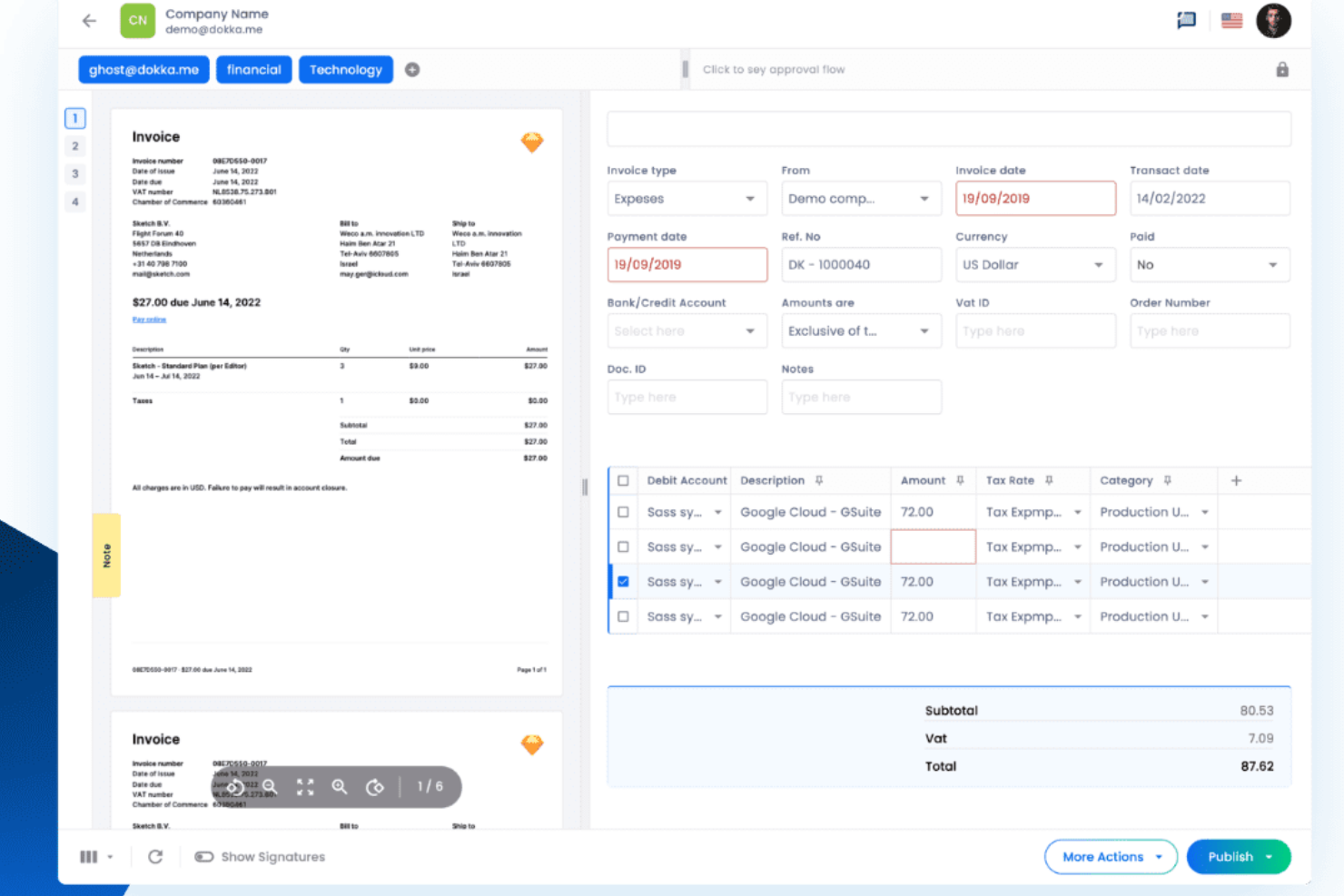
DOKKA is a cloud-based accounting automation platform that connects with your existing ERP to handle AP automation, financial close automation, invoice processing, approval workflows, and reconciliations.
Who Is DOKKA Best For?
DOKKA is a good fit for accounting teams and finance departments at mid-market companies that already use an ERP and need to automate their AP and close processes.
Why I Picked DOKKA
I picked DOKKA as one of the best because of how it handles invoice data extraction. Unlike basic OCR tools that rely on rigid templates, DOKKA's AI recognizes patterns like vendor logos, currencies, and layouts across languages to pull key fields accurately. It then maps that data directly into a journal entry recommendation, ready to post to your ERP in one click. I also like the two-way and three-way PO matching, which flags discrepancies against purchase orders and receipts before a payment goes out.
DOKKA Key Features
- Multi-level approval workflows: Set up custom approval chains for invoices and bills, routing documents to the right approvers based on amount, vendor, or department.
- Account reconciliation automation: Match transactions against bank statements and ledger entries automatically, flagging unmatched items for manual review.
- Financial close task management: Assign, track, and sign off on close tasks within a shared checklist to manage month-end and year-end close cycles.
- Audit-ready document archive: Store all financial documents with a timestamped activity log that tracks every action taken on each file.
Pros and Cons
Pros:
- Strong fit for invoice-heavy workflows and AP automation
- Built-in audit trail for compliance tracking
- Direct ERP integrations with SAP and NetSuite
Cons:
- Not a full accounting system—relies on external ERP/accounting platforms
- May be less impactful for teams with low document volume

Oracle
Best for AI-driven financial automation

Oracle Fusion Cloud Financials is a cloud-based financial management platform that covers general ledger, accounts payable and receivable, fixed assets, expense management, cash forecasting, and revenue recognition with built-in AI and machine learning.
Who Is Oracle Best For?
Oracle Fusion Cloud Financials is built for large enterprises and multinational corporations with complex, multi-entity financial operations that need a scalable platform.
Why I Picked Oracle
Oracle Fusion Cloud Financials is on my shortlist because its AI automation goes deeper than most platforms. The built-in AI automates up to 96% of standard transactions, and the Payables Agent handles the full invoice lifecycle—extracting data, validating against POs, applying tax checks, and routing for approval without human intervention. I also like the predictive cash forecasting, which replaces spreadsheet-based processes with daily AI-generated forecasts built from real-time unified financial data.
Oracle Key Features
- Multi-entity consolidation: Manage financials across multiple legal entities, currencies, and ledgers from a single chart of accounts.
- Revenue management: Automate revenue recognition across complex contracts in compliance with ASC 606 and IFRS 15 standards.
- Account reconciliation: Match balances, flag variances, and certify accounts automatically as part of the financial close process.
- Fixed assets management: Track asset lifecycles, calculate depreciation, and manage retirements across global asset books.
Pros and Cons
Pros:
- Advanced analytics
- Real-time financial insights
- AI-driven automation
Cons:
- Requires extensive training
- Slight learning curve

Best for end-to-end small business accounting

QuickBooks is a cloud-based accounting platform for small businesses that covers bookkeeping, invoicing, expense tracking, payroll, inventory, tax management, and financial reporting—all in one place, with AI-driven categorization and insights built in.
Who Is QuickBooks Best For?
QuickBooks is a strong fit for small business owners and their accountants who need a full accounting system without dedicated in-house finance staff.
Why I Picked QuickBooks
QuickBooks earns its spot on my shortlist because it covers the full accounting cycle—invoicing, tax prep, and reporting—in a single platform. I particularly like how it uses AI to auto-categorize transactions and flag anomalies, cutting reconciliation time. Its project profitability tracking pulls in labor costs, payroll, and expenses in real time, so I can see where money is going on any job.
QuickBooks Key Features
- Bill management: Track and schedule vendor bill payments, with due-date alerts to help you stay on top of accounts payable.
- Inventory tracking: Monitor stock levels, set reorder points, and sync inventory quantities with sales and purchase orders.
- Cash flow forecasting: See projected cash in and out on a visual dashboard, pulling from live bank and transaction data.
- Sales tax tracking: Automatically calculate sales tax across multiple rates and jurisdictions, then generate reports for filing.
Pros and Cons
Pros:
- Strong third-party integrations
- User-friendly interface
- Extensive reporting options
Cons:
- Higher cost for advanced features
- Occasional software bugs

Best for freelancers and small business owners

FreeAgent is a cloud-based accounting platform for freelancers, sole traders, and small businesses that covers invoicing, expense tracking, payroll, tax filing, and cashflow forecasting in one place.
Who Is FreeAgent Best For?
FreeAgent is a natural fit for UK-based freelancers, contractors, and small business owners who need to manage their own accounting and tax obligations without an accountant.
Why I Picked FreeAgent
I've included FreeAgent in my top picks because it's one of the few cloud accounting tools built specifically around how freelancers and sole traders work. I love that it handles Self Assessment tax returns and Making Tax Digital VAT submissions directly from the platform, so there's no jumping between tools at tax time. The 90-day cashflow forecast updates as invoices and expenses come in, which I find useful for spotting gaps before they become problems.
FreeAgent Key Features
- Bank feed syncing: Connect your bank account via Open Banking to import and categorize transactions in real time.
- Invoice management: Create and send branded invoices with payment reminders and built-in online payment options.
- Smart Capture: Photograph receipts and bills in the mobile app to extract and log expense data.
- Payroll: Run payroll and submit Real Time Information reports directly to HMRC from within the platform.
Pros and Cons
Pros:
- Project management tools
- End-to-end tax management features
- User-friendly interface
Cons:
- Basic reporting capabilities
- Limited advanced features

Xero
Best for automated paperless record keeping

Xero is a cloud-based accounting platform that covers invoicing, bank reconciliation, expense tracking, reporting, and bill capture for small businesses and their advisors.
Who Is Xero Best For?
Xero is a strong fit for small to mid-sized businesses that work closely with an external accountant or bookkeeper.
Why I Picked Xero
I picked Xero as one of the best because of how well its Hubdoc integration handles automated document capture. Hubdoc pulls bills and bank statements directly from suppliers and financial institutions, extracts the key data, and publishes it to Xero without any manual entry. I also like that receipt capture works right from the mobile app, so paper receipts don't pile up waiting for reconciliation.
Xero Key Features
- Bank feeds: Connect to 21,000+ financial institutions to pull transactions automatically into Xero for reconciliation.
- Online invoicing: Create and send branded invoices with automated payment reminders and online payment options.
- Multi-currency accounting: Manage transactions in 160+ currencies with automatic exchange rate updates.
- Cash flow forecasting: Use Analytics Plus to project short-term cash positions based on live accounting data.
Pros and Cons
Pros:
- Multi-currency support
- Real-time financial data
- Strong automation features
Cons:
- Occasional sync issues with banks
- Some advanced features can be costly

Best for customizable and affordable accounting

Zoho Books is a cloud-based accounting platform that covers invoicing, expense tracking, bank reconciliation, inventory, project accounting, and tax compliance across a wide range of business sizes and industries.
Who Is Zoho Books Best For?
Zoho Books is a strong fit for small to mid-sized businesses that need a full-featured accounting solution without enterprise-level pricing.
Why I Picked Zoho Books
I've included Zoho Books in my top picks because the level of customization you get at this price point is genuinely hard to match in the market. You can build custom fields, custom modules, and custom report views inside the platform, so your chart of accounts and reporting output reflect how your business is structured. The custom workflow automation is another standout for me: you can set up trigger-based rules that auto-send payment reminders, flag overdue bills, or update transaction statuses without any manual intervention.
Zoho Books Key Features
- Bank reconciliation: Automatically match imported bank transactions to recorded entries and flag discrepancies for review.
- Multi-currency support: Record transactions in multiple currencies with real-time exchange rates and automatic conversion to your base currency.
- Project time tracking: Log billable hours against specific projects and convert tracked time directly into client invoices.
- Client portal: Give customers a self-service portal where they can view invoices, make payments, and approve estimates.
Pros and Cons
Pros:
- Multi-currency support
- Affordable pricing
- Highly customizable
Cons:
- Steeper learning curve
- Limited third-party integrations

Kashoo
Best for simple and automated accounting

Kashoo is a cloud-based accounting platform built for small businesses and sole proprietors, covering invoicing, expense tracking, bank transaction imports, sales tax, multi-currency, and double-entry bookkeeping.
Who Is Kashoo Best For?
Kashoo is a good fit for freelancers, sole proprietors, and very small businesses that need straightforward bookkeeping without the complexity of enterprise-grade accounting tools.
Why I Picked Kashoo
Kashoo earns its spot on my shortlist because it cuts out the friction that makes accounting feel like a second job. I particularly like its automatic bank transaction import, which pulls in transactions from 5,000+ banks and credit unions in real time—so the ledger stays current without manual data entry. I also like that you can create and send invoices directly within Kashoo and collect payment through Stripe without ever leaving the platform. For a small business owner doing their own books, that kind of self-contained workflow is genuinely useful.
Kashoo Key Features
- Double-entry bookkeeping: Every transaction is recorded with a corresponding debit and credit, keeping your books audit-ready and accurate.
- Sales tax tracking: Assign tax rates to transactions and let Kashoo calculate what you owe automatically at tax time.
- Multi-currency support: Record transactions and send invoices in foreign currencies, with automatic exchange rate conversions applied.
- Receipt attachment: Upload and attach receipt images directly to transactions to keep supporting documentation in one place.
Pros and Cons
Pros:
- Real-time financial reporting
- Strong automation features
- Simple, intuitive interface
Cons:
- Basic inventory management
- Limited advanced features
Best for integrated ERP and accounting solutions

Multiview ERP is a cloud-based ERP and accounting platform built specifically for healthcare organizations, covering general ledger, accounts payable, accounts receivable, budgeting, supply chain management, and multi-entity financial reporting.
Who Is Multiview ERP Best For?
Multiview ERP is a strong fit for finance teams in healthcare organizations—hospitals, FQHCs, senior living, and skilled nursing facilities—managing complex, multi-entity accounting needs.
Why I Picked Multiview ERP
Multiview ERP earns its spot on my shortlist because it's one of the few cloud-based platforms where ERP and accounting aren't bolted together—they're built as one. I like that the general ledger pulls in daily EHR transactions automatically, so finance teams aren't manually reconciling clinical data against financial records. The intercompany management module handles multi-entity consolidations with automatic eliminations and financial roll-ups, which is a real advantage for organizations running multiple facilities under one umbrella.
Multiview ERP Key Features
- Fixed asset management: Track and manage healthcare equipment like infusion pumps and beds, with automated depreciation schedules and audit-ready reporting.
- Budget and forecasting: Model what-if scenarios across departments, giving department leaders real data to guide spending decisions.
- Accounts payable automation: Route invoices through configurable approval workflows with automated reminders and document management.
- Audit and compliance readiness: Lock closed periods, enforce segregation of duties, and maintain full audit trails to meet HIPAA and SOC 2 Type 2 requirements.
Pros and Cons
Pros:
- Advanced reporting tools
- Customizable dashboards
- Extensive ERP functionalities
Cons:
- Pricing not transparent
- Higher learning curve
Other Cloud-Based Accounting Software
Below is a list of additional cloud-based accounting software that we shortlisted, but did not make it to the top list. Definitely worth checking them out.
- MYOB
For scalable small business solutions
- Fulfil
For retail and ecommerce brands
- Puzzle
For accrual accounting automation
- Wave
For free invoicing and accounting
- Patriot
For affordable payroll and accounting
- Iris Kashflow
For small business tax compliance
- ZarMoney
For customizable invoicing
- Odoo
For integrated business apps
- Certinia
For professional services automation
- OneUp
For inventory management
- Aplos
For nonprofits and churches
- Sage 50
For small to medium-sized businesses


How I Evaluate Cloud Based Accounting Software
I evaluate each platform against two layers: the baseline functionality—GL, bank feeds, cloud access, and financial reporting—that earns a spot, and the differentiators that make one the right fit.
Core Functionality (Table Stakes For This List)
When I'm selecting tools for my list, I rank each one on a scale from 0 (does not offer the functionality) to 5 (excels in this area) for each core functionality listed below. Then, I calculate the tool's total score into a percentage. Each tool needs to achieve a minimum total score of 65% to be considered for inclusion.
- General Ledger & Chart of Accounts: I check whether the GL supports double-entry accounting with a customizable COA, including sub-accounts and segments for tracking departments or projects.
- AP/AR & Invoicing: Vendor bill management, customer invoicing, and payment tracking all need to live in one place—I look for recurring invoices, approval routing, and aging reports.
- Bank Feeds & Reconciliation: A platform should pull live transactions from bank and credit card accounts and offer matching rules, so month-end reconciliation takes minutes instead of hours.
- Financial Reporting: I evaluate the depth of built-in reports—P&L, balance sheet, cash flow—and whether you can customize layouts, filter by date or class, and schedule reports to stakeholders.
- Cloud-Native, Multi-User Access: Every tool I consider needs browser-based access, a mobile app, and role-based permissions so a controller and a staff accountant see different data and actions.
- Tax & Compliance Support: I look at how each platform handles sales tax, VAT, or GST calculation across jurisdictions and whether it generates audit trails aligned with GAAP or IFRS standards.
Once I have a list of tools that meet this criteria, I consider what sets each platform apart.
Differentiating Factors (What Sets Vendors Apart)
Here's how I compare and contrast different vendors:
Standout Features
Multi-entity consolidation matters when your org runs multiple subsidiaries or locations—I look for platforms that handle intercompany eliminations without manual journal entries. Multi-currency support pairs well here, especially for teams invoicing or paying vendors in different currencies with real-time FX rates. I also evaluate AI-driven automation, like auto-categorization of transactions and anomaly detection, which can shave time off monthly close. An open API and app marketplace round things out, letting you connect payroll, CRM, or expense tools without custom development.
Beyond Features
Integration ecosystem is one of the first things I check—your accounting platform needs to talk to payroll, expense management, and ecommerce tools without workarounds. Pricing transparency matters just as much; I look at whether costs scale predictably as you add users, entities, or transaction volume. I also evaluate business size and industry fit, since a platform built for freelancers will frustrate a 50-person finance team, and vice versa. Security certifications like SOC 2 Type II give confidence that your financial data is properly protected.
How to Choose Cloud-Based Accounting Software
As you work through your own unique software selection process, keep the following points in mind:
- Ease of Integration: Many businesses already use a variety of software systems for different operations, such as CRM or ERP systems. A cloud-based accounting software must seamlessly integrate with these existing systems to ensure a smooth data flow. For instance, a retail business using a CRM system to track sales and customer interactions would benefit from accounting software that can pull sales data directly from the CRM, reducing manual data entry and errors.
- Scalability: As your business grows, your accounting needs will evolve. It’s essential to choose software that can scale with your business. This means it should handle an increasing volume of transactions, users, and even multi-currency transactions if your business expands internationally. For example, a small media company might become a multinational corporation in a few years, and scalable software will support this growth without requiring a switch to a new system.
- User-Friendliness: The complexity of accounting can be a barrier for those without a financial background. Therefore, user-friendly software with an intuitive interface and easy-to-understand features can be quite helpful. For instance, a non-profit organization with volunteers managing finances would benefit from software such as Wave, which simplifies tasks like generating reports or tracking expenses. Offering helpful user guides, customer service support, and tutorials ensures that users can operate it effectively without extensive training.
- Security Features: Financial data is highly sensitive and requires standardized security measures. Look for software that offers data encryption, regular security updates, and compliance with industry standards such as GDPR or SOX. For example, a healthcare provider must protect patient billing information and would need accounting software that ensures data privacy and security compliance to avoid legal issues and to ensure they protect their patients’ data.
- Customization Options: Every business has unique accounting needs, and a one-size-fits-all approach may not be effective. Choose software that allows customization to match your specific processes and reporting requirements. For example, a farm owner might need custom reports on production costs and inventory levels, which customizable software can provide, thereby enhancing decision-making based on precise, tailored financial data.
Trends for Cloud-Based Accounting Software
The landscape of cloud-based accounting software is rapidly evolving with new trends shaping the industry. Here are some of the most notable trends for this year.
- AI and Machine Learning Integration: AI and machine learning are increasingly being integrated into accounting software to automate repetitive tasks. These technologies enhance accuracy and provide predictive insights, helping businesses make informed decisions. This trend is vital as it reduces manual labor and improves efficiency.
- Real-Time Data Processing: Real-time data processing allows for instant updates and accurate financial reporting. This capability is crucial for businesses needing timely insights to stay competitive. The trend is important because it supports more agile and responsive financial management.
- Blockchain for Security: Blockchain technology is being used to enhance the security of financial transactions. It ensures transparency and prevents fraud, making accounting records more reliable. This trend is significant due to the growing need for secure financial data and reducing liabilities, especially in the medical and legal sectors.
- Mobile Accessibility: Increasingly, accounting software is offering robust mobile applications. This trend allows business owners to manage their finances on the go, improving flexibility and productivity. It is interesting as it caters to the modern need for mobility and convenience.
- Advanced Integrations: Advanced integrations with other business tools, such as CRM and ERP systems, are becoming standard. These integrations streamline operations and consolidate data across platforms, enhancing overall business efficiency. The trend is important for creating a unified accounting system with your other business operations (i.e. inventory for retail or restaurant-based companies).
Cloud-based accounting software continues to innovate, offering enhanced features and capabilities to meet evolving business needs.
What is Cloud-Based Accounting Software?
Cloud-based accounting software is a tool that allows businesses to manage financial logistics and records over the internet. It is used by small to large businesses, accountants, and financial professionals to track income, expenses, and other financial activities in real-time.
The software typically includes components such as general ledger, accounts payable, accounts receivable, payroll, and financial reporting. These features help users maintain accurate financial records, comply with tax regulations, and generate financial statements.
Features of Cloud-Based Accounting Software
When evaluating cloud-based accounting software, I focus on the features that make it a powerful tool for managing business finances. These key features streamline accounting processes, enhance accuracy, and provide valuable insights.
- Automated Invoicing: Automatically generate and send invoices to clients.
- Expense Tracking: Monitor and categorize business expenses with ease.
- Financial Reporting: Generate detailed financial reports for better decision-making.
- Bank Reconciliation: Match bank transactions with recorded entries automatically.
- Multi-Currency Support: Handle transactions in multiple currencies seamlessly. This is beneficial for both companies with international operations, or businesses who deal with international transactions, like hotels.
- Mobile Access: Access accounting features from any mobile device. This is especially beneficial for startups and SMBs who are building their business.
- Payroll Integration: Integrate payroll management to streamline employee payments.
- Tax Management: Calculate and file taxes efficiently.
- Customizable Dashboards: Tailor dashboards to display key financial metrics.
- Real-Time Data Sync: Ensure financial data is always up-to-date and accurate for financial statements. This is beneficial for the close and consolidation processes, and other planning operations.
These features are excellent assets for any business looking to improve its accounting processes and gain better financial control. They offer the tools needed to manage finances effectively and efficiently.
Benefits of Cloud-Based Accounting Software
Cloud-based accounting software offers numerous advantages for users and organizations. These benefits enhance financial management, improve efficiency, and provide valuable insights that help businesses thrive.
- Accessibility: Access financial data from anywhere with an internet connection, enabling remote work and real-time updates.
- Cost Efficiency: Reduce costs associated with traditional accounting methods by eliminating the need for physical storage and manual processes.
- Automation: Automate repetitive accounting tasks, such as invoicing and expense tracking, to save time and reduce errors.
- Scalability: Easily scale the software as your business grows, adding features and users without significant disruption.
- Enhanced Security: Benefit from advanced security measures that protect sensitive financial data, reducing the risk of data breaches.
These benefits highlight how cloud-based accounting software can transform financial management for businesses of all sizes. By adopting this technology, organizations, from retail to trucking companies, can streamline their processes, improve accuracy, and gain valuable insights into their financial health.
Costs and Pricing of Cloud-Based Accounting Software
Understanding the costs and pricing options for cloud-based accounting software is essential for making an informed decision. Different plans cater to varying business sizes and needs, offering a range of features at different price points. Below, I have outlined the typical plan types, their average prices, and the common features included in each.
Plan Comparison Table for Cloud-Based Accounting Software
| Plan Type | Average Price | Common Features |
| Free | $0 | Basic invoicing, expense tracking, and limited reports |
| Basic | $10/user/month | Invoicing, expense tracking, basic financial reports, and mobile access |
| Standard | $20/user/month | All basic features, bank reconciliation, and multi-currency support |
| Premium | $30/user/month | All standard features, advanced reporting, payroll integration, and tax management |
| Enterprise | $50/user/month | All premium features, customizable dashboards, AI-powered insights, and dedicated support |
When choosing a plan, consider your business size and specific accounting needs. Each plan offers different features and capabilities, so select one that aligns with your financial management requirements and budget.
Cloud-Based Accounting Software FAQs
Here are some answers to frequently asked questions you may have about cloud-based accounting software and how it works:
How secure is cloud-based accounting software?
Cloud-based accounting software employs advanced security measures, including encryption and multi-factor authentication, to protect sensitive financial data. Data is often stored in secure, redundant servers to prevent loss. Regular updates and security patches help mitigate vulnerabilities. Many providers comply with industry standards and regulations for data protection, especially for sensitive financial information.
Can I access cloud-based accounting software on mobile devices?
Yes, most cloud-based accounting software offers mobile applications. These apps provide access to key features such as invoicing, expense tracking, and financial reports. Mobile access allows you to manage your finances on the go. Compatibility with iOS and Android devices is common.
What integrations are available with cloud-based accounting software?
Cloud-based accounting software typically integrates with various business tools. Common integrations include CRM systems, e-commerce platforms, payment processors, and payroll services. These integrations streamline accounting data flow and improve operational efficiency. Check specific software for a list of supported integrations.
Is cloud-based accounting software suitable for small businesses?
Yes, cloud-based accounting software is well-suited for small businesses. It offers scalability, allowing businesses to start with basic features and upgrade as they grow. Cost-effective plans cater to tight budgets. The software simplifies financial management, making it accessible even for those with limited accounting knowledge.
How does cloud-based accounting software handle multi-currency transactions?
Many cloud-based accounting software solutions support multi-currency transactions. This feature allows businesses to conduct transactions in various currencies and automatically convert them based on current exchange rates. Financial reports can also display amounts in multiple currencies. This functionality is vital for businesses operating internationally.
Can I automate tasks with cloud-based accounting software?
Yes, automation is a key feature of cloud-based accounting software. Common automated tasks include invoicing, expense categorization, and bank reconciliation. Automation reduces manual work, increases efficiency, and minimizes errors. It allows businesses to focus on more strategic activities.
What kind of customer support is available for cloud-based accounting software?
Customer support varies by provider but often includes 24/7 availability via phone, email, and live chat. Some providers offer comprehensive support resources such as FAQs, help articles, and video tutorials. Premium plans may include dedicated account managers or priority support. Assess support options when choosing a provider.
How do I migrate my data to cloud-based accounting software?
Most cloud-based accounting software offers tools to facilitate data migration. This may include importing data from spreadsheets, other accounting software, or bank statements. Providers often supply step-by-step guides or support to assist with migration. Ensure you back up your data before starting the migration process.